 admin@prodriver.in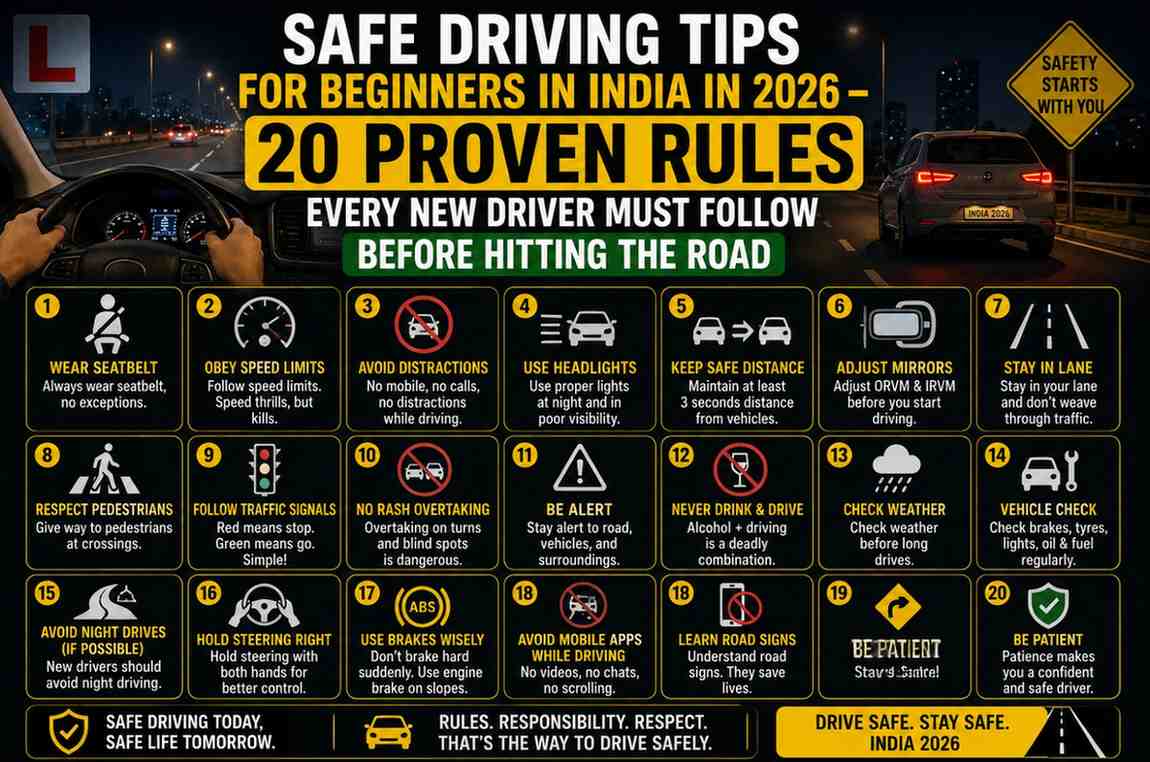
Getting your driver’s license is one of the most exciting milestones in any young person’s life. But excitement must be balanced with responsibility—because Indian roads in 2026 remain among the most challenging and unpredictable in the world. These safe driving tips for beginners in India in 2026 are not optional suggestions. They are the foundational rules that separate drivers who stay safe from those who become part of India’s alarming road accident statistics.
India recorded over 1.68 lakh road accident deaths in 2023 — nearly 461 deaths every single day. A significant proportion of fatal accidents involve young and inexperienced drivers. These safe driving tips for beginners in India 2026 have been compiled with that sobering reality in mind, drawing from the Motor Vehicles Act 2019 amendments, Ministry of Road Transport and Highways data, and internationally recognized defensive driving principles adapted for Indian road conditions.
Whether you’ve just passed your driving test or have been driving casually for a few months, these safe driving tips for beginners India 2026 will build the habits that protect you, your passengers, and everyone sharing the road with you.
Why Safe Driving Is More Important Than Ever in India 2026
Before the 20 rules, understanding the road safety landscape adds critical context to these safe driving tips for beginners in India 2026:
- India has just 1% of the world’s vehicles but accounts for 11% of global road accident deaths
- Over 50% of accident victims are in the 18–35 age group—predominantly new or young drivers
- Mobile phone use while driving has surpassed drunk driving as the leading cause of fatal accidents in urban India
- Night driving accounts for 43% of fatal accidents despite lower traffic volumes
- Overspeeding remains the single largest cause of road fatalities—cited in 68% of all deaths
Every one of the following safe driving tips for beginners in India 2026 addresses one or more of these risk factors directly.
The 20 Safe Driving Tips for Beginners India 2026
Tip 1 — Always Wear Your Seatbelt Before the Engine Starts
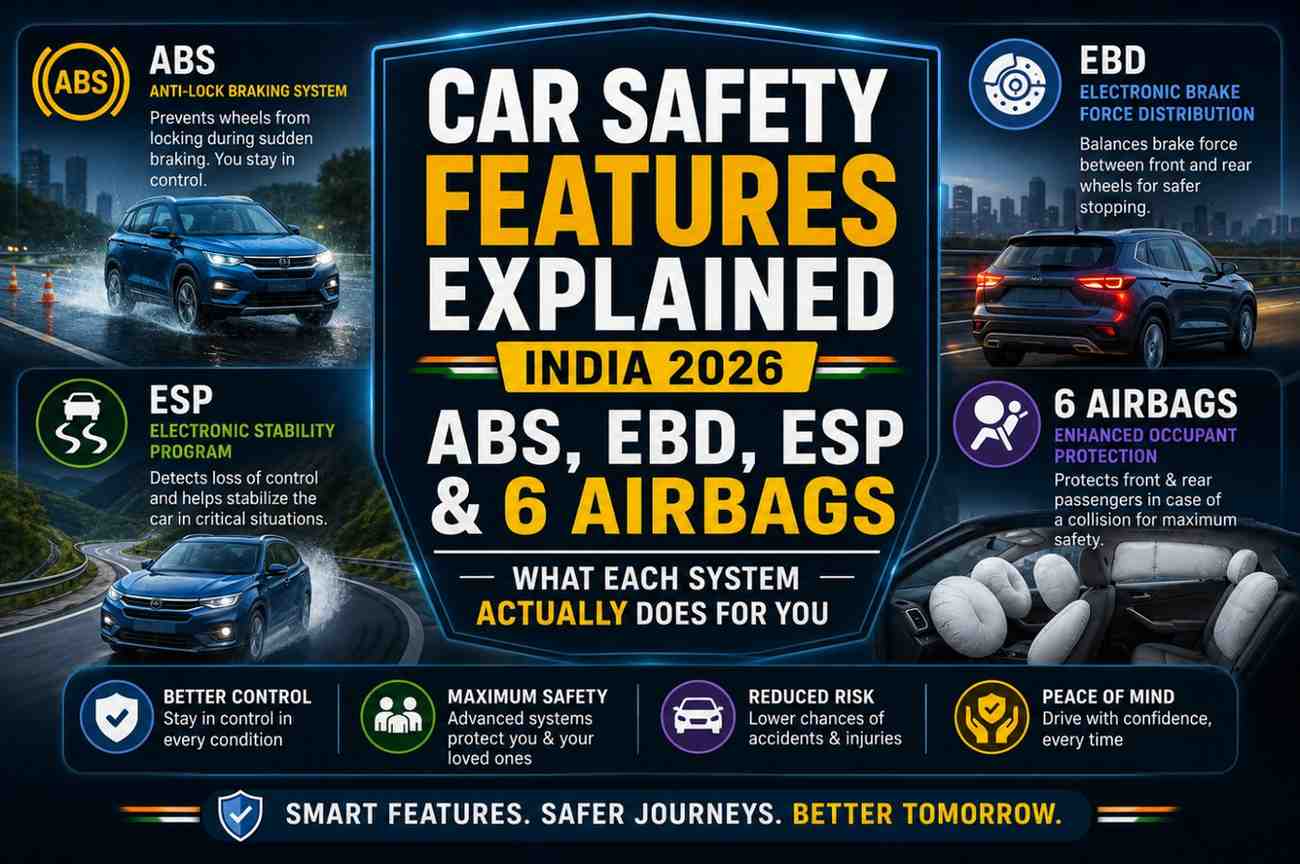
The most fundamental of all safe driving tips for beginners in India in 2026: belt up before you start the car—not after. All occupants, including rear passengers, must wear seatbelts. As of 2022, rear seatbelts are mandatory under the Motor Vehicles Act. Seatbelts reduce the risk of death in a crash by up to 45%.
Tip 2 — Adjust Your Mirrors Before Every Drive
Before moving, set your side mirrors and rearview mirror precisely. Mirrors should cover blind spots, not show the sides of your own car. Poor mirror positioning causes 12–15% of lane-change accidents on Indian highways.
Mirror adjustment rule: Your rearview mirror should frame the entire rear window. Each side mirror should show just a sliver of your car’s flank with maximum road coverage.
Tip 3 — Understand the Correct Seating Position
Correct seating posture is one of the most underrated safe driving tips for beginners in India 2026:
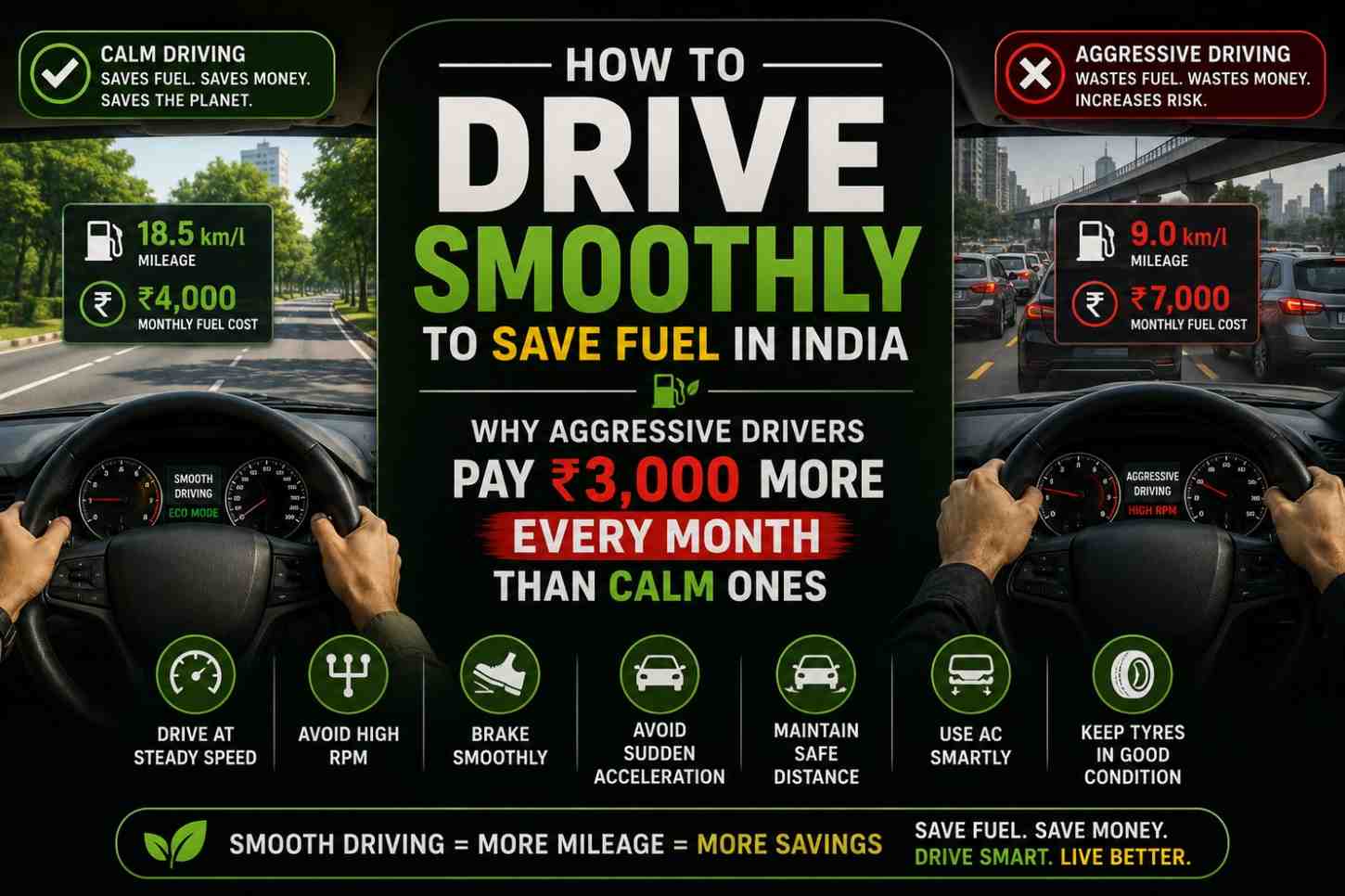
- Arms slightly bent when hands are on the steering wheel at 9 and 3 o’clock positions
- Back fully supported by the seat
- Headrest aligned with the centre of your head
- Feet reaching pedals without stretching
Poor seating posture causes fatigue and reduces reaction speed—particularly dangerous on long highway drives.
Tip 4 — Never Use Your Mobile Phone While Driving
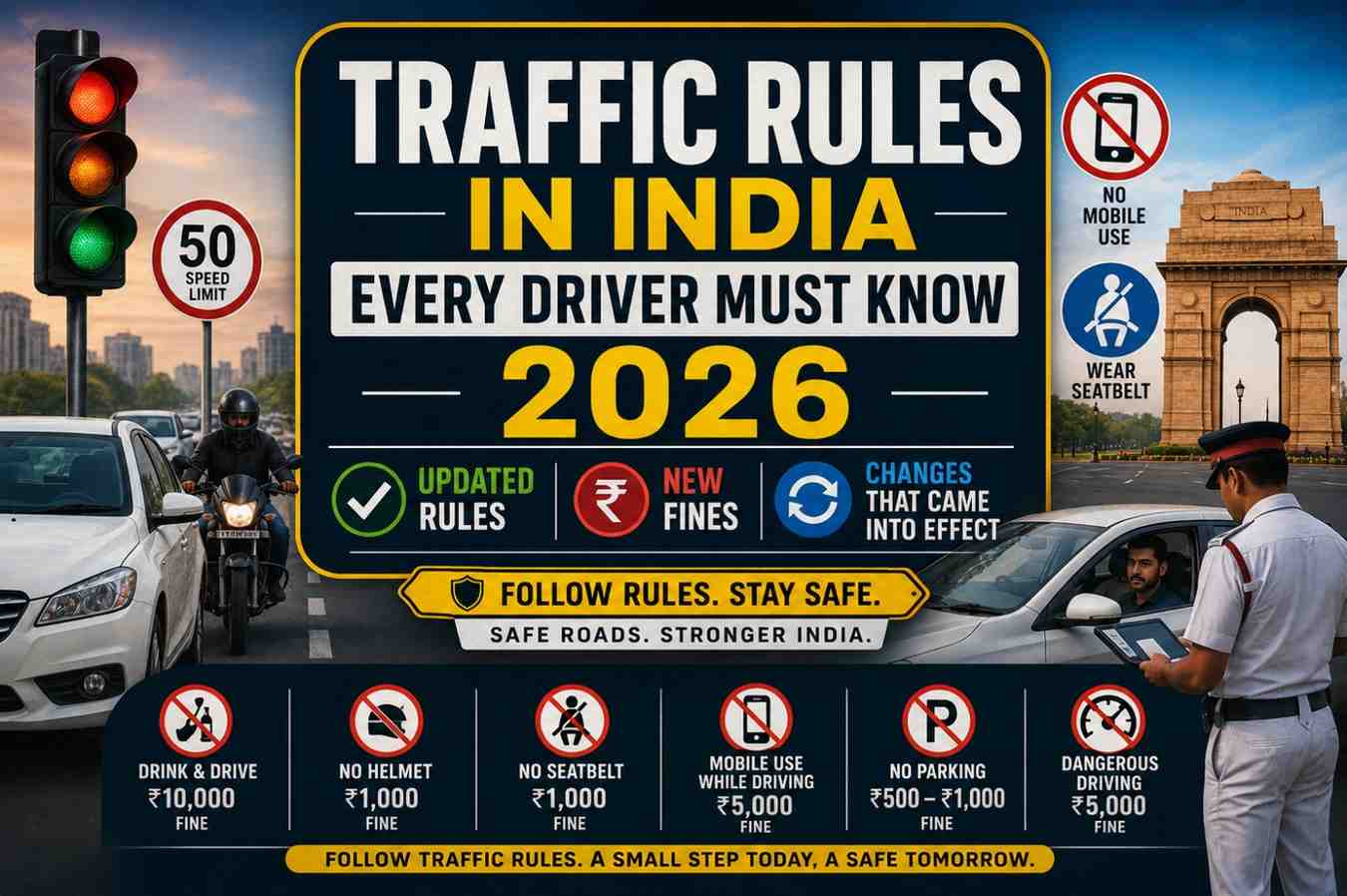
Distracted driving now kills more people in Indian cities than drunk driving. Under the Motor Vehicles (Amendment) Act 2019, using a handheld mobile phone while driving carries a fine of ₹5,000 and potential license suspension.
Even hands-free phone calls reduce driving reaction time by 37%. Among all safe driving tips for beginners in India 2026, this is the one that saves the most lives immediately.
Tip 5 — Maintain the 4-Second Following Distance
New drivers consistently follow too closely, especially in city traffic. The 4-second rule: as the vehicle ahead passes a fixed point (a sign or tree), count four seconds before you pass the same point. If you can’t count to four, you’re too close.
In rain, extend this to 6–8 seconds. On wet Indian roads, stopping distances increase by 2–3 times.
Tip 6 — Never Drive Above the Speed Limit
Speed limits exist because physics is non-negotiable. The relationship between speed and crash severity is exponential:
- At 60 km/h, a frontal crash is survivable with seatbelts
- At 80 km/h, the same crash doubles fatality probability
- At 100+ km/h, survival in a frontal crash becomes statistically unlikely without significant safety infrastructure
Posted speed limits on Indian roads: City roads: 50 km/h. State highways: 100 km/h. National highways (cars): 120 km/h. Always drive at the appropriate speed for conditions—rain, fog, and night driving require speed reductions of 20–30%.
Tip 7 — Never Drive Under the Influence
India’s legal blood alcohol limit is 30 mg per 100 ml of blood—far lower than many assume. Even at the legal limit, reaction time is measurably impaired. Two drinks is typically enough to cross this threshold for an average Indian adult.
Under the Motor Vehicles Amendment Act 2019, a first DUI offense carries a fine of ₹10,000 or 6 months’ imprisonment. A second offense: ₹15,000 or 2 years’ imprisonment.
[IMAGE 1 — Place after Tip 7]
Suggested Image: An illustrated infographic showing all 20 safe driving tips for beginners in India 2026 as icons with brief text labels arranged in a 4×5 grid—seatbelt, mirrors, phone, speed, following distance, lane discipline, etc.—in a clean, bold design. ALT Text: “Safe driving tips for beginners India 2026—an infographic showing all 20 rules as icons with labels, including seatbelt, speed limit, phone ban, following distance, and lane discipline.”
Tip 8 — Use Indicators 30 meters before every turn
Indicators are not optional courtesies — they are legal requirements. Failing to indicate before turning or changing lanes is a traffic offense carrying a ₹500 fine. More importantly, it causes accidents. Apply the indicator at least 30 meters before the action you intend to take.
Tip 9 — Understand Right of Way at Intersections
Unmarked intersections are one of the trickiest situations in safe driving tips for beginners in the India 2026 context:
- Vehicles on the main road have right of way over side road vehicles
- At unmarked crossings, the vehicle on the right has priority
- Emergency vehicles (ambulance, fire truck, police) always have absolute priority
- Pedestrians on a zebra crossing have absolute right of way
Tip 10—Never Overtake on Blind Curves or Hills
Overtaking on a blind curve or approaching the crest of a hill is one of the most dangerous actions on Indian roads. You cannot see oncoming traffic. Head-on collisions at combined speeds of 100–160 km/h are almost universally fatal.
Rule: If you cannot see at least 200 meters of clear road ahead, do not overtake.
Tip 11 — Keep Your Vehicle Roadworthy
Safe driving begins before you get in the car. A pre-drive check covering:
- Tires—Check pressure and tread depth monthly
- Brakes—Any sponginess or pulling requires immediate professional inspection
- Lights — All lights operational before every night drive
- Windshield — No cracks in the driver’s sightline
- Fluids—Engine oil, coolant, brake fluid checked regularly
Tip 12 — Adjust Speed for Weather Conditions
Indian roads transform in the monsoon. The first rain after a dry spell creates the most dangerous conditions—accumulated oil and dust create a surface more slippery than ice. Safe speed in early monsoon rain: 30–40% slower than dry conditions.
Tip 13 — Master Highway Lane Discipline
India’s National Highway network now carries significantly more high-speed traffic. Lane discipline is fundamental to safe driving tips for beginners in India 2026 on highways:
- Left lane — Slow vehicles, trucks, buses
- Middle lane — Normal passenger car cruising speed
- Right lane — Overtaking only (return to middle immediately after passing)
Driving in the right lane at slow speed (lane hogging) is a traffic offense and one of the leading causes of highway rear-end accidents.
Tip 14—Handle Roundabouts Correctly
Give way to vehicles already inside the roundabout. Signal your exit. Do not stop inside the roundabout. Many new Indian drivers enter roundabouts without yielding — a common cause of minor accidents in urban areas.
Tip 15 — Night Driving Requires Extra Caution
Among all safe driving tips for beginners in India 2026, night driving protocol deserves special attention:
- Reduce speed by 20–30% after sunset
- Use low beams when following another vehicle (within 150m) or when oncoming traffic approaches
- High beams blind oncoming drivers and are a leading cause of head-on collisions
- Be alert for unlit vehicles, cyclists, and pedestrians—all common hazards on Indian roads after dark
Tip 16 — Never Drive When Fatigued
Drowsy driving is as dangerous as drunk driving. Reaction times are equally impaired. On highway drives exceeding 2 hours, take a 15-minute rest stop. Signs of dangerous fatigue:
- Difficulty focusing
- Heavy eyelids
- Missing road signs
- Drifting within lane
If any of these appear, pull over immediately to a safe, well-lit location.
Tip 17 — Keep a Safe Distance From Trucks and Buses
Large vehicles have significantly larger blind spots than cars:
- Don’t drive alongside a truck or bus for extended periods
- Never sit in the blind spot directly beside or slightly behind a large vehicle
- Maintain extra following distance—trucks take 30–40% longer to stop than cars
Tip 18 — Know What to Do After an Accident
Accident response is a critically important part of safe driving tips for beginners India 2026:
- Switch on hazard lights immediately
- Call 112 (emergency) or 108 (ambulance)
- Do not move injured persons unless they’re in immediate danger of fire
- Note the other vehicle’s registration number, driver details, and insurance information
- Take photographs of the scene from multiple angles
- Under the Good Samaritan Law (Motor Vehicles Act), you are legally protected for helping accident victims
Tip 19 — Understand and Obey Traffic Signals
Traffic signals including flashing amber, blinking red, and countdown timers are all mandatory compliance signals. Running a red light carries a minimum ₹1,000 fine and 3 months licence suspension in India for repeat offenders.
Tip 20 — Keep Updating Your Knowledge
Road rules change. New highways open. Traffic enforcement evolves. The best of all safe driving tips for beginners India 2026 is this: never stop learning. Take a defensive driving course. Study the Motor Vehicles Act updates. Read road safety publications from MoRTH.
[IMAGE 2 — Place before FAQs]
Suggested Image: A clean illustrated dashboard view showing a beginner driver’s perspective — hands at 9 and 3 on the wheel, mirrors properly positioned, seatbelt on, phone face-down in the holder, speedometer at 50 km/h in a city zone. Clean infographic style with labels. ALT Text: “Safe driving tips for beginners India 2026 — illustrated beginner driver perspective showing correct hand position, mirror setup, seatbelt worn, phone away, and appropriate speed”
FAQs: Safe Driving Tips for Beginners India 2026
Q1: What are the most important safe driving tips for beginners India 2026 to follow immediately? A: The three highest-impact safe driving tips for beginners India 2026 are: always wear your seatbelt (all passengers), never use your mobile phone while driving, and never exceed the speed limit. These three habits alone address the top three causes of fatal road accidents in India.
Q2: How long does it take to develop good driving habits using safe driving tips for beginners India 2026? A: Research suggests that safe driving habits become automatic after approximately 6–9 months of consistent, conscious practice. New drivers should actively apply safe driving tips for beginners India 2026 for the first year until they become instinctive.
Q3: Are safe driving tips for beginners India 2026 different from international driving rules? A: The core principles are universal. However, India-specific challenges — driving on the left, high two-wheeler density, cattle on rural roads, poor road lighting, and monsoon conditions — require additional adaptations beyond basic international driving rules.
Q4: What is the most dangerous mistake new drivers make according to safe driving tips for beginners India 2026? A: Following too closely (tailgating) is statistically the most common error of new drivers. It eliminates reaction time and makes rear-end collisions inevitable during sudden stops. The 4-second following distance rule directly addresses this.
Q5: Do safe driving tips for beginners India 2026 apply differently in cities vs highways? A: Yes. City driving requires constant attention to pedestrians, cyclists, autos, and two-wheelers in dense, unpredictable traffic. Highway driving requires vigilance against speeding, fatigue, sudden lane changes by trucks, and poor visibility at night. Both require the same foundational habits.
Conclusion
The 20 safe driving tips for beginners India 2026 in this guide are not a checklist you read once and forget. They are daily habits that must be practised consciously until they become automatic responses. India’s roads are genuinely challenging — but they are navigable safely by drivers who know the rules, respect other road users, and never stop learning.
Every accident that didn’t happen is a life saved. Every driver who adopts these safe driving tips for beginners India 2026 makes Indian roads safer not just for themselves, but for the millions of other road users sharing the same roads every day.
Bookmark this guide, share it with every new driver you know, and commit to practicing all 20 rules every time you get behind the wheel. Safe roads start with you.
External Links
- https://morth.nic.in/road-accident-in-india — Ministry of Road Transport & Highways: Road Accident Report India
- https://www.nithe.nic.in — National Institute for Training of Highway Engineers
- https://roadsafety.transport.nsw.gov.au/driving-safely — NSW Roads: Defensive Driving Principles
- https://www.who.int/teams/social-determinants-of-health/safety-and-mobility/road-safety — WHO Road Safety Programme
- https://parivahan.gov.in/parivahan — Parivahan Sewa: Motor Vehicles Act India