 admin@prodriver.in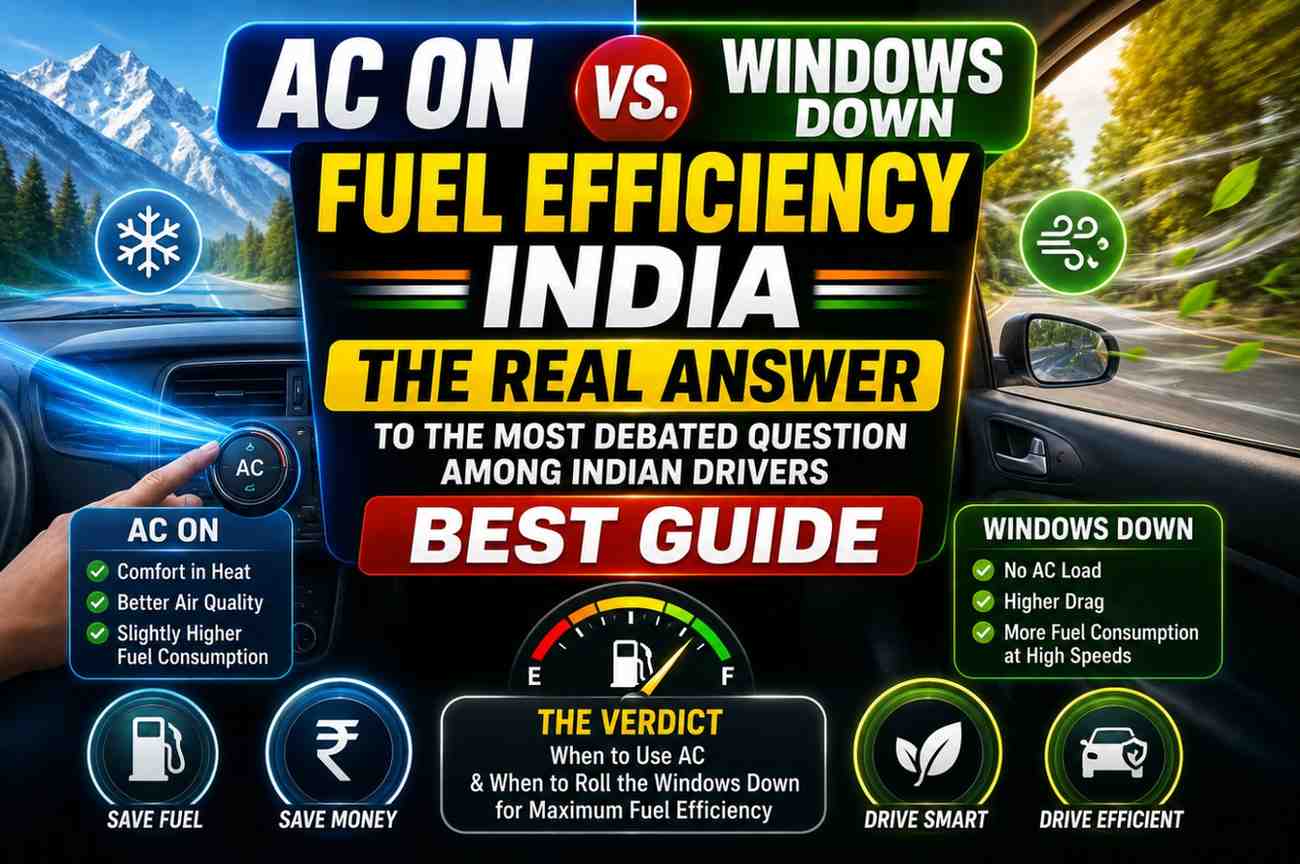
Few motoring debates generate more heat—pun absolutely intended—than the AC on vs. windows down fuel efficiency India question. At every petrol station, in every WhatsApp family group, and on every Indian car forum, someone is passionately arguing one side or the other. The reality, backed by engineering data and Indian driving conditions, is more nuanced and more interesting than either side of the debate suggests.
The AC on vs. windows down fuel efficiency in India answer is not a simple “always use AC” or “always use windows down”—it is a speed-dependent, temperature-dependent, and occupancy-dependent calculation. This guide gives you the complete framework to make the right decision for every driving situation you encounter on Indian roads.
The core science behind AC on vs. windows down fuel efficiency in India involves two competing forces: the aerodynamic drag created by open windows (which increases with the square of speed) versus the engine load imposed by the AC compressor (which remains relatively constant regardless of speed). The crossover point between these two forces determines which is more fuel-efficient at any given speed.
The Science of AC On vs. Windows Down Fuel Efficiency India
The AC Compressor Load
A typical Indian car’s AC compressor adds 3–7 kW of load to the engine—roughly equivalent to adding a small additional engine running continuously. This load is largely constant regardless of vehicle speed, though it reduces slightly at highway speeds when the condenser receives better airflow. In AC on vs. windows down fuel efficiency India terms, this represents approximately 8–15% additional fuel consumption in city conditions and 5–10% on highways.
The Aerodynamic Drag of Open Windows
Open windows at speed create turbulent airflow inside the cabin that significantly increases aerodynamic drag. This drag force is proportional to the square of speed—meaning the aerodynamic penalty of open windows is minimal at 30 km/h, moderate at 50 km/h, and substantial at 80+ km/h. At 100 km/h with all four windows open, the additional drag can exceed the fuel cost of running the AC.
The Crossover Point for India
Multiple studies, including those from SAE International, place the aerodynamic-vs.-AC crossover at approximately 65–75 km/h for typical passenger cars. For Indian conditions—where temperature affects AC compressor load and road quality affects aerodynamic drag—the AC on vs. windows down fuel efficiency India crossover is approximately:
Below 60–65 km/h → Windows Down is more fuel-efficient. Above 65–70 km/h → AC One is more fuel-efficient (or equivalent)
The Complete AC On vs. Windows Down Fuel Efficiency India Framework
In Indian City Traffic (0–50 km/h Average)
At Indian city traffic speeds, the aerodynamic drag from open windows is minimal. The AC compressor’s 8–15% engine load is the dominant factor. In purely fuel efficiency terms, AC on vs. windows down fuel efficiency in Indian city driving verdict: Windows down wins in stop-start traffic below 50 km/h average speed.
However—and this is crucial in the Indian context—comfort and practical considerations modify this conclusion dramatically. At 40°C with 70% humidity in Chennai in May, “windows down” is not a comfortable or sustainable driving option for most Indian commuters. The AC on vs. windows down fuel efficiency India calculation must include productivity and driver alertness.
On Indian National Highways (60–100 km/h)
At sustained highway speeds, open windows create significant drag. The AC on vs windows down fuel efficiency India highway verdict is clear: AC on wins for sustained driving above 65–70 km/h. The compressor load is offset by improved aerodynamics, and driver comfort at temperature is far better with AC at these speeds.
In Indian Ghat or Hill Roads (30–50 km/h with Climbing Load)
On heavy inclines where the engine is already under significant load, adding AC compressor load can cause meaningful power reduction in smaller-engined Indian cars (800cc–1000cc). In this specific situation, the AC on vs. windows down fuel efficiency India advice for small-engined cars: switch off AC during steep climbing sections and re-enable on flat or descending sections.
The India-Specific Factors That Change the Answer
Monsoon Season: During India’s monsoon, windows-down driving is impractical due to rain entry. AC with recirculation mode and closed windows is the only viable option. AC on vs windows down fuel efficiency India monsoon answer: AC on, non-negotiable.
Extreme Dust Conditions: In desert and semi-arid zones of Rajasthan, Haryana, and parts of Maharashtra, open windows introduce particulate matter that clogs air filters rapidly—increasing engine load and reducing mileage more than AC would. AC on vs windows down fuel efficiency in India’s dusty conditions answer: AC on, for engine protection.
Multiple Occupants: More passengers mean more body heat generation, higher AC demand to cool the cabin, and greater weight (reducing mileage regardless of ventilation choice). With 4–5 occupants in Indian summer conditions, AC efficiency is degraded—but so is the comfort argument for windows down. AC on vs windows down fuel efficiency India multi-occupant answer: AC on the lowest comfortable setting, rear windows cracked.
The Practical Decision Chart
| Speed | Temperature | Condition | Recommendation |
|---|---|---|---|
| Under 50 km/h | Below 32°C | Clear weather | Windows down |
| Under 50 km/h | Above 32°C | Any | AC on lowest setting |
| 50–70 km/h | Any | Highway | Either (roughly equal) |
| Above 70 km/h | Any | Highway | AC on, windows closed |
| Any | Monsoon/Dust | Any | AC on always |
Frequently Asked Questions
Q1. Does using AC on recirculation mode save more fuel than fresh air mode? Yes. Recirculation mode re-cools already-cooled cabin air rather than drawing in hot external air — reducing compressor workload by 10–20%. In AC on vs windows down fuel efficiency India recirculation mode comparison, recirculation is always more fuel-efficient when interior air quality is acceptable.
Q2. Does running AC while parked waste significant fuel? Yes. Idling with AC active burns approximately 0.7–1.0 litres per hour. For the AC on vs windows down fuel efficiency India parked vehicle question: park in shade, use windshield sun shades, and either open doors briefly before entering or start driving immediately rather than cooling the parked car with AC.
Q3. Is economy mode AC the same as lower fuel consumption? Economy (ECO) AC mode in modern Indian cars reduces compressor cycling frequency and limits maximum cooling power. It does reduce fuel consumption by 3–6% compared to full AC — making it a good middle ground in the AC on vs windows down fuel efficiency India spectrum of choices.
Q4. Do AC filters affect fuel economy? A clogged cabin air filter forces the AC blower to work harder and reduces cooling efficiency — requiring lower temperature settings and more compressor work. Regular filter replacement (₹300–₹800) contributes to AC on vs windows down fuel efficiency India AC efficiency optimisation.
Q5. What is the greenest choice between AC and windows down? In carbon terms, lower fuel consumption is always greener. The AC on vs windows down fuel efficiency India environmental answer mirrors the efficiency answer: windows down below 65 km/h in tolerable conditions; AC on above 65 km/h and in extreme heat conditions.
Conclusion
The AC on vs windows down fuel efficiency India debate has a real, data-driven answer — and it is neither “always AC” nor “always windows down.” The correct choice is speed-dependent, with the crossover occurring at approximately 65–70 km/h for most Indian passenger cars.
In Indian city traffic below 60 km/h, windows down saves fuel. On Indian highways above 70 km/h, AC on is more efficient. In monsoon, dust, or extreme heat, AC on is the only practical choice regardless of speed. Applying this AC on vs windows down fuel efficiency India framework to your daily driving will optimise both your fuel economy and your comfort — which, in India’s climate extremes, is exactly the right balance to strike.