 admin@prodriver.in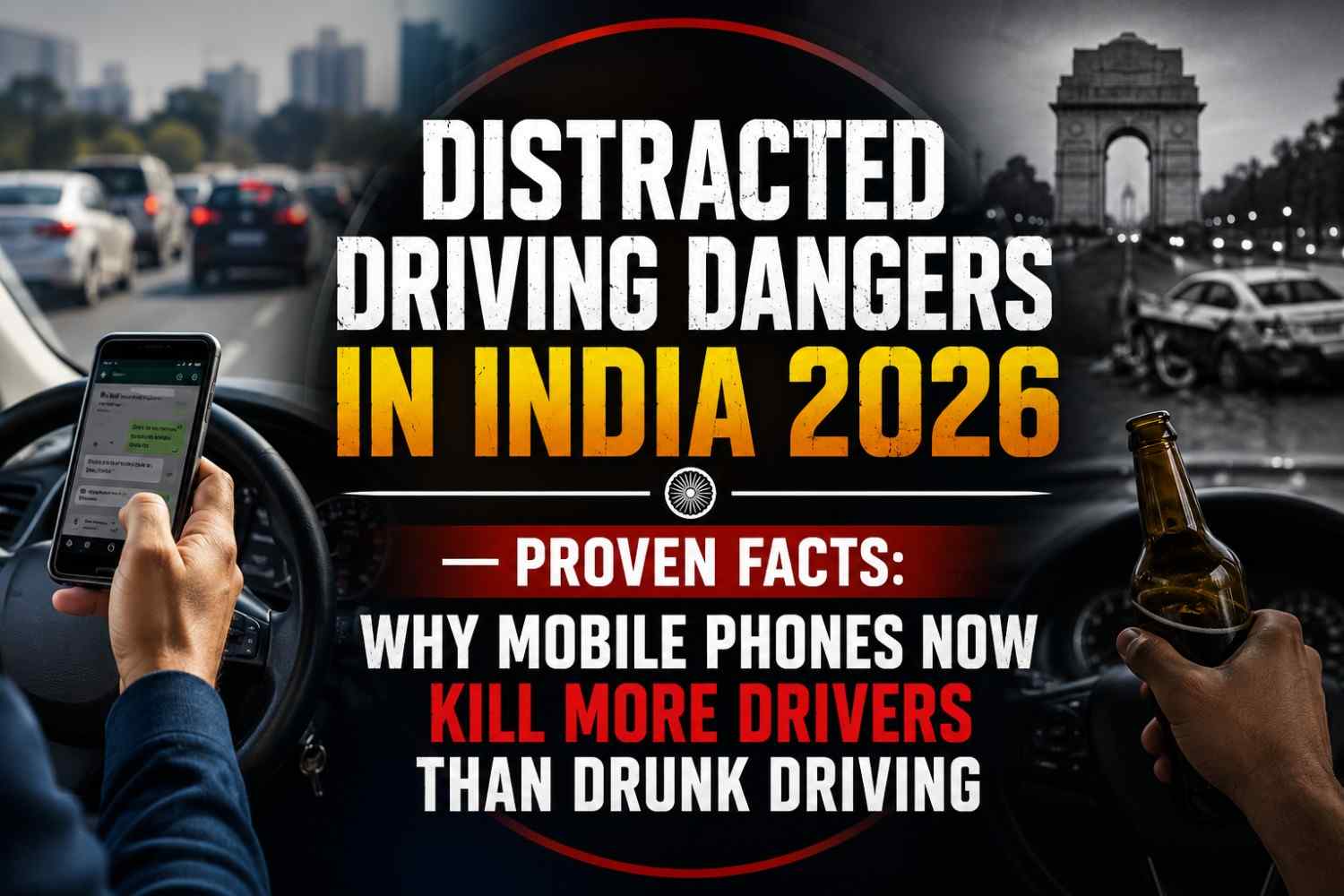
A decade ago, drunk driving was India’s most feared road killer. Today, a different, more insidious threat has taken its place. Distracted driving dangers in India 2026—particularly the use of mobile phones while driving—now contribute to more fatal accidents in Indian cities than alcohol does. And unlike drunk driving, which most people recognize as dangerous, distracted driving is something millions of Indians engage in without recognizing the deadly risk they’re creating.
Distracted driving dangers in India in 2026 are not hypothetical risks. According to data from the Ministry of Road Transport and Highways (MoRTH) and the National Crime Records Bureau (NCRB), mobile phone use while driving was a contributing factor in over 42,000 accidents in India in 2023 alone—a figure that experts believe is significantly under-reported because mobile use is difficult to document in post-crash investigations.
This complete guide on distracted driving dangers in India 2026 explains exactly what distraction does to your brain and body when you drive, what the law says, how severe the penalties are, and most critically, what you must do to protect yourself, your passengers, and the thousands of innocent road users your distraction puts at risk.
What Is Distracted Driving?
Understanding distracted driving dangers India 2026 requires a clear definition. Distracted driving is any activity that diverts attention from the primary task of driving. There are three types of distraction:
1. Visual Distraction — Taking your eyes off the road
- Looking at a phone screen
- Reading a navigation screen that’s poorly positioned
- Turning to look at a billboard or accident scene
2. Manual Distraction — Taking your hands off the wheel
- Holding a phone
- Eating or drinking
- Adjusting the music or AC controls
3. Cognitive Distraction — Taking your mind off driving
- Phone conversations (even hands-free)
- Deep conversation with passengers
- Daydreaming
The most dangerous form is all three simultaneously, which is exactly what texting while driving does. This is why texting while driving is considered by safety experts to be more dangerous than driving at twice the legal alcohol limit.
The Science Behind Distracted Driving Dangers: India 2026
The neuroscience behind distracted driving dangers India 2026 explains why even brief distractions are catastrophic:
The 5-Second Rule: Taking your eyes off the road for just 5 seconds while traveling at 60 km/h means you’ve covered 83 meters—nearly the length of a cricket pitch—completely blind. If a child steps off the kerb, if the vehicle ahead brakes suddenly, or if a pothole appears: you have zero awareness and zero reaction time for those 83 meters.
Cognitive Load: When your brain processes a phone conversation, it reduces the neural resources available for visual processing. Studies show that drivers on phone calls (even hands-free) miss up to 50% of the visual information in the environment around them—stop lights, pedestrians, and road hazards become literally invisible to a brain overloaded with conversation.
Reaction Time Impact:
- Normal reaction time for a young adult driver: approximately 0.7–1.0 seconds
- Reaction time while texting: 3.0–4.5 seconds
- Reaction time at the legal alcohol limit (0.08%): 1.4 seconds
This data from the distracted driving dangers India 2026 research body makes one thing absolutely clear: texting while driving is significantly more dangerous than drunk driving in terms of reaction time impairment.
The Specific Distracted Driving Dangers India Faces in 2026
Distracted driving dangers India 2026 in the Indian context has several unique dimensions:
Urban Traffic Density
Indian city roads are extraordinarily complex environments — pedestrians crossing from multiple angles, two-wheelers weaving between vehicles, auto-rickshaws stopping unexpectedly, cattle crossing roads, and vehicles coming from wrong directions. Managing this environment requires 100% cognitive attention. The margin for distraction is essentially zero.
Rising Smartphone Penetration
India had approximately 900 million smartphone users in 2025. As 4G and 5G coverage expands to Tier 2 and Tier 3 cities, the temptation and ability to use phones while driving has grown proportionally—making distracted driving dangerous. India 2026: a worsening trend rather than an improving one.
Navigation App Use
GPS navigation, while essential for unfamiliar routes, contributes to distracted driving when
- The phone is held rather than mounted
- The driver looks at the screen rather than listening to audio guidance
- Drivers reroute manually while driving
Social Media and Notification Culture
India’s 600 million active WhatsApp users generate an almost continuous stream of messages and notifications. The psychological compulsion to check messages immediately—even behind the wheel—is one of the most dangerous distracted driving dangers in India’s 2026 behavioral patterns.
[IMAGE 1 — Place after Indian context section]
Suggested Image: A dramatic infographic showing a car’s perspective from the driver’s seat—a phone in hand, looking at a WhatsApp message—with an 83-meter “blind zone” highlighted on the road ahead showing all the hazards (pedestrian, dog, stopped vehicle) the driver cannot see during those 5 seconds. ALT Text: “Distracted driving dangers India 2026—a driver’s perspective infographic showing 83-metre blind zone created by 5 seconds of phone distraction at 60 km/h with hidden road hazards.”
Legal Consequences of Distracted Driving in India 2026
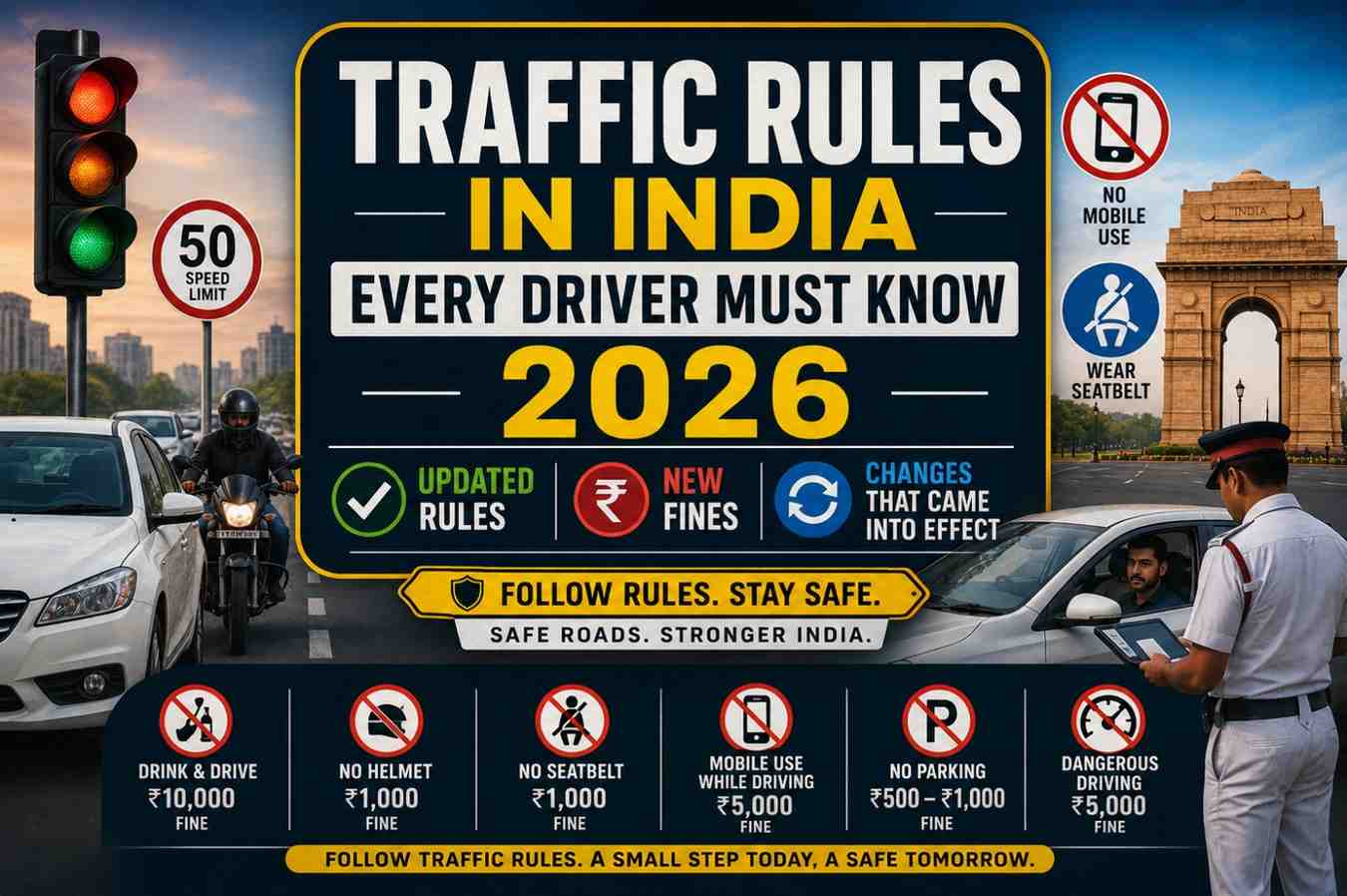
The Motor Vehicles (Amendment) Act 2019 significantly increased penalties for distracted driving. Understanding the legal framework is essential to appreciating distracted driving dangers in India in 2026 fully.
| Offence | Fine | Additional Consequences |
|---|---|---|
| Using handheld mobile while driving | ₹5,000 | License suspension (repeat offence) |
| Causing accident due to distraction | ₹10,000–₹100,000 | Imprisonment up to 6 months |
| Causing grievous hurt due to distraction | Criminal charges | Imprisonment up to 2 years |
| Causing death due to distracted driving | IPC Section 304A (culpable homicide) | Up to 2 years imprisonment |
In 2026, traffic police in major cities including Delhi, Mumbai, Bengaluru, and Hyderabad have deployed AI-enabled cameras that automatically detect mobile phone use through windshields and issue e-challans electronically. There is no longer any meaningful chance of avoiding detection.
Types of Distraction and Their Risk Levels
| Distraction Type | Eyes Off Road | Hands Off Wheel | Mind Off Driving | Risk Level |
|---|---|---|---|---|
| Texting/WhatsApp | ✅ Yes | ✅ Yes | ✅ Yes | ⚠️ EXTREME |
| Calling (handheld) | ✅ Yes | ✅ Yes | ✅ Yes | ⚠️ EXTREME |
| Calling (hands-free) | ❌ No | ❌ No | ✅ Yes | ⚠️ HIGH |
| Navigation screen | ✅ Partial | ❌ No | ✅ Partial | ⚠️ HIGH |
| Eating/drinking | ❌ No | ✅ Yes | ✅ Partial | ⚠️ MEDIUM-HIGH |
| Talking to passengers | ❌ No | ❌ No | ✅ Yes | ⚠️ MEDIUM |
| Loud music | ❌ No | ❌ No | ✅ Yes | ⚠️ MEDIUM |
This table clarifies the full scope of distracted driving dangers in India in 2026—mobile phone use is the most dangerous, but other distractions carry real risk too.
10 Habits to Eliminate Distracted Driving Dangers India 2026
1. Phone in Do Not Disturb While Driving Mode Both Android (Driving Mode) and iPhone (Focus: Driving) have features that automatically silence notifications and send automatic replies when movement is detected. Activate this before every drive.
2. Mount Your Phone, Never Hold It If you use navigation, mount your phone at eye level on the dashboard — never hold it. A properly mounted phone reduces visual distraction by 60% compared to a hand-held device.
3. Set Your Navigation Before Moving Enter your destination, set the route, and start audio guidance before the car moves. Never adjust navigation while in motion.
4. Pull Over to Make Calls If a call cannot wait, pull over safely to a legal stopping area. The call will still be there 2 minutes later. The accident caused by not pulling over might be permanent.
5. Eat Before or After — Never During Eating while driving takes at least one hand off the wheel and significant mental attention off the road. Stop at a dhaba, petrol station, or rest area.
6. Manage Passengers Who Create Distraction Children fighting in the back seat, loud music debates, and emotionally charged conversations are all sources of distraction. Address these before driving or pull over to resolve them.
7. Alert Your Contact List Inform your regular contacts that you don’t respond to messages while driving. This social norm, once established, reduces the pressure to check incoming messages.
8. Use Drive Mode Apps Apps like DriveMode (Android) automatically read incoming messages aloud and allow voice replies—never requiring you to touch your phone.
9. Keep the Radio at safe volumes. Loud music masks important audio cues—horns from approaching vehicles, ambulance sirens, and tire screeching sounds. Keep audio at a level where you can easily hear the horn of a vehicle approaching from behind.
10. Recognise Cognitive Distraction Even after ending a call, cognitive distraction persists for up to 27 seconds. If you’ve just had a hands-free call, consciously refocus your attention on the road for at least 30 seconds before resuming normal driving.
[IMAGE 2 — Place before FAQs]
Suggested Image: A comparison infographic titled “Drunk Driving vs Distracted Driving” showing two parallel columns — reaction time, stopping distance, legal penalty, and accident risk — with data points showing texting while driving is more dangerous than the legal BAC limit in several key metrics. ALT Text: “Distracted driving dangers India 2026—comparison infographic showing distracted driving vs drunk driving across reaction time, stopping distance, risk, and legal penalties in India.”
FAQs: Distracted Driving Dangers India 2026
Q1: Are distracted driving dangers in India in 2026 worse than drunk driving statistically? A: In terms of urban accident contribution, yes. Mobile phone use while driving now contributes to more accidents in Indian cities than alcohol does. However, drunk driving still causes disproportionately more deaths per incident due to the added risk of severely impaired speed judgment.
Q2: Is hands-free calling safe according to Distracted Driving Dangers India 2026 research? A: No — hands-free calling is safer than handheld calling (it keeps both hands on the wheel) but still creates significant cognitive distraction. Research shows hands-free calls reduce a driver’s awareness of the visual environment by up to 37%. Pull over for important calls.
Q3: What are the distracted driving dangers and India 2026 penalties for a first offense? A: Using a handheld mobile while driving carries a ₹5,000 fine for the first offense under the Motor Vehicles (Amendment) Act 2019. If the distraction causes an accident with injury or death, criminal charges under the IPC apply with potential imprisonment.
Q4: How do I address distracted driving dangers in India in 2026 when my passengers are the distraction? A: Inform passengers calmly but clearly that you need to concentrate on driving. For child passengers, address behavior before starting the journey. If a serious in-car issue arises, pull over safely before addressing it.
Q5: Can distracted driving dangers in India in 2026 include things other than mobile phones? A: Yes — eating, drinking, adjusting in-car controls, intense passenger conversations, daydreaming, and interacting with navigation screens all constitute distracted driving. Mobile phone use is the most dangerous and most legally penalized, but all forms of distraction increase accident risk.
Conclusion
Distracted driving dangers India’s 2026 goals are real, immediate, and growing. Mobile phones have become the cigarettes of modern driving—a ubiquitous habit that millions engage in daily, fully aware that they shouldn’t and equally unaware of just how lethal the consequences can be.
The data from Distracted Driving Dangers India 2026 is unambiguous: five seconds of distraction at 60 km/h covers 83 meters blindly. In Indian traffic, there’s enough space to hit a child, a two-wheeler, or a pedestrian crossing without warning. The solution is equally clear: put the phone away every time before the car moves.
Share this article with everyone in your contact list—because the next distracted driver to cause an accident on an Indian road might be someone who simply hasn’t seen the data yet.
External Links
- https://morth.nic.in/road-accident-in-india — MoRTH: Road Accidents in India Annual Report
- https://www.who.int/news-room/fact-sheets/detail/road-traffic-injuries — WHO Road Traffic Injury Fact Sheet
- https://www.nhtsa.gov/risky-driving/distracted-driving — NHTSA: Distracted Driving Research USA
- https://parivahan.gov.in/parivahan — Parivahan Sewa: Motor Vehicles Act Penalties
- https://www.aaos.org/research/guidelines/driving-orthopaedics — Traffic Safety Research: Reaction Time Studies