 admin@prodriver.in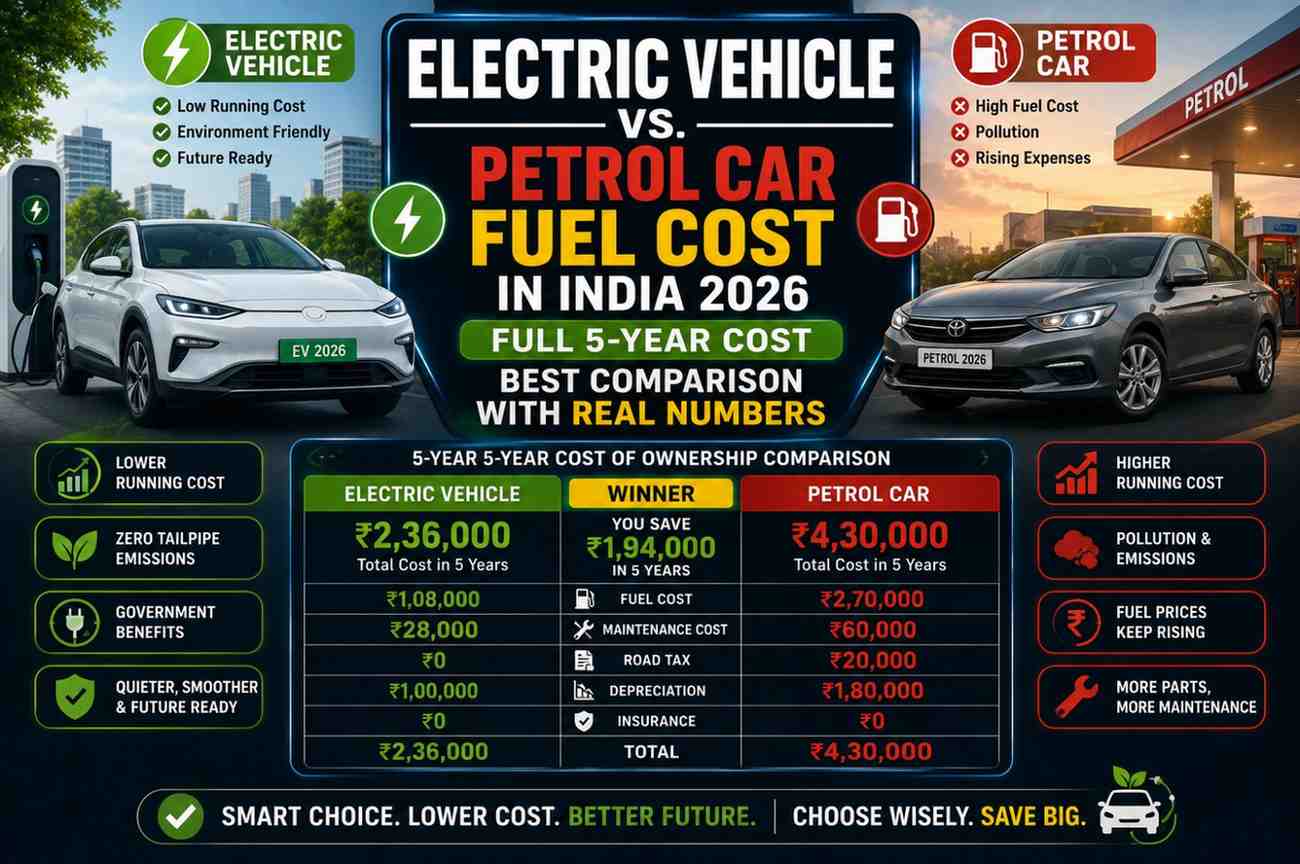
The electric vehicle vs. petrol car fuel cost India 2026 comparison has become one of the most important financial calculations an Indian car buyer can make. With the Indian EV market now offering compelling options from Tata, MG, Hyundai, BYD, and Mahindra at a range of price points, and with petrol costs continuing to climb, the electric vehicle vs. petrol car fuel cost India 2026 numbers have shifted decisively in EVs’ favor for certain buyer profiles—and remained challenging for others.
This guide delivers the complete electric vehicle vs. petrol car fuel cost India 2026 analysis over a 5-year ownership period—covering purchase price differential, fuel/charging cost, insurance, maintenance, battery warranty considerations, and residual value—to give you a genuine total cost of ownership comparison.
According to SMEV (Society of Manufacturers of Electric Vehicles), EV penetration in India’s passenger car segment crossed 3.8% in 2025 and is projected to reach 6–8% by the end of 2026. The electric vehicle vs. petrol car fuel cost in India in 2026 is improving annually as EV prices decrease and electricity remains significantly cheaper than petrol per km of driving.
The Fundamental Numbers: Electric Vehicle vs Petrol Car Fuel Cost India, 2026
Energy Cost per km
| Vehicle Type | Energy Cost | Efficiency | Cost per km |
|---|---|---|---|
| Petrol car (city) | ₹100/litre | 12 km/l | ₹8.33/km |
| Petrol car (mixed) | ₹100/litre | 15 km/l | ₹6.67/km |
| EV (home charging) | ₹7/kWh (avg) | 6 km/kWh | ₹1.17/km |
| EV (public fast charging) | ₹18/kWh (avg.) | 6 km/kWh | ₹3.00/km |
| EV (mixed charging) | — | 6 km/kWh | ₹1.75/km |
The electric vehicle vs. petrol car fuel cost in India in 2026: the per-km energy cost advantage for EVs is ₹4.92–₹6.58/km less than petrol on home charging or ₹3.67–₹5.33/km less on mixed charging patterns.
5-Year Total Cost of Ownership: Electric Vehicle vs Petrol Car Fuel Cost India, 2026
Comparison: Tata Nexon EV vs Tata Nexon Petrol (Representative Models)
| Cost Category | Nexon EV (Max) | Nexon Petrol | Notes |
|---|---|---|---|
| Ex-showroom price | ₹1,800,000 | ₹1,200,000 | ₹6L EV premium |
| 5-yr fuel/charging cost (1,200 km/month) | ₹126,000 | ₹600,000 | Home charging assumed for EVs. |
| 5-yr insurance (estimated) | ₹180,000 | ₹150,000 | EV insurer premium loading |
| 5-yr maintenance cost | ₹30,000 | ₹120,000 | EV: no oil changes, fewer brake services |
| 5-yr total cost | ₹2,136,000 | ₹2,070,000 | EV still ₹66,000 more at 5 years |
| 7-yr total cost | ₹2,262,000 | ₹2,490,000 | EVs are now ₹228,000 cheaper |
The electric vehicle vs. petrol car fuel cost India 2026 analysis shows the EV breaks even at approximately 6–7 years for the 1,200 km/month driver—and becomes increasingly economical thereafter.
At Higher Mileage: The EV Case Strengthens
| Monthly Mileage | EV Break-Even Point | 5-yr EV Advantage |
|---|---|---|
| 1,000 km/month | 7.5 years | ₹25,000 disadvantage |
| 1,500 km/month | 5.5 years | ₹70,000 advantage |
| 2,000 km/month | 4.2 years | ₹185,000 advantage |
| 2,500 km/month (commercial) | 3.2 years | ₹320,000 advantage |
The electric vehicle vs. petrol car fuel cost in India in 2026 is dramatically more favorable for high-mileage drivers. For taxi operators, delivery vehicles, and corporate fleets covering 2,000+ km monthly, EVs are already clearly the superior economic choice.
The Variables That Shift the Electric Vehicle vs Petrol Car Fuel Cost India 2026 Calculation
Home Charging Access
The electric vehicle vs. petrol car fuel cost in India in 2026 assumes home charging access—the major competitive advantage for EV owners. Without home charging (apartment dwellers without dedicated charging, for example), reliance on public fast charging at ₹15–₹20/kWh significantly reduces the monthly savings.
Government Subsidies and FAME-II Benefits
State-level EV subsidies in Maharashtra, Delhi, Rajasthan, and Gujarat can reduce the EV purchase price by ₹100,000–₹200,000—dramatically accelerating the electric vehicle vs. petrol car fuel cost India 2026 breakeven timeline. These subsidies should always be factored into real-world calculations.
Battery Life and Replacement Cost
The most significant uncertainty in electric vehicle vs. petrol car fuel cost in India’s 2026 10-year calculations is battery replacement cost. Most Indian EVs offer 8-year/1.6 lakh km battery warranties. Beyond warranty, battery replacement costs ₹300,000–₹600,000—a significant potential liability for long-term EV ownership that must be part of any honest 10-year comparison.
Petrol Price Trajectory
Every ₹5 increase in petrol price improves the electric vehicle vs. petrol car fuel cost India 2026 breakeven calculation by approximately 8–12 months at typical Indian driving distances. Given historical petrol price trends, the long-term EV cost advantage is likely to grow rather than shrink.
Which Indian buyers benefit most from EVs in 2026?
| Buyer Profile | EV Recommendation | Reason |
|---|---|---|
| Urban commuter, home charging, 1,500+ km/month | ✅ Strongly yes | Fastest breakeven, maximum savings |
| Commercial/fleet operator | ✅ Essential | Payback under 4 years typically |
| Apartment dweller, no home charging | ⚠️ Calculate carefully | Public charging erodes advantage |
| Highway-heavy, rural routes | ⚠️ Wait for better range | Charging infrastructure gaps remain |
| Budget buyer under ₹8 L | ⚠️ Petrol still better | EV price premium too large at entry level |
Frequently Asked Questions
Q1. What is the cheapest EV available in India in 2026? The Tata Tiago EV (₹8.49–₹11.89 lakh ex-showroom) is the most affordable legitimate EV option in the electric vehicle vs. petrol car fuel cost India 2026 comparison. Its 19.2 kWh battery gives a practical urban range of 150–170 km—sufficient for most urban Indian commuters.
Q2. How much does it cost to charge an EV at home in India? At typical Indian residential electricity rates of ₹5–₹9/kWh, a full charge of a 40 kWh battery costs ₹200–₹360—providing approximately 200–240 km of range. The electric vehicle vs. petrol car fuel cost in India in 2026, with the home charging advantage, is most stark compared to this petrol equivalent (approximately ₹1,600–₹2,000).
Q3. Are EVs reliable in India’s climate conditions? Yes. Modern EVs from Tata, Hyundai, and MG are engineered with battery thermal management systems designed for Indian climatic conditions. Heat reduces battery efficiency slightly in summer but does not cause permanent damage within designed operating parameters. The electric vehicle vs. petrol car fuel cost India 2026 reliability comparison favors EVs on mechanical simplicity.
Q4. What happens to EV resale value in India after 5 years? EV resale values in India remain uncertain due to the nascent market. Current data suggests a 5-year depreciation of 45–55% for mainstream EVs—similar to or slightly higher than equivalent petrol cars. Battery warranty status significantly affects resale value and should always be verified in any electric vehicle vs. petrol car fuel cost India 2026 resale analysis.
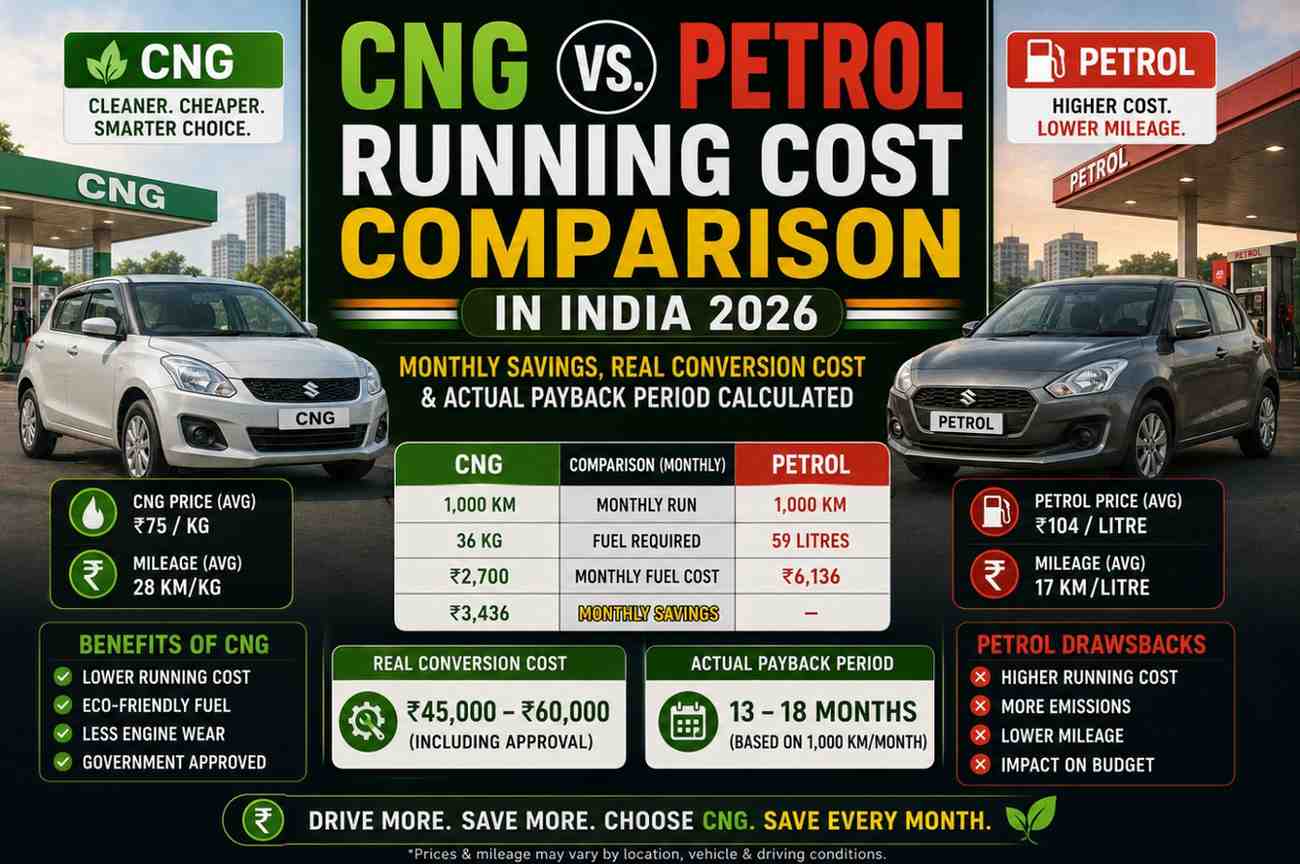
Q5. Will CNG or EV give better running costs in India in 2026? For urban drivers with home charging: EV wins on per-km running cost (₹1.17/km vs. ₹4.72/km for CNG). For drivers without home charging: CNG is more cost-effective. The electric vehicle vs. petrol car fuel cost India 2026 three-way comparison places EVs with home charging first, CNG second, and petrol third for urban running costs.
Conclusion
The electric vehicle vs. petrol car fuel cost India 2026 comparison delivers a nuanced but increasingly clear message: for urban Indian drivers covering 1,500+ km monthly with access to home charging, electric vehicles are approaching or have crossed the 5-year cost parity point with petrol equivalents—and will be decisively cheaper over 7–10 years.
The electric vehicle vs. petrol car fuel cost in India in 2026 is not yet universal. High purchase price premiums, apartment-dweller charging challenges, highway range limitations, and battery replacement uncertainty remain real considerations. But for the right buyer profile—and an increasing number of Indian car buyers fit that profile in 2026—the electric vehicle is no longer the expensive alternative. It is the financially intelligent choice.