 admin@prodriver.in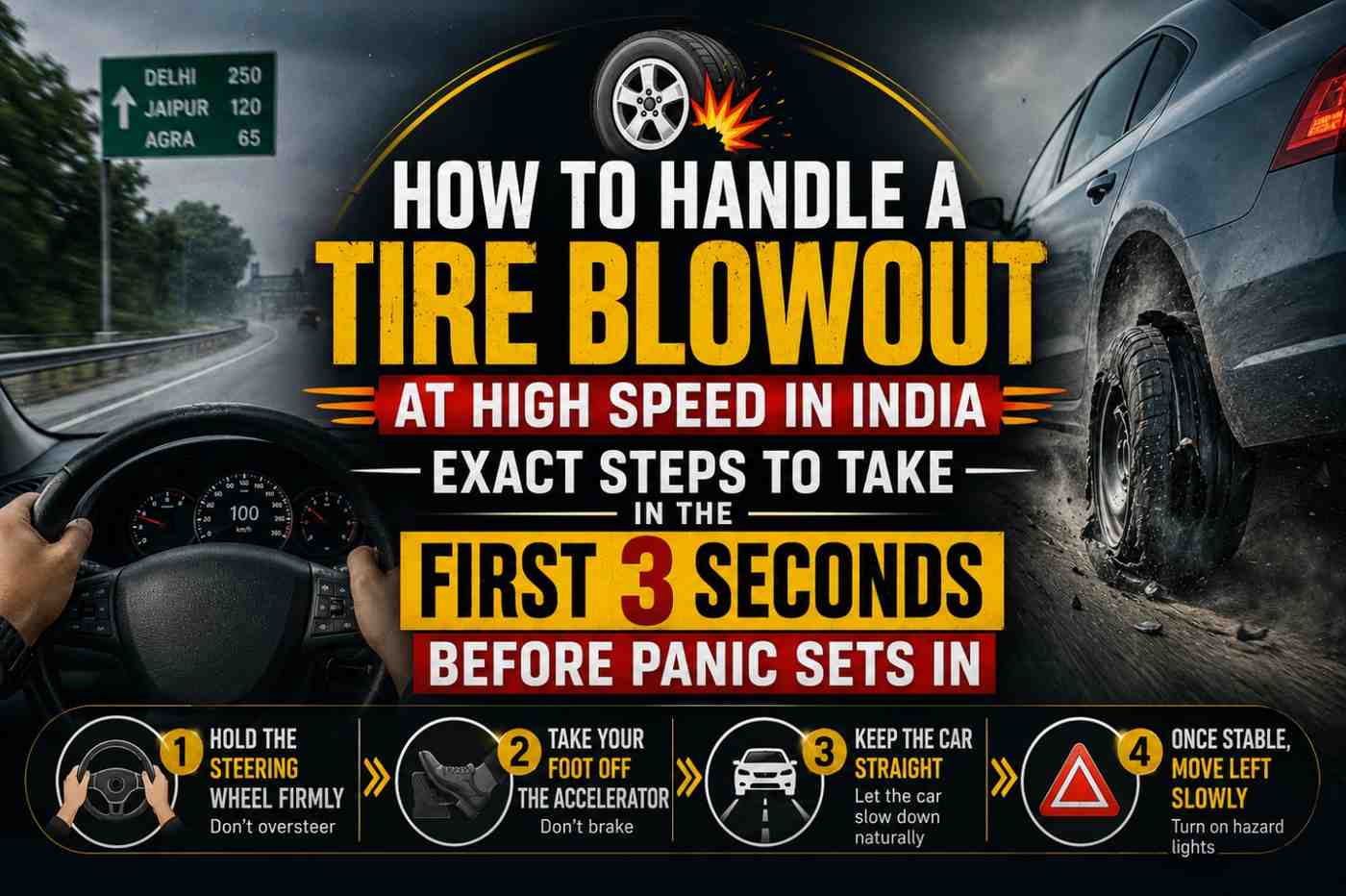
Every year, tire blowouts on Indian highways cause hundreds of fatal accidents—many involving vehicles that rolled over, crossed medians, or crashed into roadside barriers after drivers panicked and made the wrong response in the first critical seconds. Understanding how to handle a tire blowout at high speed in India is potentially the single most life-saving piece of knowledge any Indian highway driver can have.
The paradox of how to handle a tire blowout at high speed in India is that the instinctive responses most people would make—stamping the brakes, jerking the wheel—are precisely the actions that turn a survivable blowout into a fatal accident. The correct response is counterintuitive. It requires knowledge acquired before the emergency, because in the moment, you have only 2–3 seconds before the situation becomes unrecoverable.
This complete guide on how to handle a tire blowout at high speed in India covers what a blowout feels like, the three-second response sequence, the four most dangerous mistakes to avoid, and the tire maintenance practices that prevent blowouts in the first place.
What Causes Tyre Blowouts on Indian Highways?
Understanding causes is the first step in how to handle a tire blowout at high speed in India. Preparation:
1. Under-inflated Tyres The single most common blowout cause. An under-inflated tire flexes excessively at speed, generating heat that weakens the rubber structure until it fails suddenly. Over 65% of highway blowouts are linked to under-inflation.
2. Overinflated Tires Over-inflation reduces the tire’s contact patch and creates a tighter rubber structure more vulnerable to impact damage from potholes.
3. Tyre Age Rubber degrades over time regardless of tread depth. Tires over 5 years old develop micro-cracks in the sidewall. UV exposure accelerates degradation — a significant factor in India’s high-sunshine regions.
4. Overloading vehicles carrying loads beyond their rated capacity puts excessive stress on tires, particularly at highway speeds. A common cause of truck and SUV blowouts on Indian national highways.
5. Road Hazards Pothole impacts, sharp debris (broken glass and metal scraps), and road edge drops can cause an immediate blowout at any speed.
6. Worn Tyres Below 1.6 mm of tread depth, tires have significantly reduced heat dissipation capability and structural integrity—making blowout probability increase exponentially.
What a Blowout Feels Like — Recognising the Situation
Knowing how to handle a tire blowout at high speed in India requires first recognizing what’s happening in real time:
Front tire blowout:
- Sudden, explosive bang
- Vehicle pulls hard to the side of the blowout (left or right)
- Steering becomes heavy and unresponsive
- Vehicle nose dips toward the affected side
Rear tire blowout:
- Loud bang followed by a rapid flapping sound
- Vehicle fishtails—the rear swings left and right
- Less steering pull than a front blowout, but vehicle feels unstable
- The rear end feels loose and unpredictable
In both cases, the instinct will be to brake hard and steer against the pull. This is the wrong response. The correct protocol for how to handle a tire blowout at high speed in India must override that instinct immediately.
The 3-Second Blowout Response: How to Handle Tyre Blowout at High Speed India
This is the exact sequence recommended by international tire safety experts and highway driving instructors:
Second 1 — Grip and Straighten The moment you hear the bang and feel the pull:
- Grip the steering wheel firmly with both hands
- Do NOT brake
- Do NOT jerk the wheel
- Steer straight—counteract the pull gently but firmly to maintain your lane
Second 2 — Gently Accelerate (or Hold Speed) This is the most counterintuitive step in how to handle a tire blowout at high speed in India:
- Apply a brief, gentle acceleration (or simply hold the current throttle position)
- This keeps weight distributed across all four wheels and prevents the sudden deceleration that causes spinning or fishtailing
- At high speed, sudden deceleration from a blowout can cause the vehicle to pivot on the failed tyre — particularly dangerous with rear blowouts
Second 3 — Controlled Deceleration After maintaining control for 1–2 seconds:
- Gradually ease off the accelerator
- Let engine braking slow the vehicle naturally
- Only apply the brakes once speed has dropped to below 40 km/h—and then use gentle, progressive brake pressure
- Steer the vehicle toward the hard shoulder or emergency lane
Once slow and stable:
- Activate hazard lights
- Come to a complete stop on the shoulder
- Apply handbrake
- Exit the vehicle from the side away from traffic
- Place warning triangles 50 metres behind the vehicle
- Call for roadside assistance
[IMAGE 1 — Place after 3-second response]
Suggested Image: A three-panel sequential illustration showing the 3-second blowout response on an Indian highway—Panel 1: Blowout explosion icon, hands gripping wheel, “GRIP AND STRAIGHTEN”; Panel 2: Throttle gauge showing gentle acceleration; Panel 3: Vehicle moving to the shoulder with hazard lights on and speed dropping from 100 to 40 km/h. ALT Text: “How to handle a tire blowout at high speed India—a 3-panel sequential illustration showing the correct 3-second response: grip and straighten, gentle acceleration, controlled deceleration to shoulder.”
The 4 Deadly Mistakes in a Tyre Blowout
Understanding how to handle a tire blowout at high speed in India correctly also means understanding what NOT to do:
Mistake 1 — Stamping the Brakes Hard
Applying hard brakes immediately after a blowout at highway speed transfers massive weight to the front of the vehicle. Combined with a failed tyre, this almost always causes a spin or rollover. This is the cause of the majority of blowout-related rollover deaths on Indian highways.
Mistake 2 — Jerking the Steering Wheel
Pulling hard against a blowout’s pull causes oversteer — the vehicle swings hard in the opposite direction, often crossing the central divider into oncoming traffic. This is the second leading cause of fatal blowout accidents.
Mistake 3 — Releasing the Steering Wheel
Releasing the wheel in shock or to reach for your phone is obviously catastrophic—but it happens. Train yourself to tighten your grip at the moment of the bang.
Mistake 4 — Stopping in the Fast Lane
If the blowout happens in the right (fast) lane at high speed, the instinct to stop immediately is dangerous. Stopping in the fast lane with a damaged tire on a busy highway creates an extreme rear-collision risk. Always aim for the hard shoulder or emergency lane.
Tyre Blowout Prevention: How to Handle Tyre Blowout at High Speed India Starts Before You Drive
The best advice for how to handle a tire blowout at high speed in India is preventing blowouts from happening at all. A rigorous tire maintenance routine eliminates most blowout causes:
Monthly Tire Pressure Check:
- Check when tyres are cold (not driven for 3+ hours)
- Refer to your vehicle’s door-sticker or manual for correct pressure (typically 30–35 PSI for passenger cars)
- Check all four tyres and the spare
Tyre Pressure Monitoring Systems (TPMS): Under the Bharat NCAP safety regulations updating in 2026, TPMS is becoming standard in new Indian cars. If your vehicle has TPMS, learn to read and respond to its warnings.
Regular Tire Inspection:
- Check for visible cracking, bulging, or embedded objects monthly
- Measure tread depth — replace before reaching 1.6mm
- Rotate tyres every 10,000 km for even wear
Pre-Highway Blowout Check: Before any drive over 200 km:
- Verify tyre pressure is correct
- Inspect all four tyres visually for bulges or damage
- Check the spare tyre pressure (it must be road-ready)
- Verify load is within the vehicle’s rated capacity
[IMAGE 2 — Place before FAQs]
Suggested Image: A tire cross-section infographic showing the four most common blowout causes with visual indicators: under-inflation (tire bowing at sides), over-inflation (narrow contact patch), age cracking (sidewall micro-cracks), and tread wear (worn smooth surface)—each with a percentage contribution to highway blowouts. ALT Text: “How to handle a tire blowout at high speed India—a tire cross-section infographic showing four main blowout causes: under-inflation, over-inflation, age degradation, and tread wear with statistics.”
FAQs: How to Handle Tyre Blowout at High Speed India
Q1: What is the first thing to do in how to handle a tire blowout at high speed in India? A: The very first action is to grip the steering wheel firmly with both hands and steer straight — counteracting the pull without jerking. Do not brake. This first second of correct response determines whether the vehicle stays under control or goes into an unrecoverable spin.
Q2: Why is gentle acceleration recommended in how to handle a tire blowout at high speed in India? A: Brief, gentle acceleration (or simply holding throttle position) prevents the sudden weight transfer that causes the vehicle to spin or fishtail when a tire fails at speed. It keeps the vehicle stable for 1–2 critical seconds while you regain steering control before decelerating.
Q3: How to handle tyre blowout at high speed India differently for front vs rear blowout? A: A front blowout pulls the vehicle hard to the side — grip and steer straight. A rear blowout causes fishtailing — steer gently to counteract each swing without overcorrecting. Both require the same basic protocol: don’t brake, don’t jerk the wheel, and decelerate gradually to the shoulder.
Q4: What tire pressure prevents the need to know how to handle a tire blowout at high speed in India? A: Correct tire pressure as specified in your vehicle’s door sticker (typically 30–35 PSI for most Indian passenger cars). Check cold tyre pressure monthly and before every long drive. Underinflation causes 65%+ of highway blowouts.
Q5: Is knowing how to handle a tire blowout at high speed in India relevant for all vehicles? A: Yes — cars, SUVs, and motorcycles all experience tyre blowouts on Indian highways. Motorcycle blowouts require a different response (do not brake, reduce speed gradually using engine braking, and do not lean). The principles of no sudden braking and controlled deceleration apply to all vehicles.
Conclusion
How to handle tyre blowout at high speed India is knowledge that every driver on India’s expanding national highway network must have — because blowouts don’t announce themselves, they don’t give you time to think, and the instinctive response kills.
Grip the wheel. Don’t brake. Gently maintain the throttle. Steer straight. Gradually decelerate. Move to the shoulder. These five steps are the answer to how to handle tyre blowout at high speed India — and they must be so well understood that they execute automatically when the bang happens and your heart is pounding.
Check your tire pressure today. Memorize the 3-second protocol. Share this guide with every highway driver you know—because understanding how to handle a tire blowout at high speed in India is the difference between a frightening experience and a fatal accident.
External Links
- https://www.nithe.nic.in — National Institute for Training of Highway Engineers India
- https://morth.nic.in/road-accident-in-india — MoRTH: Road Accident Reports
- https://www.tyresafe.org/tyre-safety/tyre-blowouts — TyreSafe UK: Blowout Response Guide
- https://www.nhtsa.gov/equipment/tires — NHTSA: Tyre Safety Research
- https://bhatncrb.nic.in — Bureau of Indian Standards: Automotive Tyre Safety Standards