 admin@prodriver.in
Every year between July and September, India’s roads transform. What were manageable potholes became hidden traps underwater. Busy city streets become shallow rivers. Highways through ghat sections turn treacherous with runoff, mist, and sudden landslides. The monsoon driving tips for Indians in 2026 in this guide are designed for the full spectrum of these conditions—from the first light pre-monsoon drizzle to the heaviest Category 4 downpours that can reduce visibility to near zero in seconds.
Road accidents during India’s monsoon season spike dramatically. According to the Ministry of Road Transport and Highways’ Annual Road Accidents Report, rain-related road accidents account for a disproportionate share of total annual fatalities, with wet-road loss-of-control, flooding-related engine damage, and visibility-related collisions dominating the causes. Every monsoon driving tip India 2026 safety experts stress relates directly to one of these three failure modes.
This is not a guide about driving slowly and being cautious in a vague sense. These are specific, actionable monsoon driving tips for India 2026 for every situation you will encounter—city waterlogging, highway mist, ghat descents in rain, overnight long-distance driving, and the critical moments when you must decide whether to proceed or stop.
Why 2026’s Monsoon Requires Updated Driving Awareness
India’s monsoon patterns have become less predictable. The Indian Meteorological Department has noted increased instances of extreme precipitation events—rainfall in 24-hour bursts that previously would have been distributed across several days now arrives in concentrated downpours. This makes monsoon driving tips for Indians in 2026 preparation more critical than in previous years, as drivers increasingly encounter flooding conditions they have not experienced on familiar routes before.
Urban drainage infrastructure in most Indian cities—designed for 1960s–1970s rainfall patterns—struggles significantly with modern extreme rainfall events. Roads that never flooded in a driver’s memory may flood in 2026. Monsoon driving tips for Indians in 2026, therefore, include not just technique but awareness: understanding that conditions this year may be unlike what you have seen before.
The 15 Most Critical Monsoon Driving Tips for Indians 2026
Tip 1 — Reduce Speed to Match Reduced Visibility, Not Posted Limits
Speed limits are set for clear, dry, good-visibility conditions. In heavy rain, visibility can drop to 30–50 meters—yet drivers frequently maintain speeds appropriate for 200-meter visibility. The foundational monsoon driving tip for India 2026: your driving speed should always match your stopping distance to the visible road ahead, regardless of the posted limit.
Tip 2 — Double Your Following Distance in Rain
On dry roads, a 2-second following distance is standard. In rain, wet roads increase stopping distances by 50–100%. The monsoon driving tips for India in 2026 following distance rule: a minimum of 4 seconds in light rain, 6 seconds in heavy rain, and 8 seconds in extremely heavy rain or low visibility conditions.
Tip 3—Turn on Headlights in Rain—Not Hazard Lights
Many Indian drivers incorrectly use hazard lights while driving in rain. This is illegal under Rule 11 of the Central Motor Vehicles Rules and dangerous—hazard lights disable indicator functionality, removing your ability to signal lane changes or turns. The correct monsoon driving tip for India 2026 lighting: headlights on (not just DRLs) with fog lights if available and visibility is below 100 meters.
Tip 4 — Avoid Waterlogged Roads If You Cannot See the Bottom
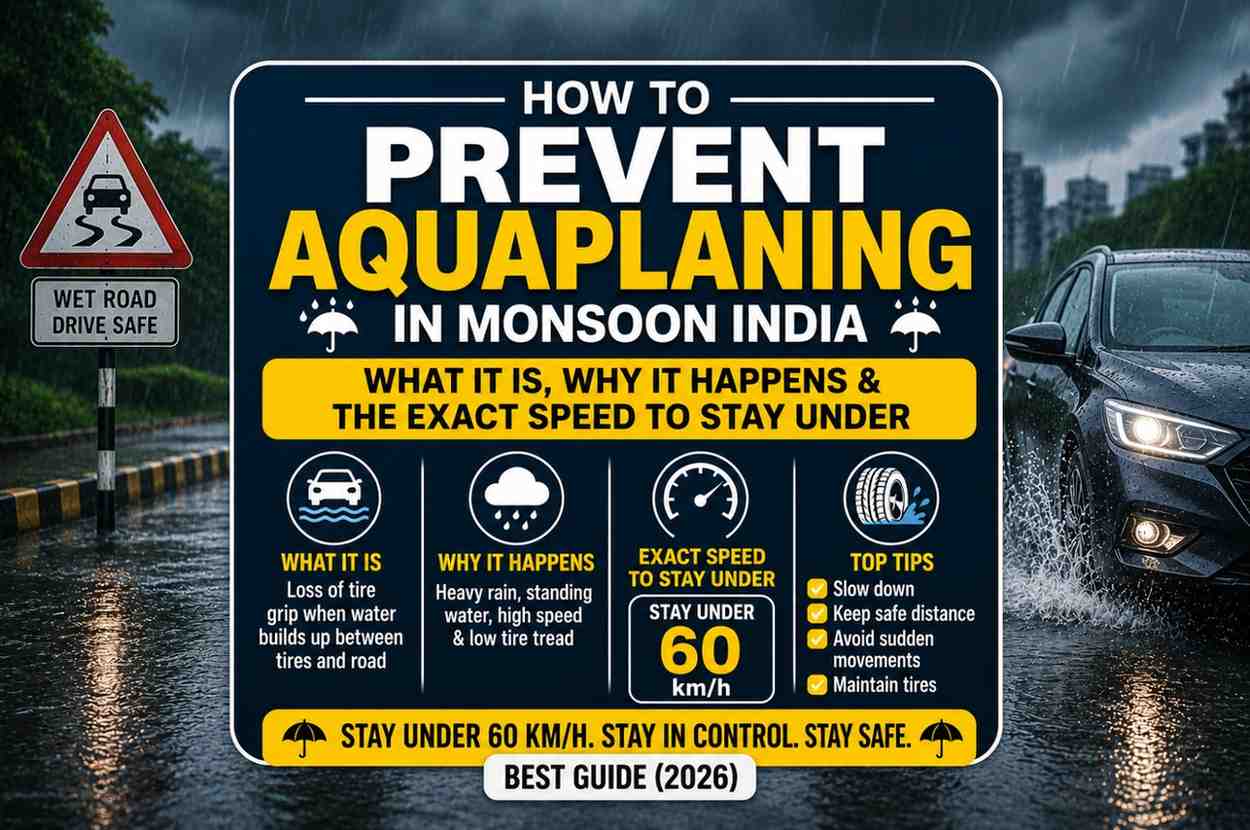
You cannot know a flooded road’s depth, current flow, surface condition, or what is lurking beneath the water without entering it. A seemingly shallow 15 cm of water flowing at speed can destabilize a car. Monsoon driving tips in India 2026 professionals consistently give: if you cannot see the road surface through the water, do not enter. Find an alternate route.
Tip 5—Enter Water Slowly and Exit in 1st Gear
If you must pass through a shallow, known-depth waterlogged section, use the correct monsoon driving tip technique for India 2026: enter slowly (5–10 km/h) in 1st gear (manual) or ‘L’ mode (automatic), maintain steady throttle without stopping, and exit without cutting the engine. Stopping mid-flood allows water to enter the exhaust and potentially the intake.
Tip 6 — Dry Your Brakes After Passing Through Water
After driving through water, brake pads and discs are wet and significantly less effective. The monsoon driving tip in India 2026 brake-drying technique: apply gentle, light brake pressure for 200–300 meters after exiting water to generate heat that dries the friction surfaces. Do not wait until you need to brake urgently to discover they are compromised.
Tip 7 — Be Extra Alert for Hidden Potholes Under Water
India’s roads develop potholes rapidly during monsoon season. These potholes, invisible under waterlogged surfaces, can be 15–30 cm deep—enough to damage suspension, tires, and alignment severely. Monsoon driving tips for India 2026 pothole management: reduce speed dramatically in waterlogged streets, maintain a wheel track slightly offset from the most heavily puddled areas, and watch how motorcyclists ahead respond.
Tip 8 — Never Park Under Trees During Heavy Rain
Lightning and structural damage from waterlogged root systems can bring branches and entire trees down during Indian monsoon storms. This is one of the most underrated monsoon driving tips in India for 2026 for parking decisions—especially during evening thunderstorm cells that develop rapidly over Indian cities.
Tip 9 — Plan Your Route Before Departure, Not During
In heavy rain, operating a navigation device while managing reduced visibility, slippery roads, and complex traffic is a dangerous combination. Monsoon driving tips India 2026 route planning: set your navigation before departure, know two alternate routes to your destination, and check IMD or Skymet rainfall alerts for your route before leaving for any journey over 30 km.
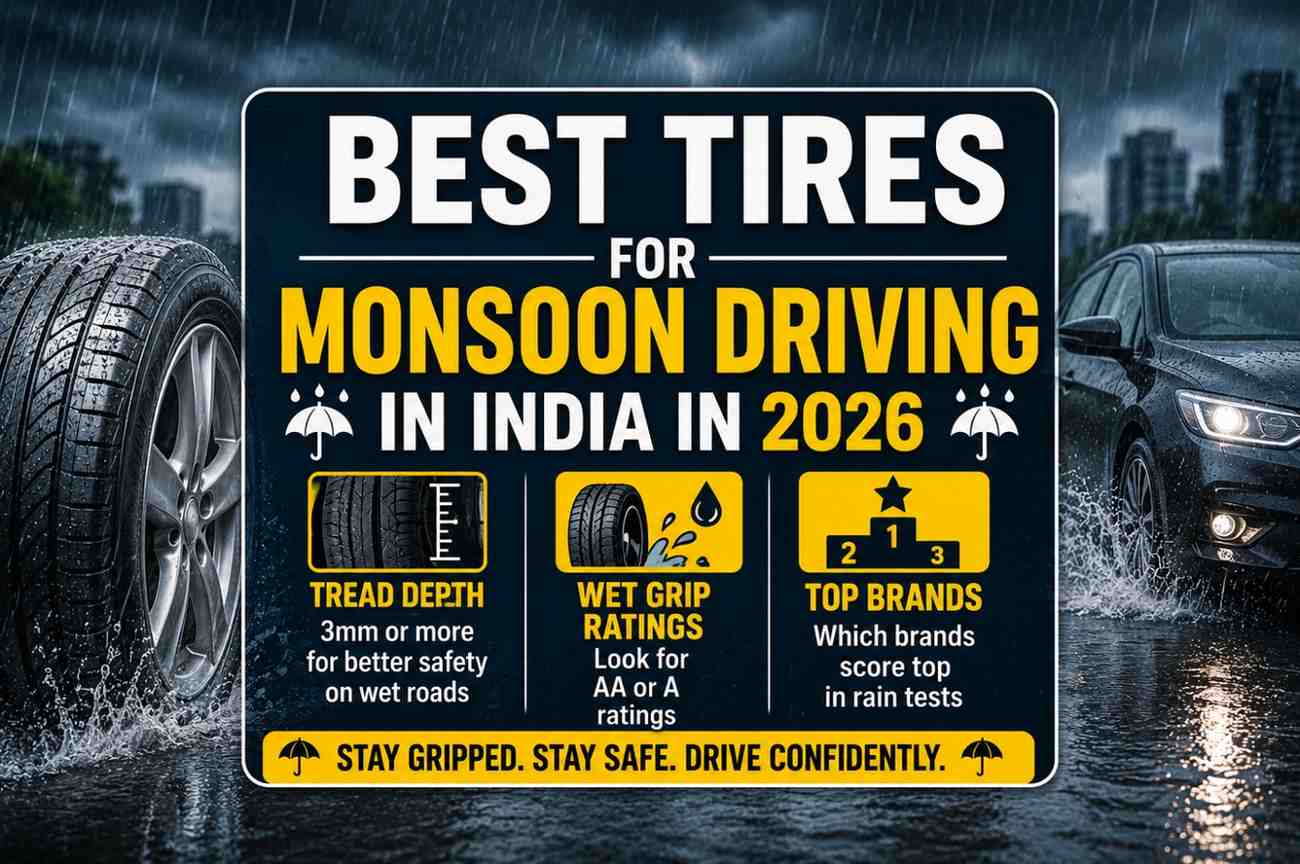
Tip 10—Check tire tread depth before the season begins.
Worn tires are the most common mechanical cause of monsoon accidents. The legal minimum tread depth in India is 1.6 mm, but wet-grip performance begins deteriorating meaningfully below 3 mm. The most critical monsoon driving tip for India 2026 maintenance action: inspect tread depth on all four tires before July and replace any tire below 3 mm immediately.
Tip 11 — Keep Windows Slightly Open in Heavy Rain
Fully closed windows in heavy rain cause rapid windshield fogging from interior humidity. Keep rear windows slightly open (2–3 cm) to maintain air circulation and reduce interior moisture. Running the AC on demist mode with front defog on is the monsoon driving tip India 2026 fog management technique—but maintaining some fresh air circulation prevents rapid re-fogging.
Tip 12—Avoid Overtaking on Blind Curves in the Ghats
Ghat sections during monsoon are some of the most dangerous roads in India. Runoff water on the outside of curves, combined with reduced visibility and the risk of oncoming vehicles partially occupying your lane to avoid their own edge hazards, makes overtaking on blind ghat curves potentially fatal. This monsoon driving tip for India in 2026 is non-negotiable: no overtaking on blind curves in ghat terrain during rain.
Tip 13 — Keep an Emergency Kit in the Car During Monsoon Season
Your monsoon emergency kit should include a torch, a reflective triangle, a basic tow rope, waterproof footwear, a rain jacket, a charging cable and power bank, and at minimum one liter of drinking water. This monsoon driving tip for 2026 Indian preparation ensures that if you do get stranded, you are safe and visible while waiting for help.
Tip 14 — Avoid Starting Your Car If the Engine Has Ingested Water
If your car’s engine dies in a waterlogged section, do not attempt to restart it immediately. Water in the combustion chamber causes hydraulic lock, which can bend connecting rods and destroy the engine in a single attempted start. The critical monsoon driving tip for India 2026 for engine submersion: exit the car safely, call for recovery assistance, and leave engine restart to a qualified mechanic.
Tip 15 — Use Engine Braking on Wet Descents Rather Than Service Brakes
Wet brake pads and wet road surfaces combine to increase stopping distances dramatically on downhill sections. The safe monsoon driving tip for descents in India 2026: select a lower gear well before the descent begins and use engine braking to control speed, minimizing reliance on service brakes that may have reduced effectiveness.
Quick Reference: Monsoon Driving Tips for Indians in 2026 by Condition
| Condition | Speed Guideline | Key Action |
|---|---|---|
| Light rain, clear road | -10 km/h from normal | Headlights on, increase following distance |
| Heavy rain, poor visibility | Max 40–50 km/h in the city | Headlights + fog lights, 6-sec gap |
| Waterlogged road (known depth) | 5–10 km/h | 1st gear, steady throttle, no stopping |
| Waterlogged road (unknown depth) | Stop | Do not enter; find alternate route |
| Ghat descent in rain | Max 20–30 km/h | Engine braking, low gear before descent |
| Highway mist/fog | Max 40–60 km/h | Headlights, no overtaking, fog lights |
Frequently Asked Questions
Q1. What is the safest speed to drive in heavy monsoon rain in India? In heavy rain with significantly reduced visibility, monsoon driving tips in India 2026 recommend a maximum of 40–50 km/h in city conditions and 60–70 km/h on highways where road quality is good and visibility allows. The operative rule is always your speed must allow you to stop within your visible range.
Q2. Should I use 4WD in monsoon driving in India? 4WD/AWD improves traction during acceleration on slippery surfaces but does not improve braking performance. Monsoon driving tips for India 2026 for 4WD vehicle owners: engage 4WD on off-road or severely flooded terrain, but remember that braking distances are identical to 2WD vehicles on wet roads—reduced speed is still essential.
Q3. Is it safe to drive in Mumbai or Chennai during red alert rainfall? No. When the IMD issues a red alert (extremely heavy rainfall >204 mm/24 hr expected), monsoon driving tips for Indians 2026 professionals unanimously advise: do not drive unless absolutely essential. Red alert conditions produce flash flooding that can be immediately life-threatening even in familiar areas.
Q4. How do I know if my car’s engine has taken in water? Signs include an engine that cranks but will not start, unusual knocking sounds after attempted restart, water visible in the air filter housing, or oil that appears milky or frothy (indicating water mixing with engine oil). The monsoon driving tip in India 2026: if you observe any of these, do not start the car; call a mechanic immediately.
Q5. What should I do if my car starts sliding on a wet road? Do not brake suddenly—this worsens the slide. Steer gently in the direction you want to go, release the accelerator smoothly, and allow the tires to regain grip. This is the monsoon driving tip, India 2026 slide recovery technique, that prevents a recoverable skid from becoming an uncontrolled accident.
Conclusion
Monsoon driving tips in India in 2026 are ultimately about one thing: understanding that the road you drive on in July is fundamentally different from the road you drive on in February—and adjusting every aspect of your driving to match. Speed, following distance, lighting, gear selection, route planning, and the courage to stop and wait rather than risk a flooded road are all part of the complete monsoon driving tips India 2026 framework.
India’s monsoon is spectacular, life-giving, and beautiful. It is also genuinely dangerous for unprepared drivers. Apply these monsoon driving tips in India 2026 systematically, prepare your car before the season begins, and approach every wet-road journey with the respect that changed conditions demand. Safe driving through the season — for you and for everyone sharing those wet roads with you.