 admin@prodriver.in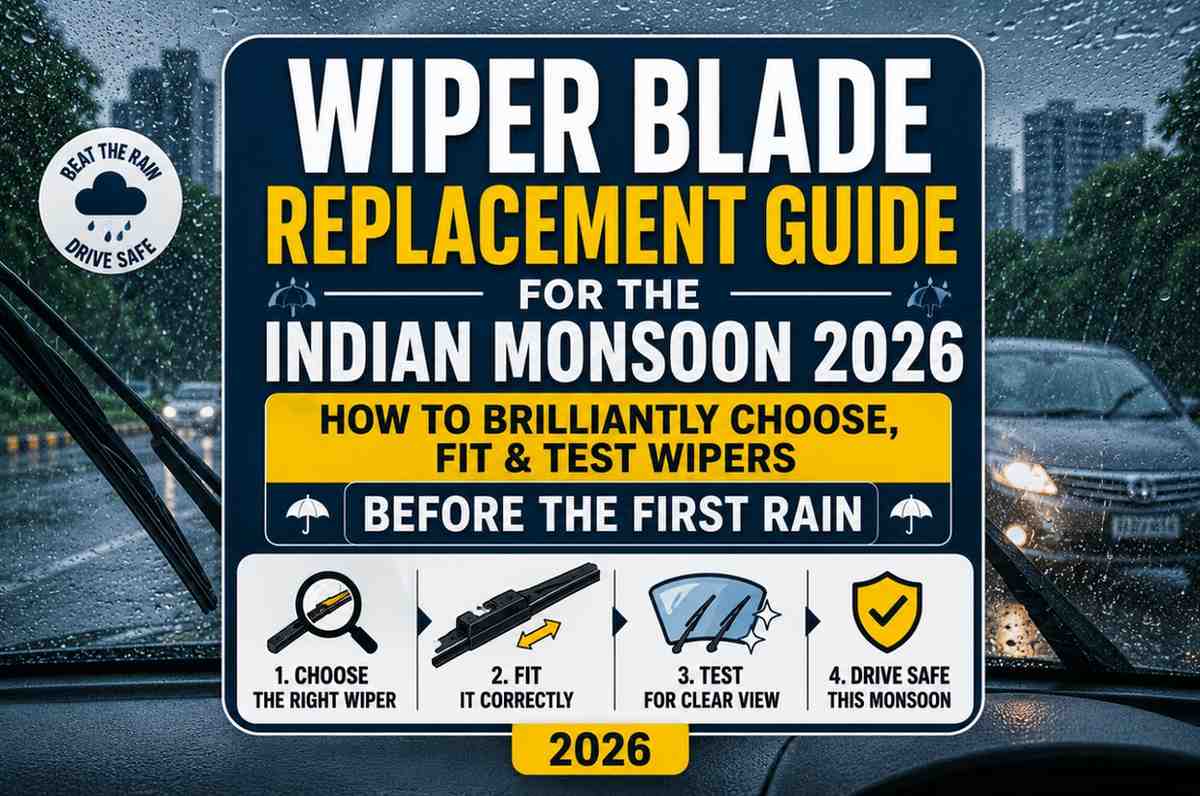
Your windshield wipers are your most important visibility tool during Indian monsoon driving. A wiper that smears, chatters, leaves uncleared zones, or lifts off the windshield at speed in heavy rain is not just an annoyance—it is a genuine safety hazard. This wiper blade replacement guide for the Indian monsoon 2026 covers everything: how to assess whether your current blades need replacing, how to choose the correct blade type for Indian conditions, how to fit them correctly, and how to test them before the first heavy rain hits.
Most Indian car owners replace wiper blades reactively—after the monsoon has started and the blades are already failing. This wiper blade replacement guide for the India monsoon 2026 approach inverts that: inspection and replacement in May or early June, before the first rain, means your blades perform at their best when you need them most—in the first heavy downpour of the season.
Wiper blades in Indian conditions degrade faster than the manufacturer’s stated replacement interval (typically 1–2 years). India’s intense UV radiation during the dry season hardens the rubber edge, reducing its conformity to the windshield. The wiper blade replacement guide for India’s monsoon 2026 recommendation for most Indian climates: replace annually before the monsoon season regardless of apparent condition.
Types of Wiper Blades: What the Wiper Blade Replacement Guide India Monsoon 2026 Recommends
Traditional Framed (Conventional) Blades
The most common type in older Indian cars. A metal frame holds a rubber insert across a series of pressure points. Economical (₹150–₹400 per blade), but the frame can trap water and debris, causing uneven pressure distribution during heavy monsoon rain. Wiper blade replacement guide India monsoon 2026 verdict: acceptable for light monsoon use; upgrade to beam blades for heavy rainfall areas.
Beam (Bracketless/Flat) Blades
A single curved rubber or silicone strip with an integrated spring steel spine — no external frame. Beam blades apply even pressure across the entire blade length, conform better to curved windshields, and have no frame crevices to trap water or debris. Wiper blade replacement guide for India monsoon 2026: strong recommendation for cities with heavy rainfall (Mumbai, Cherrapunji-region routes, Mangalore, Kochi). Price: ₹400–₹1,200 per blade.
Hybrid Blades
A combination of a protective plastic shell (reducing debris clogging) over a traditional articulated frame. Better than conventional in monsoon conditions but not as good as beam blades. Wiper blade replacement guide for India’s monsoon 2026 middle ground for moderate monsoon regions. Price: ₹350–₹800.
Silicone Blades
Silicone rubber wiper inserts (available as replacement inserts or full blade assemblies) last 3–4× longer than natural rubber in Indian UV and heat conditions and maintain flexibility at extreme temperatures. Wiper blade replacement guide for India’s monsoon 2026: long-term value recommendation: silicone inserts from Bosch, PIAA, or Rain-X for drivers wanting a 2–3 year replacement interval. Price: ₹600–₹1,800 for quality silicone wiper blades.
Sizing: Critical Step in Wiper Blade Replacement Guide India’s Monsoon 2026
An incorrect wiper size is the most common fitting error. Using your vehicle’s registration number on the Bosch, Valeo, or Rain-X online fitting guides gives exact size recommendations. The wiper blade replacement guide for India’s monsoon 2026 sizing check: note both driver (longer) and passenger (shorter) blade lengths—they are almost always different. Also check whether your car has a rear wiper requiring replacement (SUVs, hatchbacks, and MUVs).
Common Indian car wiper sizes for reference:
| Car Model | Driver Blade | Passenger Blade |
|---|---|---|
| Maruti Swift | 22″ / 550mm | 14″ / 350mm |
| Hyundai Creta | 24″ / 600mm | 14″ / 350mm |
| Honda City | 26″ / 650mm | 18″ / 450mm |
| Tata Nexon | 22″ / 550mm | 16″ / 400mm |
| Toyota Innova | 22″ / 550mm | 18″ / 450mm |
Always verify with your specific model year before purchasing—some models changed wiper sizes across generations.
How to Fit Wiper Blades: The Wiper Blade Replacement Guide for the Indian Monsoon 2026, Step-by-Step
Step 1: Turn off the car and set the wipers to the resting (down) position. Then carefully lift the wiper arm away from the windshield and support it—if dropped without a blade, the bare metal arm can crack the windshield.
Step 2: Examine the connection type. Most modern Indian cars use a J-hook (hook-shaped arm end). Other types include pin-top, side-pin, and pinch-tab. Premium blade packages include adapters for all common types.
Step 3: For J-hook blades, press the release tab on the underside of the blade-arm junction and slide the blade forward (toward the pivot) to release it. The blade should click off cleanly.
Step 4: Align the new blade with the arm and push it back until it clicks firmly into the hook. Test the connection by gently pulling the blade—it should not come free.
Step 5: Repeat for the passenger-side blade. Lower both arms gently onto the windshield—do not let them snap down.
Step 6: Test: run the wipers at both speeds on a wet windshield (spray washer fluid). Check for chattering, streaking, missed zones, or lifting. This testing step is the final validation in the wiper blade replacement guide for the India monsoon 2026 process.
Top Wiper Blade Brands for Indian Monsoon Conditions
| Brand | Type | Price Range | Best For |
|---|---|---|---|
| Bosch AeroTwin | Beam (natural rubber) | ₹600–₹1,400 | Overall best performance |
| Valeo Ultimate | Beam (natural rubber) | ₹550–₹1,200 | Strong wet performance |
| Rain-X Latitude | Beam (natural rubber) | ₹500–₹1,000 | Best value beam blade |
| Piaa Silicone | Beam (silicone) | ₹1,000–₹1,800 | Best longevity |
| MRF Wipers | Conventional | ₹200–₹450 | Budget standard use |
| Denso DM | Conventional | ₹250–₹500 | Reliable OEM-grade budget |
The wiper blade replacement guide for the India monsoon 2026 top recommendation for most Indian drivers: Bosch AeroTwin beam blades. Available at almost all Indian car accessory stores and online, they deliver excellent wet wipe quality and are easy to fit without specialized tools.
Frequently Asked Questions
Q1. How do I know if my wiper blades need replacing? Signs covered in this wiper blade replacement guide for India’s monsoon 2026: streaking (blade leaving a water film), chattering (vibrating/jumping across the glass), squeaking, missed zones (areas never touched by the blade), and visible rubber cracking or tearing on the blade edge. Any single sign means replacement before monsoon.
Q2. Can I replace just one wiper blade? Technically yes, but the wiper blade replacement guide for the India monsoon 2026 recommendation is always to replace both driver and passenger blades simultaneously. Blades degrade together, and mismatched blades create uneven visibility even when only one technically fails.
Q3. How long do wiper blades last in Indian conditions? Natural rubber conventional blades: 8–12 months in the Indian climate. Beam blades with natural rubber: 12–18 months. Silicone beam blades: 24–36 months. This wiper blade replacement guide for India’s monsoon 2026 longevity data explains why annual pre-monsoon replacement is recommended for most Indian drivers.
Q4. Should I apply rain repellent to the windshield? Rain repellent products (Rain-X and Soft99) create a hydrophobic coating that causes water to bead and roll off the windshield at speed. In combination with good blades, they significantly improve visibility. Wiper blade replacement guide: India monsoon 2026 Addition: Apply rain repellent after fitting new blades for the best combined effect.
Q5. Can I use truck wiper blades on my car for better rain clearing? No, truck blades are sized and pressure-engineered for different windshield curvatures. Incorrect blade pressure damages the windshield rubber seal and creates poor wipe quality. The wiper blade replacement guide for India’s monsoon 2026 sizing rule: always use blades specified for your vehicle model and year.
Conclusion
The wiper blade replacement guide for the India monsoon 2026 delivers one primary message: replace your wipers every year before the monsoon, use beam blades for heavy rainfall areas, and test them before the first rain. The cost—₹600–₹1,400 for a quality pair of Bosch AeroTwin beam blades—is trivially small compared to the visibility and safety benefit during India’s 3–4 month monsoon season.
Visibility is the first defense in monsoon driving safety. Your wiper blades are what stands between you and driving blind in heavy rain. Follow this wiper blade replacement guide for the India monsoon 2026, and you will enter the season with complete confidence in your most critical visibility system.