 admin@prodriver.in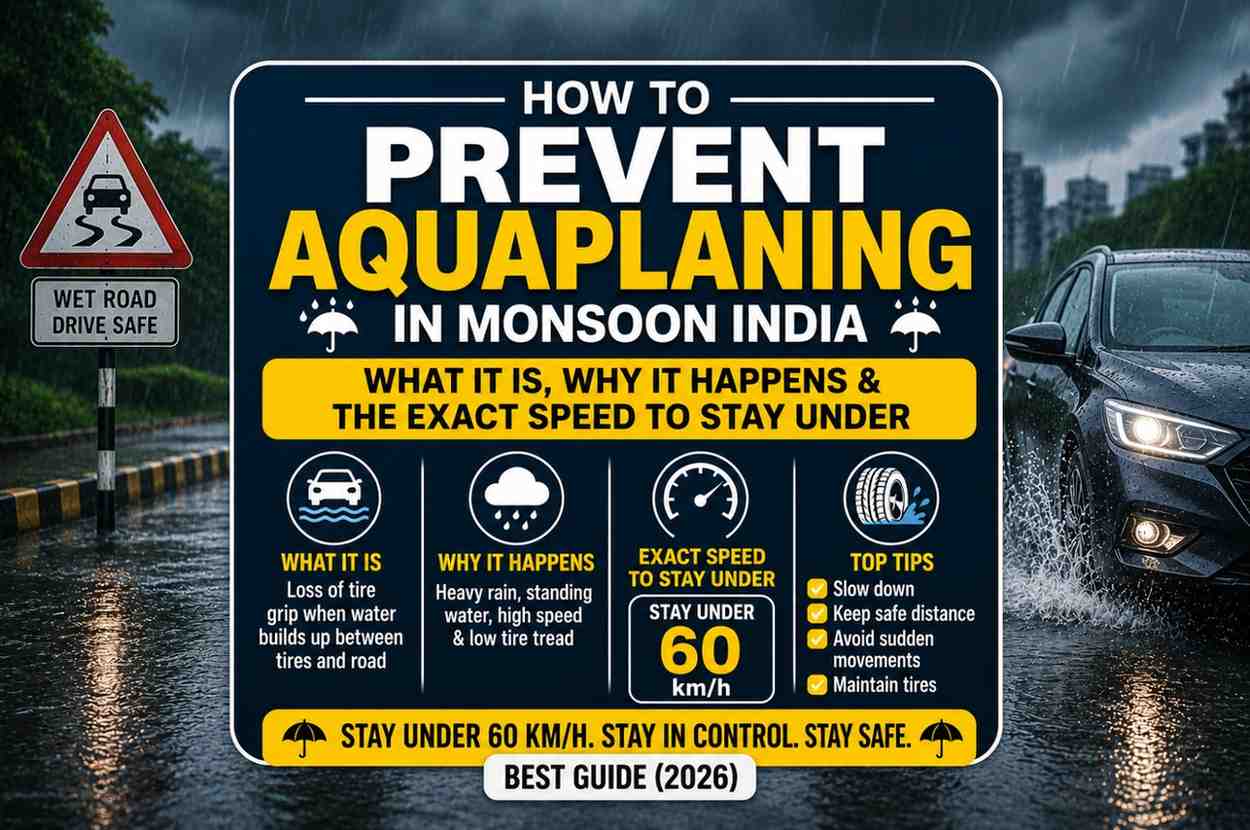
Aquaplaning is one of the most terrifying and misunderstood driving phenomena that Indian monsoon conditions create. When it happens — when your car suddenly feels as though it has lifted off the road surface and steering input produces no response — most drivers instinctively do exactly the wrong thing. Understanding how to prevent aquaplaning in monsoon India is a knowledge-level skill: knowing the physics prevents the event from occurring, and knowing the recovery technique prevents a recoverable loss of control from becoming an accident.
How to prevent aquaplaning in monsoon India starts with understanding what aquaplaning actually is. It occurs when your tires encounter a volume of water on the road surface faster than the tread grooves can evacuate it. The water creates a wedge between the tire and the road—the car literally rides on a film of water rather than the asphalt—resulting in complete or partial loss of traction, steering, and braking effectiveness.
The consequences of aquaplaning at speed—loss of directional control on highways, inability to brake before intersections, and unexpected lane departure—make knowledge of how to prevent aquaplaning in monsoon India critical for any driver using Indian roads from July to September. Fortunately, aquaplaning is largely preventable with the right tire condition, the right speed management, and the right road awareness.
The Physics of Aquaplaning: Why It Happens
Aquaplaning occurs when the road water film depth exceeds the tire’s capacity to evacuate it. The critical factors are the following:
Vehicle speed: Aquaplaning risk increases dramatically with speed—it approximately follows a square-law relationship, meaning doubling speed quadruples aquaplaning risk. How to prevent aquaplaning in monsoon India: Speed management is, therefore, the most powerful single intervention.
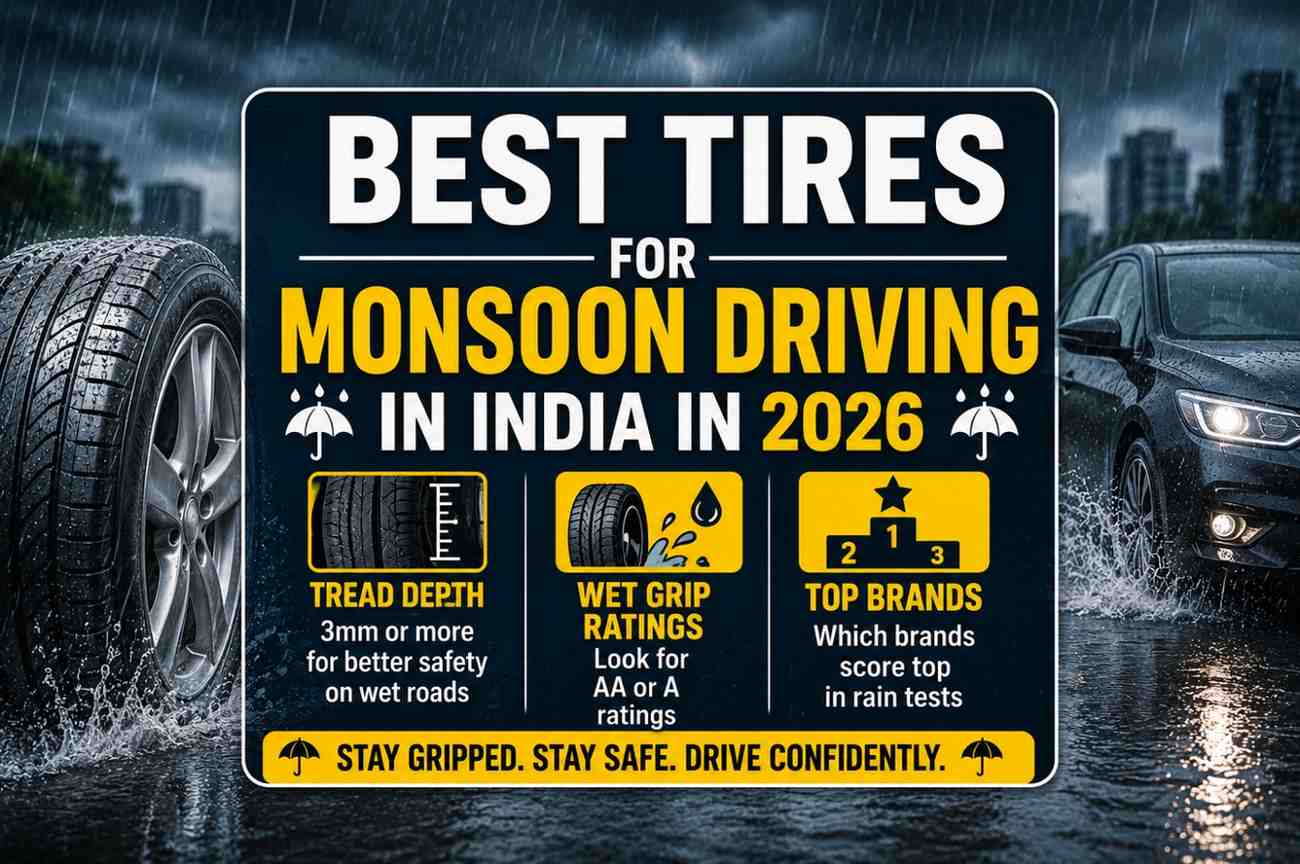
Tyre tread depth: Deeper treads can evacuate more water per second. At 7 mm tread depth, a typical tire can evacuate 8+ liters of water per second at 80 km/h. At 2mm tread depth, this capacity is reduced by 65%. How to prevent aquaplaning in monsoon India: tread depth requirement: minimum 3 mm, ideally 4 mm+ for highway monsoon driving.
Tire width: Wider tires have a larger contact patch and must evacuate more water per second. Counter-intuitively, narrower tires (correctly sized for the vehicle) are more aquaplaning-resistant than wider aftermarket tires. How to prevent aquaplaning in monsoon India: Tire sizing guidance: always use manufacturer-recommended width.
Water depth on road: Standing water above 2–3 mm depth significantly increases aquaplaning risk. Indian monsoon roads—with poor drainage and bowl-shaped road profiles in many cities—regularly develop 5–15 mm standing water films.
The Exact Speed to Stay Under: How to Prevent Aquaplaning in Monsoon India
Research from tire manufacturers and independent automotive institutes provides consistent aquaplaning speed data for typical passenger car tires.
| Tread Depth | Aquaplaning Onset Speed (Wet Road) | Safe Maximum Highway Speed |
|---|---|---|
| 7 mm (new tyre) | ~95–110 km/h | 85–90 km/h |
| 5mm | ~85–95 km/h | 75–80 km/h |
| 3mm | ~70–80 km/h | 60–65 km/h |
| 2mm | ~55–65 km/h | 50 km/h max |
| 1.6mm (minimum legal) | ~45–55 km/h | Do not use in the rain. |
For how to prevent aquaplaning in Indian monsoon highway driving: maintain at least 10–15 km/h below the aquaplaning onset speed for your tire’s tread depth. This safety margin accounts for variable water depth across different road sections.
8 Ways to Prevent Aquaplaning in Monsoon India
1. Maintain adequate tread depth. This is the foundational answer to how to prevent aquaplaning in monsoon India—no other measure compensates for worn tires.
2. Reduce speed in standing water. When you see a wide puddle, lane of standing water, or flooded section ahead, reduce speed 15–20 km/h before reaching it—not while in it.
3. Avoid sudden acceleration in water. Rapid acceleration forces the tire’s contact patch to push backward through water rather than downward into the road surface. How to prevent aquaplaning in monsoon India acceleration rule: maintain a steady throttle in standing water.
4. Hold the steering wheel firmly and straight. A car entering aquaplaning typically veers slightly. A firm, straight wheel input gives the best chance of maintaining direction as grip returns. How to prevent aquaplaning in monsoon India: A steering grip is a physical preparation—both hands on the wheel, 9-and-3 position, in all monsoon highway driving.
5. Avoid outer-lane wheel tracks. The outer edges of Indian highway lanes collect the most standing water—runoff from the camber flows outward. Where possible, position the car toward the crown of the road (higher, drier). This lateral positioning is an underappreciated element of how to prevent aquaplaning in monsoon India.
6. Maintain correct tire pressure. Under-inflated tires have a concave contact patch that creates a water-collection bowl rather than a water-deflecting knife-edge. Correct pressure maintains the optimal convex contact patch geometry. How to prevent aquaplaning in monsoon India pressure requirement: exactly the manufacturer’s specification.
7. Follow previous tire tracks. In the rain, the vehicle ahead has partially cleared water from its wheel tracks. Following in the same tracks (with a safe following distance) reduces the water depth your tires encounter. How to prevent aquaplaning in monsoon India: the following-track technique is useful but should never compromise following distance.
8. Avoid cruise control in heavy rain. Cruise control maintains a constant speed through aquaplaning events rather than naturally allowing the car to slow—making recovery more difficult. How to prevent aquaplaning in monsoon India cruise control rule: disengage in any sustained rainfall.
Recovery: What to Do If Aquaplaning Happens Despite Precautions
If aquaplaning occurs despite following how to prevent aquaplaning in monsoon India guidance,
- Do not brake. Sudden braking with no tire-road contact spins the wheels and makes recovery slower.
- Do not turn the steering wheel sharply. Steering input while aquaplaning has no effect on direction but creates sudden oversteer when grip returns.
- Lift off the accelerator smoothly. Reducing drive forces allows the tire to settle back toward the road surface.
- Hold the steering wheel straight and firm. As speed reduces, the water wedge dissipates, and contact returns.
- Brake gently once grip returns. You will feel a slight vibration or “grounding” sensation when the tire re-contacts the road. Only then do you apply the brakes.
Frequently Asked Questions
Q1. Can AWD vehicles aquaplane? Yes. AWD improves traction during acceleration but provides no advantage against aquaplaning. All four tires can simultaneously ride on water films regardless of drive configuration. How to prevent aquaplaning in monsoon India applies identically to AWD, FWD, and RWD vehicles.
Q2. Does ABS help during aquaplaning? ABS is designed for tire-road contact situations. During full aquaplaning (complete loss of road contact), ABS has no beneficial effect — there is no traction to modulate. ABS helps in partial aquaplaning. This reinforces why, to prevent aquaplaning in monsoon India, speed management and tread depth are the primary preventive measures.
Q3. How do I know if my car is aquaplaning? Steering suddenly feels very light or non-responsive; the car wants to continue in a straight line despite steering input, engine RPM may rise slightly as driven wheels lose resistance, and the ride feels unusually smooth. Recognizing these sensations is part of how to prevent aquaplaning in monsoon India awareness training.
Q4. Are sports tires worse at aquaplaning than touring tires? Summer sports tires (UHP—ultra-high performance) typically have shallower tread depths and larger tread blocks with fewer sipes—optimized for dry grip rather than water evacuation. They are generally more susceptible to aquaplaning than touring tires. How to prevent aquaplaning in monsoon India for sports car owners: consider a seasonal touring tire swap before the monsoon.
Q5. What road surface is most prone to aquaplaning in India? Newly laid smooth asphalt with no surface texture, polished concrete flyovers, and painted road markings (which have near-zero surface friction when wet) are the highest-risk surfaces. How to prevent aquaplaning in monsoon India: high-risk surface management—reduce speed by an additional 10–15 km/h on these surface types in heavy rain.
Conclusion
How to prevent aquaplaning in monsoon India reduces to three primary interventions: maintain tire tread above 3 mm, reduce speed to 10–15 km/h below the aquaplaning threshold for your tread depth, and maintain correct tire pressure. Everything else is a supporting technique.
Aquaplaning is not an unpredictable event—it is a predictable physics outcome of specific tire, speed, and road water conditions. Managing the variables within your control, like how to prevent aquaplaning in monsoon India, transforms a frightening emergency scenario into something that simply does not occur. And if it ever does despite your precautions, the recovery technique—off throttle, straight wheel, wait for grip—is the calm, correct response that keeps a momentary physics event from becoming a lasting consequence.