 admin@prodriver.in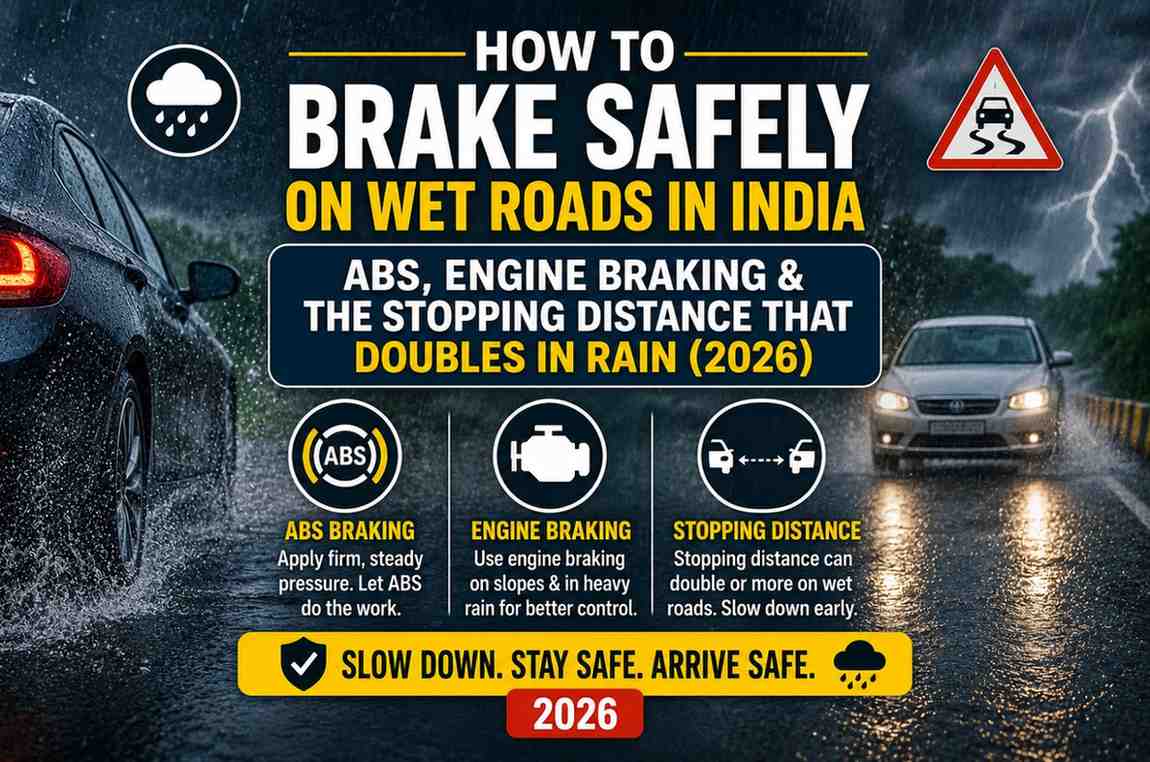
Braking is the most critical driving action in wet conditions—and the most frequently misapplied. Indian drivers who understand dry-road braking but have never studied the physics of wet-road stopping distances make dangerous assumptions about how quickly their car can stop in rain. Knowing how to brake safely on wet roads in India is a knowledge gap that, once filled, changes your following distances, your approach speeds, and your entire understanding of safety margins in monsoon conditions.
The fundamental truth behind how to brake safely on wet roads India: on a wet road surface, the coefficient of friction between a tire and a road drops by 30–50% compared to dry conditions. On standing water, it drops further. On muddy or oily wet roads (common on Indian highways and construction zones during early monsoon), it can drop by 70–80%. This means your stopping distance — from the moment you apply the brakes to the moment the car stops — can double or triple.
According to research from ARAI (Automotive Research Association of India), a car braking from 80 km/h on a wet Indian road surface requires 40–60% more stopping distance than the same car on a dry surface. At 100 km/h, stopping distances in rain exceed 100 meters for many Indian passenger cars. How to brake safely on wet roads in India: Knowledge is what bridges the gap between these physics realities and driver behavior.
Understanding What Happens When You Brake on Wet Roads in India
Why Wet Roads Reduce Braking Effectiveness
Water between the tire and road surface reduces friction through two mechanisms: hydrodynamic lubrication (a thin film of water prevents full rubber-road contact) and reduced rubber compound grip on wet asphalt micro-texture. Both mechanisms reduce the tire’s ability to generate the deceleration forces needed to stop the car. The wetter the road and the faster you are going, the more dramatic this reduction. How to brake safely on wet roads The Indian technique must account for this physics reality, not fight it.
The Role of ABS on Wet Roads
ABS (Anti-lock Braking System) prevents wheel lockup under hard braking by rapidly modulating brake pressure—allowing the tire to continue rolling (and therefore steering) rather than skidding. On wet roads, ABS is enormously beneficial because:
- Locked wheels have significantly worse braking force than rolling wheels at the slip threshold.
- Locked wheels completely eliminate steering control, whereas ABS-modulated braking preserves it.
How to brake safely on wet roads in India with the ABS technique: apply firm, continuous pressure to the brake pedal—do not pump it. The ABS system will modulate for you. Pumping the pedal on an ABS-equipped car defeats the system. You may feel vibration through the pedal—this is normal and confirms ABS is working.
The 5 Techniques: How to Brake Safely on Wet Roads India
Technique 1 — Increase Following Distance to 4–6 Seconds in Rain
Longer stopping distances demand more space. The standard 2-second following distance is designed for dry conditions. How to brake safely on wet roads India’s following distance rule: minimum 4 seconds in light rain, 6 seconds in heavy rain. In Mumbai’s monsoon stop-start traffic, leave at least 3 full car lengths at idle.
Technique 2 — Brake Earlier and More Progressively
On dry roads, you can begin braking relatively late and apply significant force quickly. How to brake safely on wet roads India’s wet braking approach: begin braking earlier (double the distance you would start braking on a dry road) and build brake pressure progressively—squeeze rather than stamp. Progressive pressure application maintains more uniform tire contact during the initial braking phase.
Technique 3 — Use Engine Braking Before Service Brakes
For anticipated slow-downs (signals, turns, known hazards), shift down one or two gears well before the braking point. Engine braking begins decelerating the car without any risk of wheel lockup and without requiring the same level of friction from the wet road surface. How to brake safely on wet roads in India: Use engine braking: decelerate to near-target speed with engine braking, then apply light service braking for the final stop. This technique is particularly valuable when brakes may have been water-wetted from puddles.
Technique 4 — Avoid Braking in Corners
Applying brakes while cornering divides the tire’s limited wet-road grip between two demands: maintaining lateral (cornering) grip and providing longitudinal (braking) grip. On wet roads, this combined demand frequently exceeds available traction, causing understeer or spin. How to brake safely on wet roads India’s corner braking rule: complete all braking before the corner entry, not during.
Technique 5 — Dry the Brakes After Water Crossing
After driving through a puddle or waterlogged section, brake pads and discs are wet. Wet pad-disc interfaces reduce initial braking force by 30–50% for the first few applications. How to brake safely on wet roads in India: brake-drying technique: immediately after crossing water, apply light, continuous brake pressure for 200–300 meters to generate friction heat that evaporates the water film.
Wet Road Stopping Distances: Know Your Numbers
| Speed | Dry Road Stopping Distance | Wet Road Stopping Distance | Difference |
|---|---|---|---|
| 40 km/h | ~14m | ~20m | +43% |
| 60 km/h | ~28m | ~45m | +61% |
| 80 km/h | ~48m | ~82m | +71% |
| 100 km/h | ~75m | ~130m | +73% |
| 120 km/h | ~108m | ~190m | +76% |
Data based on ARAI-category typical Indian passenger car with good-condition tires on wet tarmac.
These are the numbers that make how to brake safely on wet roads in India genuinely urgent knowledge. At 80 km/h, you need 82 meters to stop on wet roads—the length of nearly three cricket pitches, end to end.
Frequently Asked Questions
Q1. Does ABS make wet-road braking completely safe? ABS improves wet-road braking performance and preserves steering control under hard braking. It does not eliminate the physics of reduced wet-road friction—stopping distances are still significantly longer in rain than in dry conditions regardless of ABS. How to brake safely on wet roads in India with ABS still requires increased following distance and earlier brake application.
Q2. What happens if I brake hard and my car doesn’t have ABS? Without ABS, hard braking on wet roads causes wheel lockup, converting rolling friction into sliding friction (significantly less stopping force) and eliminating steering control. How to brake safely on wet roads in India for non-ABS vehicles: threshold braking—applying maximum pressure just below lockup—requires practice but is learnable. Alternatively, cadence braking (rapid pump-release cycles) approximates ABS function manually.
Q3. Do disc brakes or drum brakes perform better in wet conditions? Disc brakes recover from water exposure faster than drum brakes because the disc is exposed to airflow. How to brake safely on wet roads India for drum-brake rear wheels (common on smaller Indian budget cars): the brake-drying technique after water crossings is especially important, as water trapped inside drum housings takes longer to evaporate.
Q4. Does brake pad material affect wet performance? Yes. Ceramic and semi-metallic pads maintain better wet-condition bite compared to organic compound pads. For Indian monsoon conditions, ceramic brake pads (₹2,000–₹5,000 per axle set) offer improved how to brake safely on wet roads in India, initial bite, and reduced fade risk compared to standard organic pads.
Q5. What is the biggest braking mistake Indian drivers make in rain? Braking too late and too hard—the same technique used on dry roads, applied too late to a situation requiring a 70% longer stopping distance. The most fundamental improvement in how to brake safely on wet roads The Indian technique is simply starting the braking process much earlier in wet conditions than instinct suggests.
Conclusion
How to brake safely on wet roads in India is about recalibrating every assumption you have made about stopping distances on dry roads. In rain, your car needs significantly more distance, more time, and more care in brake application to stop safely. The techniques—progressive braking, engine braking first, corners entered already slowed, and brakes dried after water crossings—are all learnable and all have immediate safety impact.
On India’s monsoon roads, the drivers who understand how to brake safely on wet roads in India are the ones who create adequate following distances, brake earlier than their instincts suggest, and approach every wet-road situation knowing that physics has shifted the rules. That knowledge — applied consistently — is the difference between arriving safely and not arriving at all.