 admin@prodriver.in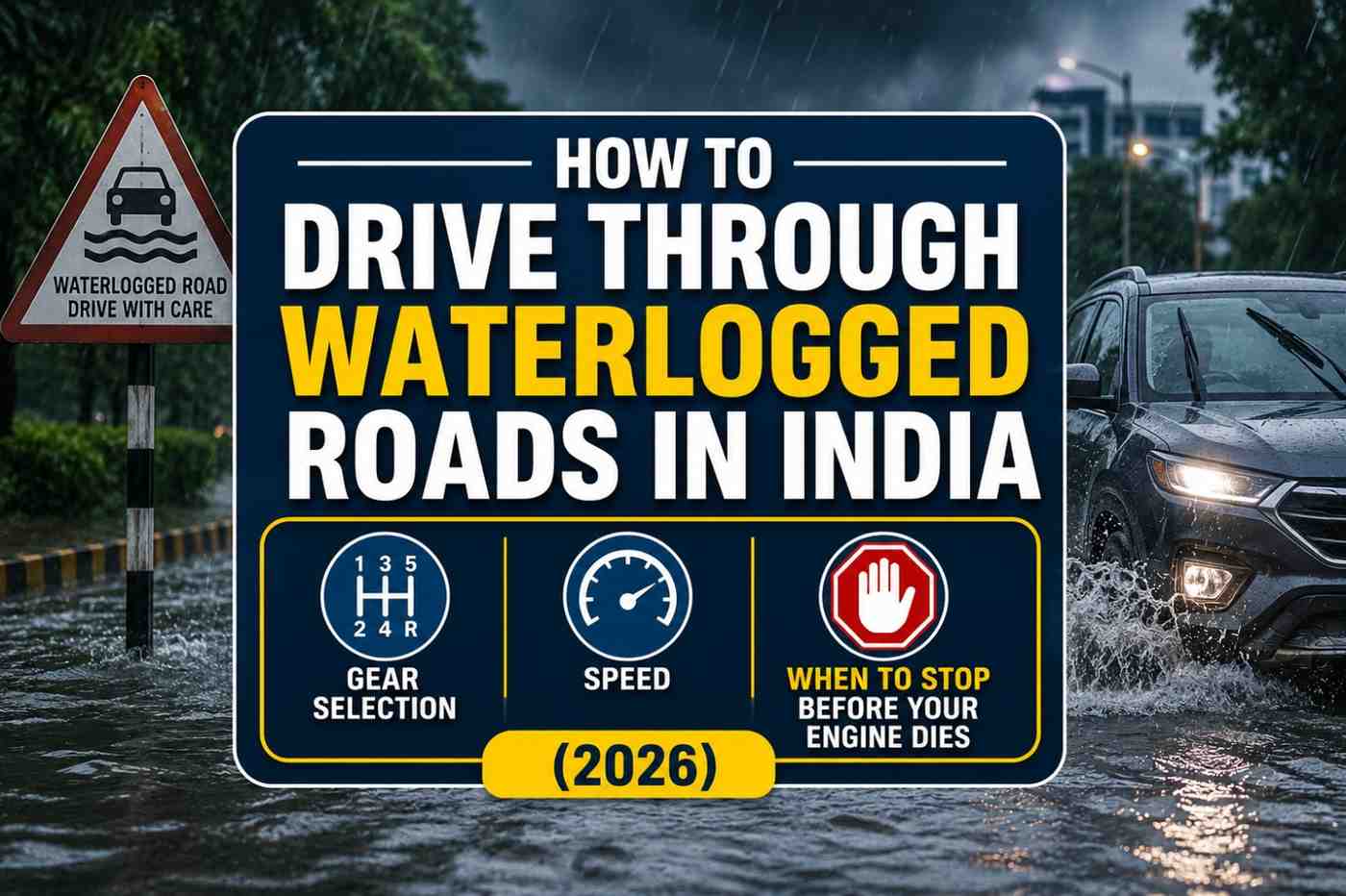
Every Indian monsoon season, thousands of cars are damaged by waterlogged roads — not because of unavoidable flooding, but because drivers made incorrect decisions about when to proceed and how. Knowing how to drive through waterlogged roads in India safely is the single most practically important monsoon driving skill for urban Indian car owners, particularly in cities like Mumbai, Chennai, Hyderabad, Bengaluru, and Kolkata, where street flooding is a seasonal certainty.
The consequences of getting this wrong are severe. Engine hydro-lock from water entering the intake can destroy a petrol or diesel engine in a fraction of a second—resulting in repair bills of ₹80,000–₹300,000 or, in many cases, total engine replacement. Understanding how to drive through waterlogged roads in India correctly is not just about safety—it is about protecting one of your most significant financial assets.
According to IRDAI (Insurance Regulatory and Development Authority of India), flood and waterlogging-related engine damage claims surge by 300–400% during monsoon months, with a significant proportion of claims denied because engine damage from attempted restart in flooded conditions is excluded from standard comprehensive policies. This denial scenario is entirely preventable—knowing how to drive through waterlogged roads in India correctly means knowing exactly when not to proceed.
The Critical Assessment: How to Drive Through Waterlogged Roads in India — Go or Stop?
Before attempting any flooded section, the how-to-drive-through-waterlogged-roads-in-India decision framework requires answering four questions:
Question 1 — Can you see the road surface? If water is dark, opaque, or flowing rapidly, you cannot assess depth. If yes—visible surface, shallow shimmer, other cars are passing safely—proceed with caution. If no, stop.
Question 2 — How deep is the water? The safe maximum depth for most Indian passenger cars is 25–30 cm—approximately the level of the bottom of the car’s door sills. How to drive through waterlogged roads India depth assessment: watch a pedestrian, observe how high water reaches on stationary motorcycles in the same water, or watch the wheel of a truck. Your exhaust pipe (typically 30–40 cm from the ground) and air intake (typically 40–60 cm from the ground) are the critical height markers.
Question 3 — Is the water flowing? Moving water is significantly more dangerous than still water. Even 15cm of fast-flowing water can push a car sideways or prevent steady forward progress. How to drive through waterlogged roads in India: flowing water rule: if the current is visible and strong, do not attempt to cross regardless of depth.
Question 4—Is there a safe route around? A 5-minute detour is always better than a ₹150,000 engine repair. How to drive through waterlogged roads: India’s decision-making always includes actively seeking the alternate route before attempting a flooded crossing.
The Correct Technique: How to Drive Through Waterlogged Roads India Step by Step
Step 1 — Assess From a Safe Position First
Before entering, stop and watch. Let another vehicle attempt it if present. A 30-second observation from dry ground is the most valuable step in how to drive through waterlogged roads in India—it reveals actual depth, current, and hidden obstacles.
Step 2—Engage 1st Gear (Manual) or ‘L’/’1’ Mode (Automatic)
The correct gear selection for how to drive through waterlogged roads in India is the lowest available gear. This provides maximum engine torque at minimum speed—allowing you to maintain steady, slow forward motion without stalling. Automatic drivers should use ‘L,’ ‘1,’ or ‘Manual Low’ mode to prevent automatic upshifting that would reduce engine braking and torque.
Step 3 — Enter at 5–10 km/h — No Faster
Speed is your enemy in water for two reasons: it creates a bow wave that pushes water toward the engine’s air intake, and it reduces your control if depth or current is more than expected. How to drive through waterlogged roads in India: maximum entry speed, 5–10 km/h, maintained consistently through the crossing.
Step 4—Maintain Steady Throttle—Never Stop, Never Surge
Stopping mid-water allows water to enter the exhaust pipe and potentially backflow toward the engine. Surging forward creates a wave that splashes water into the engine bay from above. The how-to-drive-through-waterlogged-roads India throttle technique: constant, steady pressure—the same speed entering as exiting, with no variation throughout.
Step 5 — Keep Windows Slightly Ajar
If water enters the car suddenly from an unexpected deep section, sealed windows can trap you inside as the car begins to sink. Keeping windows slightly open allows rapid egress if needed. This is the safety-critical element of how to drive through waterlogged roads in India that could save your life in a worst-case scenario.
Step 6 — Exit and Immediately Dry the Brakes
After clearing the water, apply light brake pressure for 200–300 meters to dry the friction surfaces. Then test brake response gently before resuming normal speed. This post-crossing brake dry is a non-negotiable element of how to drive through waterlogged roads in the Indian technique.
Engine Air Intake Locations: Know Your Car’s Vulnerability
| Car Type | Typical Air Intake Height | Safe Water Depth |
|---|---|---|
| Small hatchback (Swift, i10) | 45–55cm | Max 25cm |
| Compact sedans (Dzire, Amaze) | 45–60 cm | Max 25cm |
| Compact SUV (Nexon, Venue) | 55–70cm | Max 35cm |
| Full SUV (Creta, Harrier) | 65–80 cm | Max 40cm |
| Premium SUVs (Fortuner, Endeavour) | 75–90 cm | Max 45cm |
Safe depth is approximately 50–55% of intake height—maintaining a safety margin above intake level.
The intake height figures are the most important numbers in how to drive through waterlogged roads: India vehicle-specific guidance. If water approaches these levels, stop immediately.
What to Do If Your Engine Dies in Water
If the engine stalls mid-flooding, the how to drive through waterlogged roads India emergency protocol is:
- Do NOT attempt to restart. One crank with water in the cylinders can bend connecting rods and topple the engine.
- Assess your immediate safety. Is water rising? Is the current strong? Can you exit safely on foot?
- Exit the vehicle if water is rising. Move to the nearest elevated, safe position.
- Call recovery assistance. The car will need to be towed out and inspected before any restart attempt.
- Document everything for insurance. Photographs before any recovery attempt are critical for flood damage claims.
Frequently Asked Questions
Q1. Can diesel cars handle deeper water than petrol cars? No significant difference at equivalent air intake heights. The critical factor in how to drive through waterlogged roads India is always taking height relative to water depth—not fuel type. Both petrol and diesel engines hydrolock equally catastrophically when water enters the combustion chamber.
Q2. Does a higher-ground-clearance SUV make waterlogged roads safe? Higher ground clearance raises the intake height and provides more depth tolerance. However, how to drive through waterlogged roads in India in an SUV still requires the same assessment discipline—a Fortuner with 220 mm clearance will still hydrolock if water reaches its intake at approximately 60–70 cm.
Q3. Is it safe to restart a car after it stalls in water? Only if the stall was caused by wheelspin or electrical fault—not water ingestion. If there is any possibility water entered the intake (engine suddenly stopped mid-water or unusual sound before stopping), how to drive through waterlogged roads The Indian protocol is absolute: do not restart without a mechanic inspection.
Q4. What is the cost of engine hydro-lock repair in India? Depending on the extent of damage, engine repair after hydro-lock costs ₹80,000–₹300,000+ in India. Many cases require complete engine replacement. Standard comprehensive insurance may not cover this if the owner attempted to restart in flood conditions—making how to drive through waterlogged roads in India knowledge a direct financial protection.
Q5. Should I follow a truck through flooded water? Following a large truck through water gives useful depth information — but trucks have significantly higher intakes and greater momentum than passenger cars. How to drive through waterlogged roads in India: truck-following caution: even if a truck clears a section, the depth may still exceed your car’s safe intake height. Always apply the intake height calculation for your specific vehicle.
Conclusion
How to drive through waterlogged roads in India safely is a skill that combines assessment, technique, and restraint. The assessment — go or stop — is the most important decision. The technique—1st gear, 5–10 km/h, steady throttle, windows cracked—protects your engine and your safety if you proceed. And the restraint — knowing when no amount of technique makes a flooded road safe to cross — is what ultimately prevents the engine-destroying, insurance-rejecting mistakes that cost Indian drivers crores of rupees every monsoon season.
Know your car’s intake height. Know the depth rules. And remember: the detour is always faster than the repair shop.