 admin@prodriver.in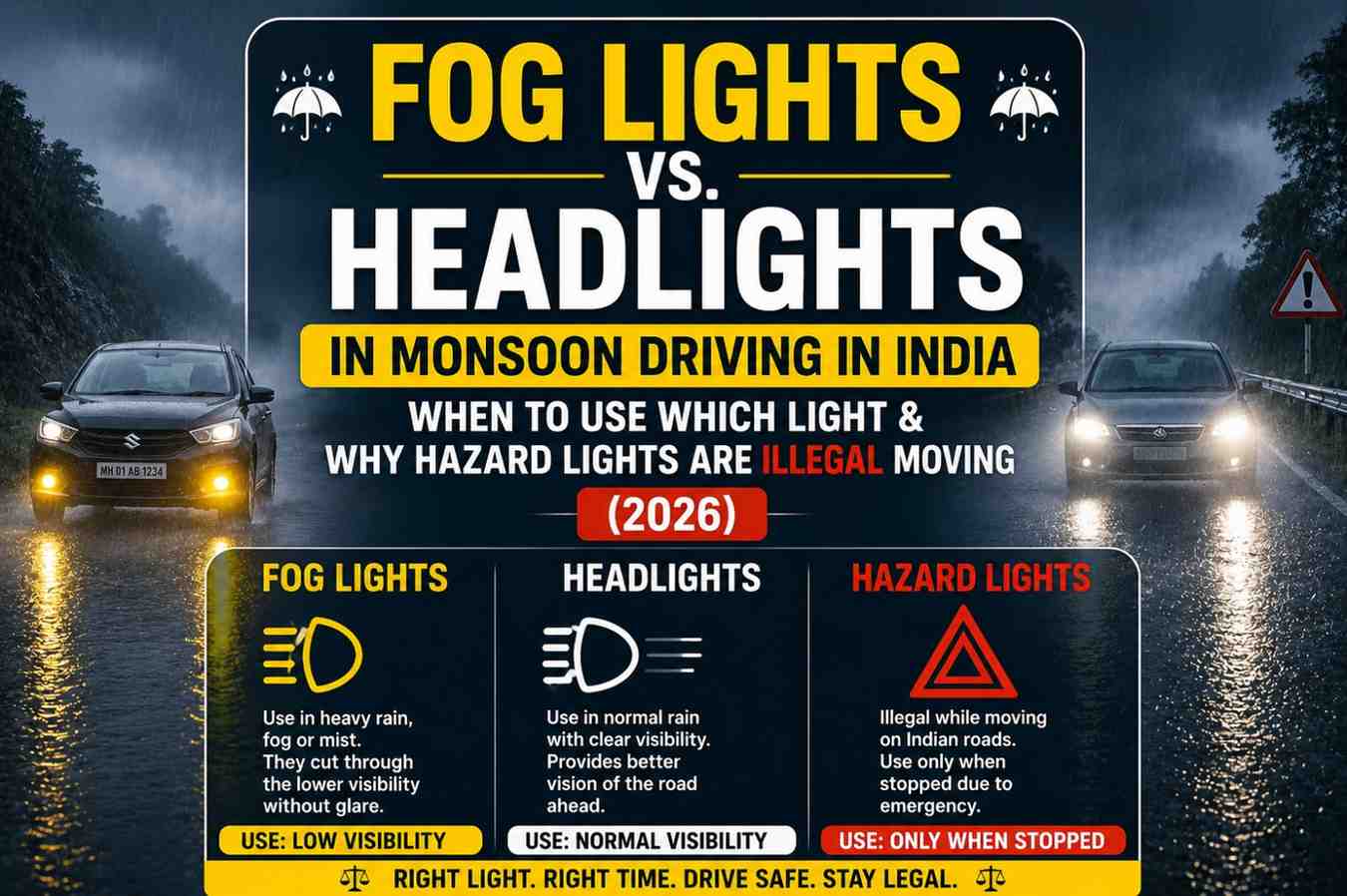
Every monsoon season in India, a well-intentioned but incorrect driving behavior spreads across the country’s roads: drivers activating hazard lights while driving in heavy rain, believing they are increasing visibility and safety. In reality, fog lights vs. headlights in monsoon driving knowledge makes clear that hazard lights while moving are illegal, dangerous, and the opposite of helpful in most monsoon driving situations. This guide tells you exactly which light to use in every monsoon condition—and why.
The fog lights vs. headlights in monsoon driving in India question matters because different lights serve fundamentally different optical purposes. Headlights illuminate the road ahead for the driver. Fog lights cut through precipitation at low angles to improve forward visibility in dense conditions. Hazard lights warn stationary vehicles of a stopped obstacle. Using the wrong light in the wrong condition reduces both your ability to see and other drivers’ ability to understand your intentions—which in monsoon traffic is potentially fatal.
Understanding fog lights vs. headlights in monsoon driving in India is also a legal matter. The Central Motor Vehicles Rules 1989, as amended, define specific lighting requirements and prohibitions. Violations are cognizable offenses under the MV Act with penalties that are increasingly enforced by state traffic police in 2026.
The Legal Framework: Fog Lights vs Headlights in Monsoon Driving India
What Indian Law Says About Headlights in Rain
Rule 11 of the Central Motor Vehicles Rules requires headlights to be used whenever visibility is reduced due to weather conditions—including rain. Fog lights vs. headlights in monsoon driving in India: legal requirement: headlights (dipped beam) must be ON in rain, not DRLs (daytime running lights) alone. DRLs are not a legal substitute for headlights in reduced visibility.
What Indian Law Says About Fog Lights
Fog lights are legal to use only when visibility is substantially reduced—generally interpreted as below 100 meters in rain, mist, or fog. Using front fog lights in clear conditions or light drizzle (when visibility exceeds 200 meters) is technically an offense under the MV Act in several states. Fog lights vs. headlights in monsoon driving in India: fog light rule: reserved for genuinely poor visibility conditions, not as a cosmetic addition to headlights in normal rain.
What Indian Law Says About Hazard Lights While Moving
Using hazard (four-way flasher) lights while a vehicle is in motion is prohibited under Rule 11(1) of the Central Motor Vehicles Rules, except in specific emergency situations (broken down or at an accident scene). Hazard lights while moving are illegal because they:
- Disable the indicator function—removing your ability to signal turns or lane changes
- Create ambiguity about vehicle intent for following drivers
- In heavy rain, the flashing pattern can be confused with emergency vehicles
Fog lights vs. headlights monsoon driving India hazard light rule: turn them off immediately if you are driving. Hazard lights are only for stationary vehicles, indicating a breakdown or obstruction.
The Practical Guide: Fog Lights vs Headlights in Monsoon Driving India by Condition
Condition 1 — Light Drizzle (Visibility 300m+)
Use: Headlights (dipped beam) ON. Wipers on intermittent. Do not use: Fog lights (unnecessary and illegal in some states at this visibility) and hazard lights. Fog lights vs. headlights in monsoon driving in India: light choice in light rain: headlights only.
Condition 2 — Moderate Rain (Visibility 100–300m)
Use: Headlights (dipped beam) ON. Wipers on continuous. Speed reduced. Fog lights: Optional — front fog lights add useful supplemental road illumination at road level. The rear fog light should remain off unless following traffic cannot see you. Fog lights vs. headlights in monsoon driving in India: light choice in moderate rain: headlights on, front fog lights optional, rear fog light off unless necessary.
Condition 3 — Heavy Rain (Visibility 50–100m)
Use: Headlights (dipped beam) ON. Both front fog lights are ON. Speed significantly reduced. Rear fog light: Consider using it if you are on a highway and following vehicles may approach at speed. Turn off in stop-and-go city traffic. Do not use: High beam (reflects off rain droplets, reduces forward visibility), hazard lights. Fog lights vs headlights monsoon driving India heavy rain lighting: dipped headlights + both fog lights = correct configuration.
Condition 4—Extremely Heavy Rain/Near-Zero Visibility (<50m)
If visibility drops below 50 meters, the fog lights vs. headlights monsoon driving expert recommendation in India is not to continue driving. Pull completely off the road to a safe position (not just the shoulder), turn on hazard lights to indicate a stationary vehicle, and wait for conditions to improve. This is the one scenario where hazard lights are both legal and correct—because you are stopped.
Condition 5 — Dense Fog (Common on North Indian Highways, October–January)
Dense fog conditions, common on NH48 (Delhi-Jaipur), NH19 (Delhi-Kolkata), and other North Indian highways in post-monsoon season, are specifically where fog lights are most critical. Fog lights vs headlights monsoon driving India in fog: dipped headlights + front fog lights + rear fog light. High beams in fog create a “white wall” effect that dramatically worsens visibility.
Why Hazard Lights While Driving Are the Most Common Monsoon Lighting Mistake
When Indian drivers use hazard lights while moving in rain, they create several simultaneous problems:
Signaling failure: Every lane change, turn, and speed change you make becomes unsignaled—invisible to following and adjacent drivers.
False emergency signal: Hazard lights indicate an emergency or breakdown. A moving car with hazards on tells following drivers that something is wrong—causing erratic following behavior.
Distraction amplification: In heavy rain, pulsing hazard lights from moving vehicles ahead become mesmerizing—reducing concentration of following drivers.
The fog lights vs. headlights monsoon driving India hazard light correction is simple: if you are moving, your hazard lights should be off. Dipped headlights with fog lights (where visibility warrants it) are the correct monsoon driving configuration.
Frequently Asked Questions
Q1. Is it illegal to use hazard lights while driving in rain in India? Yes. Under the Central Motor Vehicles Rules, hazard lights while in motion are prohibited except in specific emergency scenarios. Fog lights vs. headlights monsoon driving in India legal advice: hazard lights on a moving vehicle in rain are both illegal and create genuine safety problems for other road users.
Q2. Can I use high beams in rain for better visibility? No. High beams in rain cause backscatter—the intense beam reflects off millions of water droplets and creates a bright “wall” that reduces forward visibility. Fog lights vs. headlights in monsoon driving in India: the high beam rule is that dipped headlights are always superior to high beams in any precipitation condition.
Q3. My car has DRLs — are these sufficient in rain? No. DRLs are low-intensity lights designed for daytime use in clear conditions. They do not provide sufficient illumination in reduced-visibility rain conditions and are not a legal substitute for headlights under the Indian Motor Vehicles Rules. Fog lights vs headlights monsoon driving India DRL guidance: DRLs are on, but switch headlights ON additionally whenever it rains.
Q4. When should I use the rear fog light? The rear fog light (a single red light, significantly brighter than tail lights) should be used only when following drivers cannot clearly see your vehicle—typically when visibility drops below 100 meters. Fog lights vs headlights monsoon driving India’s rear fog rule: in city stop-start monsoon traffic, the rear fog light is generally unnecessary and can dazzle following drivers in slow traffic. Use on highways in heavy rain or fog.
Q5. Are yellow fog lights better than white in Indian monsoon rain? Yellow light has a slightly longer wavelength that theoretically penetrates water droplets better than white light. However, the difference in modern high-intensity LED fog lights is marginal. Fog lights vs. headlights in monsoon driving in India: The quality and positioning of the fog light matter far more than its color temperature—a well-aimed white LED fog light outperforms a poorly aimed yellow halogen in every real-world scenario.
Conclusion
The fog lights vs. headlights monsoon driving in India question has clear, legally grounded answers. In rain: headlights on always, fog lights in reduced visibility, rear fog light on the highway in heavy rain, and hazard lights never while moving. These are not suggestions — they are traffic law requirements and physics-based safety practices.
The single most impactful change most Indian drivers can make for fog lights vs. headlights in monsoon driving in India is simply turning off hazard lights while driving in rain and replacing them with correct headlight and fog light use. This one habit change improves your own visibility, restores your signaling function, and removes a source of confusion and distraction from every driver behind you. It costs nothing and takes one second.