 admin@prodriver.in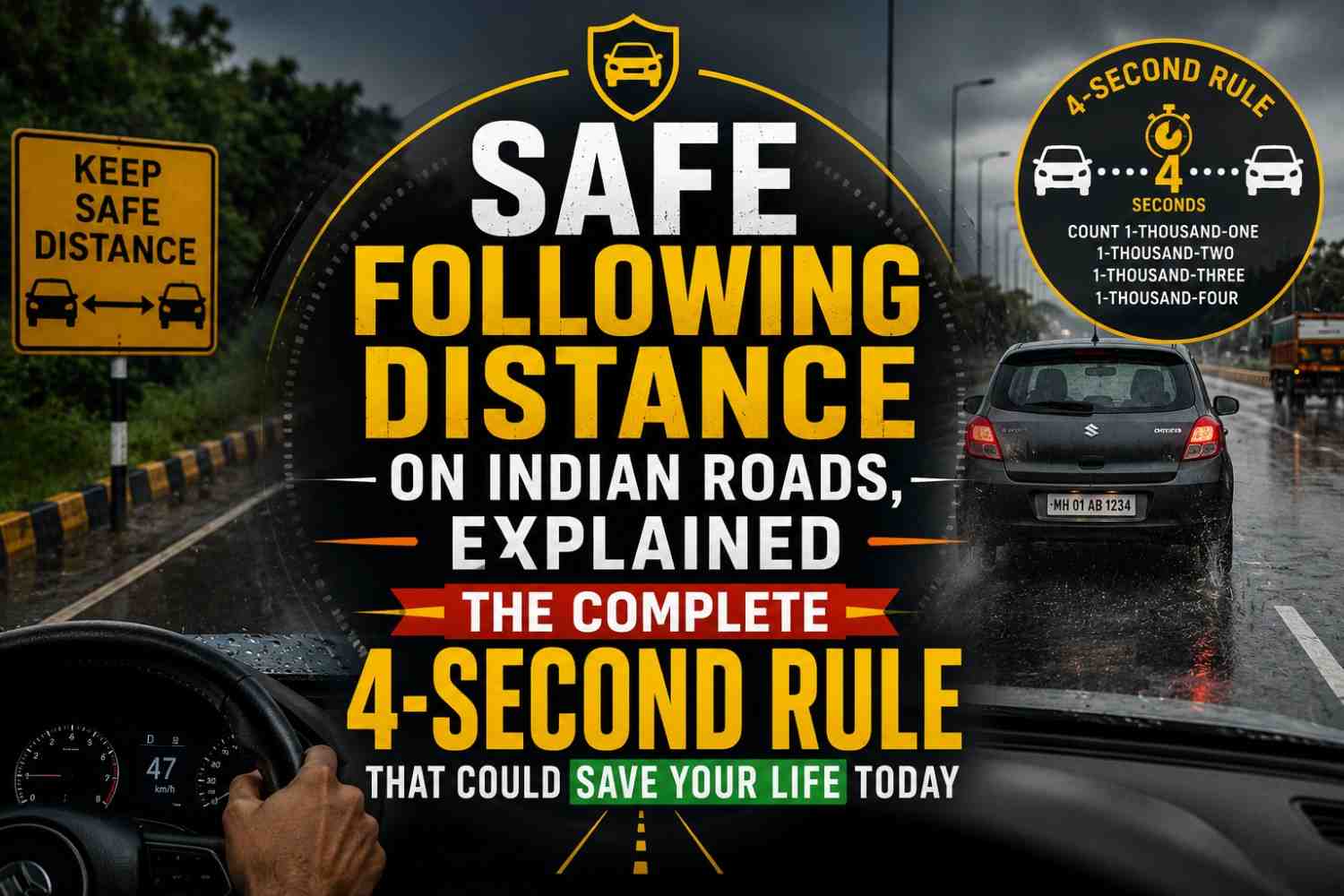
Ask any traffic police officer about the most common mistake they see Indian drivers making every single day, and the answer is almost universal: tailgating—following the vehicle ahead far too closely. Safe following distance on Indian roads, explained properly, is one of the simplest yet most ignored principles of road safety—and consistently applying it could prevent a significant proportion of India’s 5.5 lakh annual road accidents.
Safe following distance on Indian roads, explained, isn’t just a traffic rule. It is a physics equation. At any given speed, your vehicle requires a certain distance to stop — and if the distance between you and the vehicle ahead is less than your stopping distance, a rear-end collision is the only possible outcome the moment that vehicle brakes hard.
This complete guide to safe following distance on Indian roads explains the science of stopping distances, the 4-second rule for Indian roads, how following distance must adapt to different conditions, what tailgating does to your risk profile, and the legal consequences of following too closely.
Why Following Distance Is Critical on Indian Roads
Safe following distance on Indian roads, explained, must begin with why this principle matters so much in the Indian context specifically.
Indian roads present unique challenges that make adequate following distance more critical here than in many other countries.
- Sudden braking is common: Potholes, stray animals, auto-rickshaws stopping without warning, and pedestrians stepping into traffic all create sudden braking scenarios
- Road quality is variable: A smooth highway can suddenly transition to a potholed stretch with no warning
- Two-wheelers move unpredictably: Motorcycles and scooters can brake faster and more suddenly than cars, often without visible brake lights
- Mixed traffic: Vehicles of vastly different speeds and braking capabilities share the same lanes
- Night hazards: Unlit vehicles, cattle on roads, and poor road markings create sudden obstacles after dark
Each of these factors means that safe following distance on Indian roads, explained, requires a larger margin than the basic rules might suggest.
The Physics of Stopping Distance
Safe following distance on Indian roads explained with physics makes the necessity undeniable.
Total stopping distance = Reaction Distance + Braking Distance
Reaction Distance: The distance your vehicle travels during the time your brain recognizes a hazard and your foot reaches the brake.
At normal alertness, human reaction time is 0.7–1.0 seconds.
- At 50 km/h (city speed): Reaction distance = 14–17 metres
- At 80 km/h (state highway): Reaction distance = 22–27 metres
- At 100 km/h (national highway): Reaction distance = 28–33 metres
Braking Distance: The distance required to stop once the brakes are applied.
| Speed | Dry Road Braking Distance | Wet Road Braking Distance |
|---|---|---|
| 50 km/h | 14–17 metres | 28–35 metres |
| 80 km/h | 36–44 metres | 72–88 metres |
| 100 km/h | 55–67 metres | 110–134 metres |
| 120 km/h | 80–96 metres | 160–192 metres |
Total Stopping Distance (Dry Road):
- 50 km/h: ~31–34 metres
- 80 km/h: ~59–71 metres
- 100 km/h: ~83–100 metres
This is why safe following distance on Indian roads, explained properly, requires more gap than most drivers assume. The vehicle ahead of you can stop in less than half the distance it takes you to even react.
The 4-Second Rule: Safe Following Distance on Indian Roads Explained
The most practical method for maintaining a safe following distance on Indian roads, explained in real driving conditions, is the 4-second rule.
How to apply the 4-second rule:
- Watch the vehicle ahead pass a fixed point—a road sign, a shadow line, a tree, a kilometre marker
- Begin counting: “one thousand one, one thousand two, one thousand three, one thousand four.”
- If your vehicle reaches that same fixed point before you finish counting, you are following too closely
- Create more distance and check again
Why 4 seconds specifically?
The 4-second rule for safe following distance on Indian roads explained provides the following:
- 1.0 seconds of reaction time (average for an alert driver)
- 3.0 seconds of braking time (adequate stopping distance at most speeds)
- A small margin of error for road surface variation
Adjustments for conditions:
| Condition | Minimum Following Gap |
|---|---|
| Dry road, good visibility | 4 seconds |
| Light rain | 6 seconds |
| Heavy monsoon rain | 8 seconds |
| Fog or night without street lights | 8–10 seconds |
| Gravel or unpaved road | 6 seconds |
| Following a truck or bus | 5–6 seconds (larger stopping distance required) |
| Tyres worn or old vehicle | 5–6 seconds (longer braking distance) |
[IMAGE 1 — Place after 4-second rule section]
Suggested Image: A road illustration showing the 4-second rule in action — a car on an Indian highway with the vehicle ahead passing a road sign, the driver counting, and markers showing the distance covered in 1, 2, 3, and 4 seconds at 80 km/h — with labels showing reaction distance and braking distance components. ALT Text: “Safe following distance on Indian roads explained—road illustration showing 4-second rule with distance markers at 80 km/h, reaction distance, and braking distance clearly labeled.”
The Danger of Tailgating
Safe following distance on Indian roads explained must include a clear description of what tailgating actually does to your risk:
Tailgating at 80 km/h: Following just 1 second behind the vehicle ahead at 80 km/h means you are 22 meters away. Total stopping distance at 80 km/h on a dry road is approximately 65–70 meters. You are following at roughly one-third of the distance needed to stop. In any sudden braking scenario, you will hit the vehicle ahead. This is not a possibility — it is a certainty.
Tailgating as Aggression: Tailgating is also commonly used as a form of road pressure—following so closely to encourage the vehicle ahead to move over or speed up. This is extremely dangerous because the following are true:
- It eliminates the tailgater’s stopping distance
- It creates anxiety for the driver ahead who may brake suddenly
- It is a traffic offence (following too closely) under the Motor Vehicles Act
- It is a form of road rage that escalates confrontations
Tailgating and Trucks: Tailgating a truck or bus creates an additional specific hazard—the underride scenario, where a car following too closely slides beneath the truck’s chassis in a rear-end collision. At speeds above 60 km/h, this is typically fatal for car occupants.
How Following Distance Changes in Different Indian Road Scenarios
Safe following distance on Indian roads is explained for different environments:
City Traffic (Stop-and-Go)
In slow city traffic, the 4-second rule may seem excessive—but a modified version applies. Maintain at least one car length per 10 km/h of speed.
- At 20 km/h: 2 car lengths (~10 metres)
- At 40 km/h: 4 car lengths (~20 metres)
- At 60 km/h: 6 car lengths (~30 metres)
National Highway Following Distance
Safe following distance on Indian roads, explained for highway driving, requires the full 4-second minimum—and 6 seconds when following trucks, buses, or during monsoon.
Highway following is particularly critical because speeds are high and the consequences of insufficient distance are severe.
Mountain Roads
On ghat roads and mountain highways—common in states like Himachal Pradesh, Uttarakhand, Kerala, and Maharashtra—increase following distance to 6–8 seconds. Steep downhill grades significantly increase braking distance, hairpin curves reduce visibility, and the road may be wet or gravelled.
Following After Being Overtaken
When a vehicle overtakes you and pulls back into your lane, maintain awareness of the gap that is created—it may be insufficient. Gently reduce speed to re-establish the 4-second gap without sudden braking.
Legal Position on Following Distance in India
Safe following distance on Indian roads explained in a legal context:
The Motor Vehicles Act specifies that drivers must maintain a “safe distance” from the vehicle ahead—though it does not define a specific number in all scenarios. However:
- Following too closely is cited as a contributing factor in rear-end collision cases
- If you hit a vehicle from behind, Indian traffic law generally presumes the following vehicle is at fault
- Insurance claims for rear-end accidents caused by tailgating are treated as at-fault claims
- If rear-end collision causes death, IPC Section 304A applies (culpable homicide not amounting to murder)—up to 2 years imprisonment
The simplest legal protection in any vehicle following scenario: maintain an adequate safe following distance on Indian roads, as explained in full, and document it through dashcam footage if an incident occurs.
[IMAGE 2 — Place before FAQs]
Suggested Image: A vertical comparison chart showing stopping distances at 50, 80, 100, and 120 km/h on dry vs. wet roads—drawn as colored road strips of proportional length with the car icon at one end and a stop marker at the other, making the distance difference visually dramatic. ALT Text: “Safe following distance on Indian roads explained—stopping distance comparison chart at 50, 80, 100, and 120 km/h on dry vs wet road surfaces.”
FAQs: Safe Following Distance on Indian Roads Explained
Q1: What is the safe following distance on Indian roads explained for city driving? A: In city stop-and-go traffic, maintain at least one car length per 10 km/h of speed. At 40 km/h, that’s approximately 4 car lengths (20 metres). At 60 km/h, approximately 6 car lengths (30 metres). In fast-moving city traffic, apply the full 4-second rule.
Q2: How does safe following distance on Indian roads explain the change in heavy rain? A: Double your following distance in rain — use a 6–8 second gap instead of 4 seconds. Wet roads increase braking distance by approximately 2–3 times, and water spray from large vehicles severely reduces visibility. Monsoon conditions demand a significantly larger safety margin.
Q3: Is safe following distance on Indian roads explained differently for two-wheelers vs. cars? A: Two-wheelers generally have shorter braking distances than cars (lighter vehicle, good brake-to-weight ratio). However, they are far more vulnerable in any collision — which means maintaining adequate following distance behind a two-wheeler is equally important. Two-wheelers can also brake more suddenly and come to a stop faster than cars.
Q4: What is the legal consequence of not maintaining safe following distance on Indian roads explained? A: While a specific meter distance is not universally mandated in the Motor Vehicles Act, following too closely (tailgating) is a recognized traffic offense. In a rear-end accident caused by insufficient following distance, the following vehicle’s driver is typically held legally at fault, with potential IPC charges if injury or death results.
Q5: How does the 4-second rule in safe following distance on Indian roads, as explained, compare to the 3-second rule used internationally? A: Many international guidelines use a 3-second following distance, established for roads with better quality, more consistent driving behavior, and generally better-maintained vehicles. India’s road conditions — sudden potholes, mixed traffic, unpredictable stops, and monsoon roads — justify the 4-second minimum, with increases to 6–8 seconds in adverse conditions.
Conclusion
Safe following distance on Indian roads, explained through the lens of physics, law, and Indian road conditions, leads to one unambiguous conclusion: most Indian drivers follow too closely, most of the time. This single behavior is a major contributor to India’s rear-end collision statistics.
The 4-second rule is not a sophisticated technique — it takes seconds to learn and seconds to apply. But a safe following distance on Indian roads, explained and consistently practiced, has the power to prevent thousands of accidents annually. Every four-second gap you maintain is a life-saving decision made before the emergency ever happens.
Practice the 4-second rule on your very next drive—and make it a habit you maintain for every kilometer you drive for the rest of your life.
External Links
- https://morth.nic.in/road-accident-in-india — MoRTH: India Road Accident Statistics
- https://roadsafety.transport.nsw.gov.au/driving-safely/following-distance — NSW Roads: Following Distance Guide
- https://www.nhtsa.gov/driving-safety/distracted-driving — NHTSA: Following Distance Research
- https://parivahan.gov.in — Parivahan: Motor Vehicles Act India
- https://www.who.int/roadsafety — WHO: Global Road Safety Speed Management