 admin@prodriver.in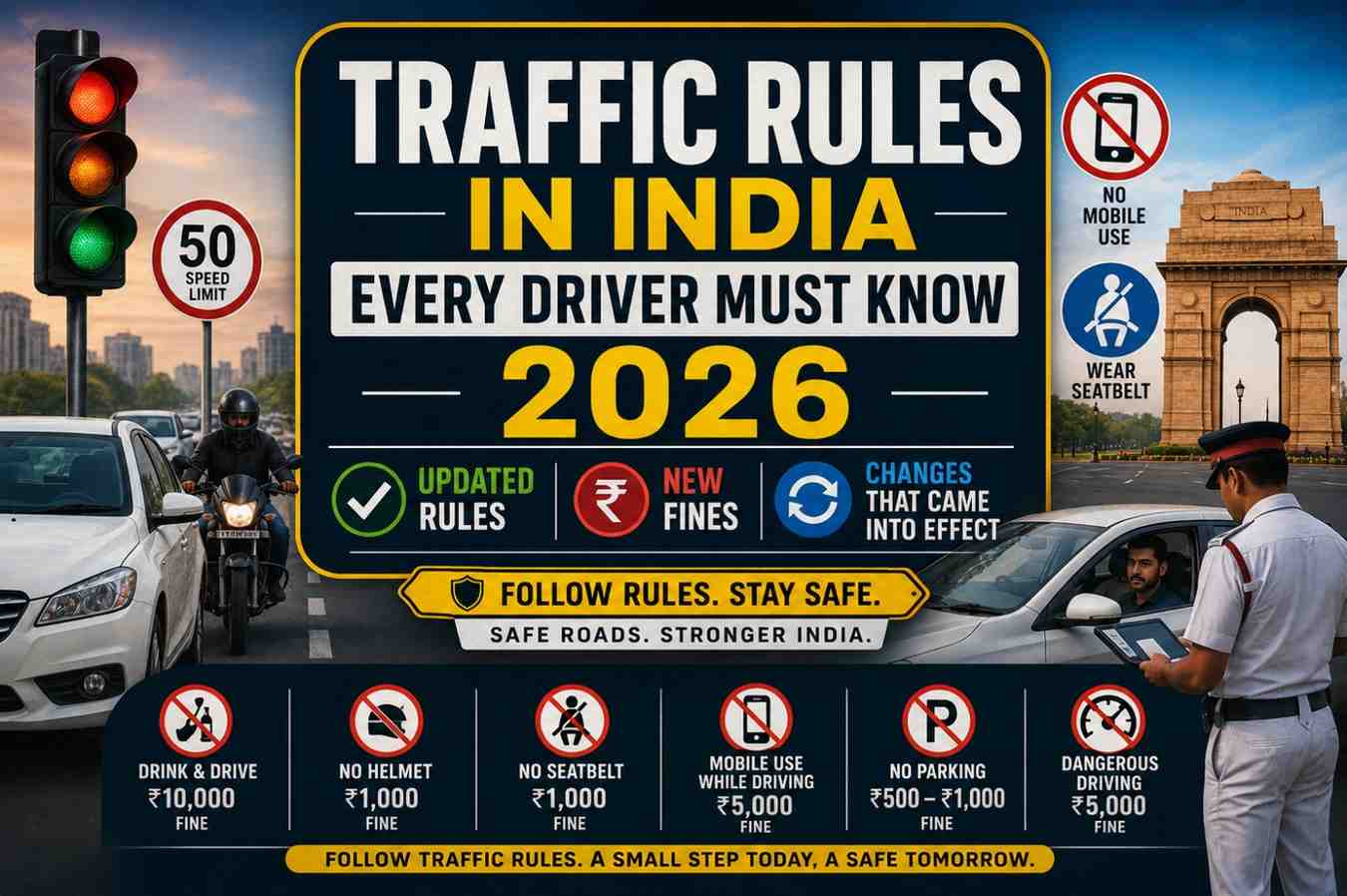
India’s traffic laws have undergone significant evolution since the landmark Motor Vehicles (Amendment) Act 2019. The traffic rules in India every driver must know in 2026 are not the same rules that were taught in driving schools five years ago. Fines have increased dramatically. New offenses have been added. AI enforcement has made evasion far more difficult. And the legal framework now holds drivers—and in many cases, vehicle owners—to a higher standard of accountability than ever before.
Ignorance of the law is not a valid defense in any Indian traffic court. The traffic rules in India every driver must know in 2026 apply to every license holder on every road, regardless of when they learned to drive or how long they’ve been driving. This complete guide covers every major traffic rule, updated fine, new enforcement mechanism, and legal change that Indian drivers need to know in 2026.
Why Traffic Rules Changed — The 2019 Amendment Context
Any discussion of traffic rules in India every driver must know in 2026 must acknowledge that the Motor Vehicles (Amendment) Act 2019 was the most significant overhaul of Indian traffic law in decades.
The trigger was India’s road safety crisis.
- Over 1.5 lakh deaths per year (at the time of the amendment)
- Extremely low fine levels that created no real deterrent
- Rampant license fraud—millions of license holders who had never actually been tested
- Near-zero enforcement of seatbelt, speed limit, and DUI laws
The 2019 amendment addressed all of these—multiplying fines by 5–10 times, introducing stricter license testing, creating corporate liability for defective vehicles, and mandating electronic enforcement systems.
Speed Limits: Core Traffic Rules Every Indian Driver Must Know 2026
Updated 2026 speed limits by road type:
| Road Type | Cars/Motorcycles | Buses/Trucks | School Zones |
|---|---|---|---|
| Urban/City Roads | 50 km/h | 40 km/h | 25 km/h |
| State Highways | 100 km/h | 80 km/h | 25 km/h |
| National Highways (4-lane) | 120 km/h | 100 km/h | 25 km/h |
| Expressways | 120 km/h (cars), 100 km/h (motorcycles) | 80 km/h | N/A |
Overspeeding fines (2026):
- Light vehicles (LMV): ₹1,000–₹2,000 (first offence), ₹2,000–₹4,000 (repeat)
- Heavy vehicles: ₹2,000–₹4,000
- Speed camera-detected violations: E-challan issued to registered owner’s mobile
Comprehensive Fine Schedule: Traffic Rules India Every Driver Must Know 2026
| Violation | Fine Amount | Additional Consequences |
|---|---|---|
| Driving without a license | ₹5,000 | Vehicle seized, criminal proceedings |
| Driving without insurance | ₹2,000 (first), ₹4,000 (repeat) | Vehicle seizure possible |
| Driving without registration | ₹5,000 | Vehicle impoundment |
| Driving without PUC certificate | ₹10,000 | Vehicle seized |
| Overspeeding | ₹1,000–₹4,000 | License suspension (repeat) |
| Dangerous driving | ₹5,000 | 6 months imprisonment |
| Drunk driving (DUI) | ₹10,000 / 6 months jail (first) | 2 years jail (repeat) |
| Mobile phone use while driving | ₹5,000 | License suspension |
| Not wearing seatbelt | ₹1,000 | — |
| Not wearing helmet (motorcycle) | ₹1,000 | 3-month license suspension |
| Jumping red light | ₹1,000–₹5,000 | 3 month suspension (repeat) |
| Wrong-side driving | ₹1,000–₹5,000 | — |
| Blocking emergency vehicles | ₹10,000 | Possible prosecution |
| Using tinted glass (illegal) | ₹500–₹1,500 | Glass removal ordered |
| Overloading passengers | ₹1,000 per extra passenger | — |
| No child restraint for under 4 | ₹1,000 | — |
| Noise pollution (horn in silent zones) | ₹1,000 | — |
These fines represent the traffic rules India’s every driver must know in the 2026 compliance framework—and they are actively enforced through AI cameras, mobile enforcement teams, and e-challan systems.
E-Challan System: How Digital Enforcement Changed Traffic Rules India Every Driver Must Know 2026
One of the most significant practical changes in traffic rules in India every driver must know in 2026 is the e-challan system, now operational in all major Indian cities and on major national highways.
How e-challans work:
- AI cameras capture traffic violations automatically (red-light jumping, overspeeding, no seatbelt, phone use, illegal parking)
- The camera reads the vehicle’s registration plate using ANPR (Automatic Number Plate Recognition)
- A challan is generated and sent to the registered owner’s address and linked mobile number via SMS
- Payment can be made at parivahan.gov.in or at the traffic court
Key e-challan facts for traffic rules in India every driver must know in 2026:
- Unpaid e-challans accumulate and can block vehicle renewal and transfer
- Outstanding challans are visible to police at check posts via the Vahan database
- In several states, unpaid challans result in automatic registration suspension
[IMAGE 1 — Place after e-challan section]
Suggested Image: A clean infographic showing the e-challan process flow — ANPR camera captures violation → vehicle plate read → challan generated → SMS to registered mobile → online payment at parivahan.gov.in — with each step as an icon in a horizontal flow diagram. ALT Text: “Traffic rules India every driver must know 2026—e-challan process flow infographic showing AI camera, ANPR plate reading, challan generation, SMS notification, and online payment steps”
Document Requirements: Traffic Rules India Every Driver Must Know, 2026
Documents every driver must carry (or have accessible digitally):
Physical or Digital (DigiLocker/mParivahan app):
- Driving License (DL)
- Vehicle Registration Certificate (RC)
- Certificate of Insurance
- Pollution Under Control (PUC) Certificate
DigiLocker and mParivahan: A critical update to traffic rules in India every driver must know 2026: the Supreme Court of India has confirmed that digital documents stored in DigiLocker and mParivahan are legally valid and must be accepted by traffic police. You are NOT required to carry physical documents if digital versions are available.
Validity:
- Driving license: Valid for 20 years or age 50 (whichever is first), then renewable
- PUC certificate: Valid for 6 months (petrol/diesel vehicles) or 1 year (CNG vehicles)
Key Traffic Rules Specific to 2026 Updates
1. Bharat NCAP Safety Ratings (2026 Update) New passenger vehicles must now display Bharat NCAP safety ratings. Vehicles with less than 3-star NCAP ratings manufactured after January 2026 require additional safety disclosures. This is a regulatory update within traffic rules in India that every driver must know in 2026.
2. OBD-II Compliance All new vehicles from April 2025 onward require OBD-II (On-Board Diagnostics) compliance—a system that allows traffic enforcement devices to directly read vehicle emission and fault data at checkpoints.
3. Enhanced Drunk-Driving Enforcement In 2026, breathalyzer tests are being conducted using sealed, hygienic mouthpiece systems to prevent refusal on hygiene grounds. Refusing a breathalyzer test is itself a traffic offense under updated traffic rules in India; every driver must know the 2026 provisions—treated as equivalent to a positive DUI test.
4. Tinted Glass Rules (Updated) The Supreme Court’s tinted glass ban remains fully in force. The only permissible factory-fitted tinting is within VLT (Visible Light Transmission) standards: a minimum of 70% for the front windshield and a minimum of 50% for the sides and rear. Aftermarket films below these standards are illegal and subject to fine and removal.
5. Mandatory Dashcam for Commercial Vehicles From 2025, all commercial vehicles (trucks, buses, and school vans) must have dashcams installed. In 2026, this is being actively enforced at RTO inspections.
Right of Way Rules: Traffic Rules India Every Driver Must Know 2026
Right-of-way rules are among the most frequently misunderstood traffic rules. India: Every driver must know 2026:
- Emergency vehicles always have absolute right of way—ambulance, fire truck, and police vehicle with sirens/lights active. Failure to yield is a ₹10,000 offense.
- Pedestrians on zebra crossings have right of way over all vehicles
- Vehicles on main roads have right of way over vehicles entering from side roads
- Vehicles already inside roundabouts have right of way over entering vehicles
- School buses with stop signs extended have right of way—overtaking a stationary school bus is a serious offense.
[IMAGE 2 — Place before FAQs]
Suggested Image: A comprehensive fine table infographic displaying the 15 most common traffic violations in India with their fine amounts in large, color-coded text—red for severe (₹10,000), orange for serious (₹5,000), yellow for moderate (₹2,000), and green for minor (₹1,000)—in a clean card layout. ALT Text: “Traffic rules India every driver must know 2026—color-coded fine table infographic showing 15 common violations and their penalty amounts from ₹1,000 to ₹10,000”
FAQs: Traffic Rules India Every Driver Must Know 2026
Q1: What are the highest-fine traffic rules in India every driver must know in 2026? A: The highest fines apply to drunk driving (₹10,000 first offense), blocking emergency vehicles (₹10,000), driving without a PUC (₹10,000), and causing accidents due to negligence (up to ₹100,000). Mobile phone use (₹5,000), driving without a license (₹5,000), and dangerous driving (₹5,000) are the next tier.
Q2: Are digital documents valid under traffic rules in India? Every driver must know 2026. A: Yes. The Supreme Court of India has confirmed that digital documents in DigiLocker and the mParivahan app are legally valid. Traffic police must accept them. Physical documents are no longer mandatory if digital versions are available and accessible.
Q3: How does the e-challan system work under traffic rules in India? Every driver must know in 2026. A: AI cameras capture violations, read number plates via ANPR, and automatically generate challans linked to the registered owner’s details. Challans are sent by SMS and post. Payment is made at parivahan.gov.in. Unpaid challans accumulate and can block vehicle renewal.
Q4: Can I be fined for a passenger’s behavior under traffic rules in India? Every driver must know 2026. A: Yes. The driver/owner is responsible for ensuring all passengers wear seatbelts (₹1,000 per unbelted rear passenger), that children under 4 are in appropriate restraints, and that no passenger overloading occurs (₹1,000 per extra passenger).
Q5: What are the new motorcycle-specific traffic rules in India every driver must know in 2026? A: A helmet is mandatory for both the rider and the pillion passenger (₹1,000 fine + 3-month license suspension for non-compliance). The speed limit for motorcycles on expressways is 100 km/h (lower than cars at 120). A maximum of 2 persons are allowed on a motorcycle; carrying children on a motorcycle requires them to wear appropriate helmets.
Conclusion
Traffic rules in India: every driver must know 2026 represents a legal framework that is more comprehensive, better enforced, and more consequential than at any previous point in Indian history. The combination of dramatically higher fines, AI-powered cameras, e-challan systems, and DigiLocker integration has created a traffic law environment where non-compliance is increasingly difficult to evade and increasingly expensive to ignore.
The best response to traffic rules India every driver must know in 2026 is not to memorize the fines—it’s to drive in a way where you never encounter them. Speed discipline, seatbelt use, no mobile phone use, and carrying valid documents cover the vast majority of all traffic violations.
Download the mParivahan app today, upload your documents to DigiLocker, check your outstanding challans at parivahan.gov.in, and commit to full compliance with every traffic rule on every drive.
External Links
- https://parivahan.gov.in — Parivahan Sewa: E-Challan, Document Verification, MVA 2019
- https://morth.nic.in — Ministry of Road Transport and Highways: Official Traffic Rules
- https://digilocker.gov.in — DigiLocker: Digital Document Storage (Legal Validity)
- https://vahan.parivahan.gov.in — Vahan: Vehicle Registration and Compliance
- https://www.india.gov.in/topics/transport/road-transport — India.gov: Road Transport Regulations