 admin@prodriver.in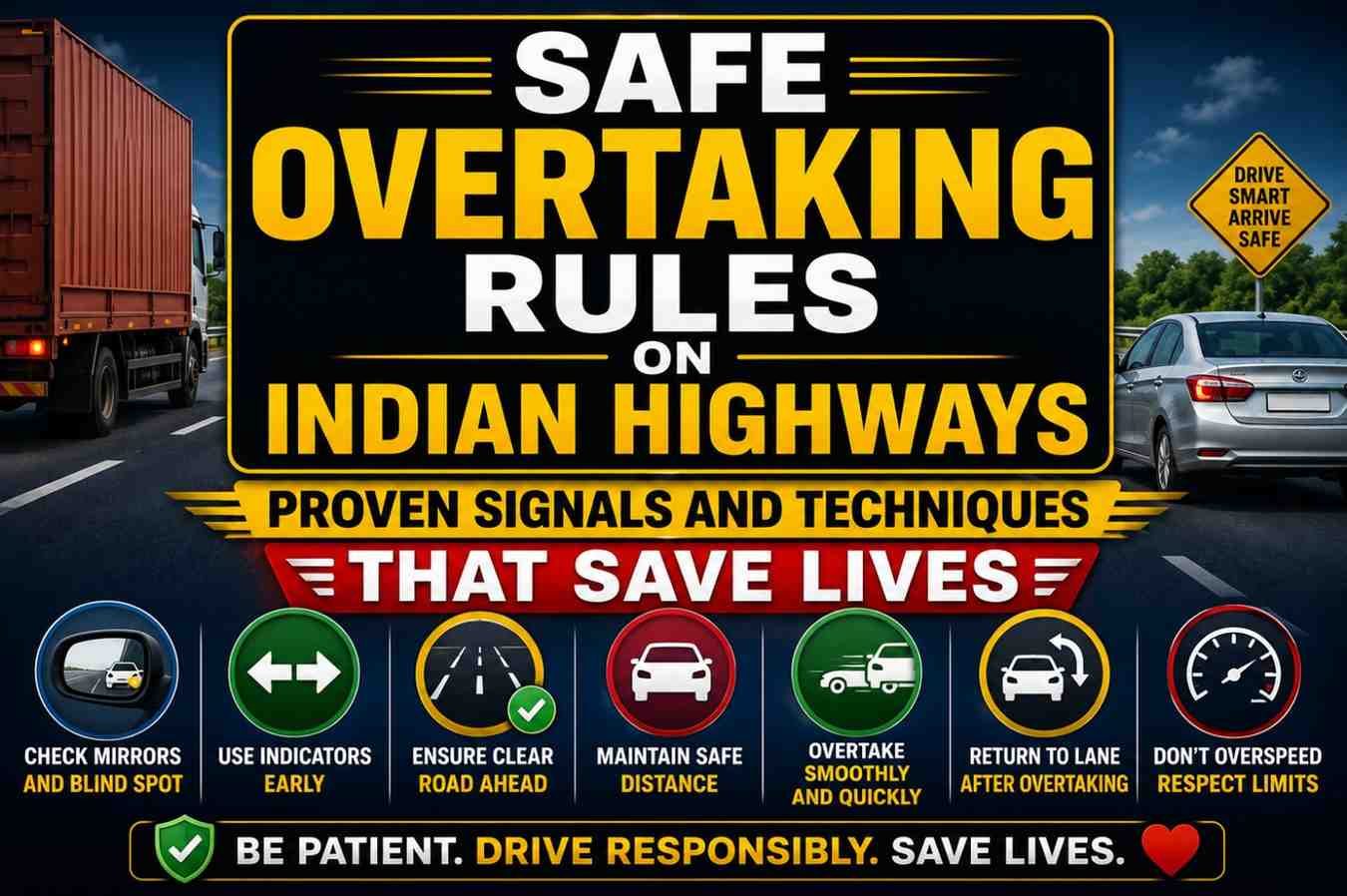
More fatal accidents on Indian highways involve overtaking than almost any other maneuver. An incorrect overtaking decision — at the wrong time, in the wrong place, without the right signals — can end lives in seconds. Understanding safe overtaking rules on Indian highways is not just about following the law. It is about coming home alive.
This comprehensive guide on safe overtaking rules on Indian highways covers every aspect of overtaking — the legal framework, the correct technique, the signals that communicate your intention, the situations where you must never attempt it, and the common mistakes that Indian drivers make every day.
The Legal Framework—Safe Overtaking Rules on Indian Highways Under Indian Motor Vehicles Act
The Motor Vehicles Act of 1988 (amended in 2019) and the Central Motor Vehicles Rules set clear safe overtaking rules on Indian highways:
- Overtaking must always be from the right side—overtaking from the left is illegal except in specific situations (left turn, vehicle signalling to turn right, one-way roads)
- You must signal your intention before moving right to overtake
- You must ensure the road ahead is clear for a sufficient distance before beginning the maneuver.
- The vehicle being overtaken must not be forced to reduce speed or change course
- Overtaking is prohibited at pedestrian crossings, intersections, blind curves, hill crests, and where road markings prohibit it
Violating safe overtaking rules on Indian highways carries fines of ₹1,000–₹5,000 and license demerit points under the 2019 amendments.
The Three-Check System — Foundation of Safe Overtaking Rules on Indian Highways
Before every overtaking maneuver, use the Three-Check System—the foundation of safe overtaking rules on Indian highways:
Check 1 — Mirrors
Check your center rearview mirror and your right door mirror. Is anyone already overtaking you from behind? Is there a vehicle already in the right lane? If yes—do not move right.
Check 2 — Blind Spot
Physically glance over your right shoulder to check your blind spot—the area not visible in any mirror. At highway speeds, a motorcycle or fast car can be in your blind spot and completely invisible in your mirrors.
Check 3 — Road Ahead
Look far ahead—not just to the vehicle in front of you, but at least 200–500 meters forward. Is the road clear? Are there any oncoming vehicles, stopped vehicles, pedestrians, or road hazards in your intended path?
Only when all three checks are clear should you initiate the overtaking maneuver.
The Correct Overtaking Technique — Step by Step
Safe overtaking rules on Indian highways require a specific technique:
Step 1—Assess the situation Is this a safe overtaking opportunity? Check: the road is straight, no curves or crests ahead, no oncoming traffic, and sufficient clear road ahead.
Step 2—Maintain safe following distance Before overtaking, maintain at least 3–4 car lengths behind the vehicle you intend to overtake. Tailgating before an overtake is dangerous.
Step 3 — Signal right Turn on your right indicator at least 3–4 seconds before moving right. This signals your intention to the vehicle ahead and any vehicles behind you.
Step 4 — Flash headlights (daytime) or briefly flash high beam (night). A brief headlight flash communicates to the vehicle ahead: “I am about to overtake—please maintain your course and speed.” This is a recognized safe overtaking signal on Indian highways.
Step 5 — Move right and accelerate Move smoothly into the right lane with a confident increase in speed. Hesitant, slow overtaking maneuvers are dangerous—the time spent alongside the other vehicle should be minimized.
Step 6 — Complete the manoeuvre and return left Once you are clearly ahead (can see the full front of the overtaken vehicle in your center mirror), signal left and return smoothly to your original lane. Do not cut in sharply.
Step 7 — Cancel your indicator Ensure your left indicator is cancelled after returning to the lane.
Situations Where You Must NEVER Overtake
These safe overtaking rules on Indian highways are absolute—no exceptions:
- On a curve or bend—oncoming vehicles are invisible
- On a hill crest—you cannot see what is on the other side
- At an intersection or crossing—traffic may enter from either side
- At a pedestrian crossing—pedestrians have right of way
- Where a solid white centre line is painted—a solid line means overtaking is prohibited by law
- In heavy rain or fog—visibility is insufficient for safe execution
- When the vehicle ahead is signalling to turn right—they may begin turning as you overtake
- When you are unsure—if in any doubt, wait. There is no overtaking opportunity worth risking your life.
Overtaking Trucks and Buses — Special Rules
Safe overtaking rules on Indian highways require special attention when dealing with heavy vehicles.
- Never cut in front of a truck too early — trucks need 3–5x the stopping distance of a car. If you move back into the left lane too soon, you are within their braking failure zone.
- Be aware of trucks’ wide right turns—before turning right, some trucks swing left first. This is dangerous if you are trying to overtake on the right.
- Trucks have massive blind spots — if you cannot see their mirrors, they cannot see you. Spend minimum time in a truck’s blind spot.
- Overtake trucks quickly—the faster you complete the maneuver, the less time you spend alongside a vehicle that can end your car if it drifts left.
- Night overtaking of trucks is high risk — many Indian trucks have poorly maintained rear lights. Increase following distance significantly at night.
Understanding Road Markings for Overtaking
Safe overtaking rules on Indian highways include understanding what road markings mean.
| Marking | Meaning |
|---|---|
| Single broken white line | Overtaking permitted when safe |
| Single solid white line | Do not cross—overtaking prohibited |
| Double solid white lines | Strict no-overtaking zone—never cross |
| Yellow broken line | Overtaking with caution permitted |
| Yellow solid line | No overtaking from your side |
Common Overtaking Mistakes on Indian Highways
- Not checking blind spots — the most common cause of overtaking accidents
- Overtaking multiple vehicles at once—attempting to pass 2–3 vehicles in one manoeuvre at high speed
- Returning to lane too early—cutting in front of the overtaken vehicle without adequate clearance
- Not accounting for the overtaken vehicle’s speed—if the vehicle ahead accelerates during your manoeuvre, abort and try again later
- Overtaking on the approach to a curve—the road looks clear but curves faster than expected
FAQs — Safe Overtaking Rules on Indian Highways
Q1. Is it legal to overtake from the left in India? Overtaking from the left is generally illegal in India. Exceptions include one-way roads when the vehicle ahead is turning right and you are proceeding straight and in slow-moving traffic where vehicles are moving in defined lanes.
Q2. What does a headlight flash mean when overtaking on Indian highways? A brief headlight flash from behind signals to the vehicle ahead. “I intend to overtake—please hold your course.” It is a standard communication signal, not aggression.
Q3. What is the minimum safe distance needed before returning to the lane after overtaking? You should be able to see the full front of the overtaken vehicle in your center rearview mirror before moving back left. In distance terms, this is approximately 30–50 meters at highway speeds.
Q4. Can I overtake on a two-lane highway in India? Yes, on a two-lane highway, overtaking uses the oncoming lane. This is the highest-risk type of overtaking. Only attempt it when you have a clear view of at least 500 meters ahead with no oncoming traffic and the road is straight.
Q5. What should I do if someone is trying to overtake me on the highway? Slow down slightly and move left to give them more room. Do not accelerate—this creates dangerous racing situations. Safe overtaking rules on Indian highways work best when both drivers cooperate.
Conclusion
Safe overtaking rules on Indian highways are not bureaucratic regulations — they are the result of years of accident data, engineering research, and the tragic loss of thousands of lives. Every rule in this guide exists because someone died when it was ignored.
Learn the three-check system. Signal every time. Never overtake on curves. Complete the maneuver decisively. And when in doubt—wait.
Drive safely. Get there. Come home.
Share this guide with every new driver you know—safe overtaking rules on Indian highways save lives, and knowledge shared is lives saved.
Image Suggestions:
- Image 1 — After the introduction: A diagram showing the correct overtaking maneuver sequence on a 2-lane highway with signal and mirror checkpoints marked. ALT text: safe overtaking rules on Indian highways — correct overtaking technique diagram
- Image 2—After the Road Markings section: A clear photo of Indian highway road markings showing broken and solid white center lines. ALT text: safe overtaking rules on Indian highways — road marking guide
External Links: