 admin@prodriver.in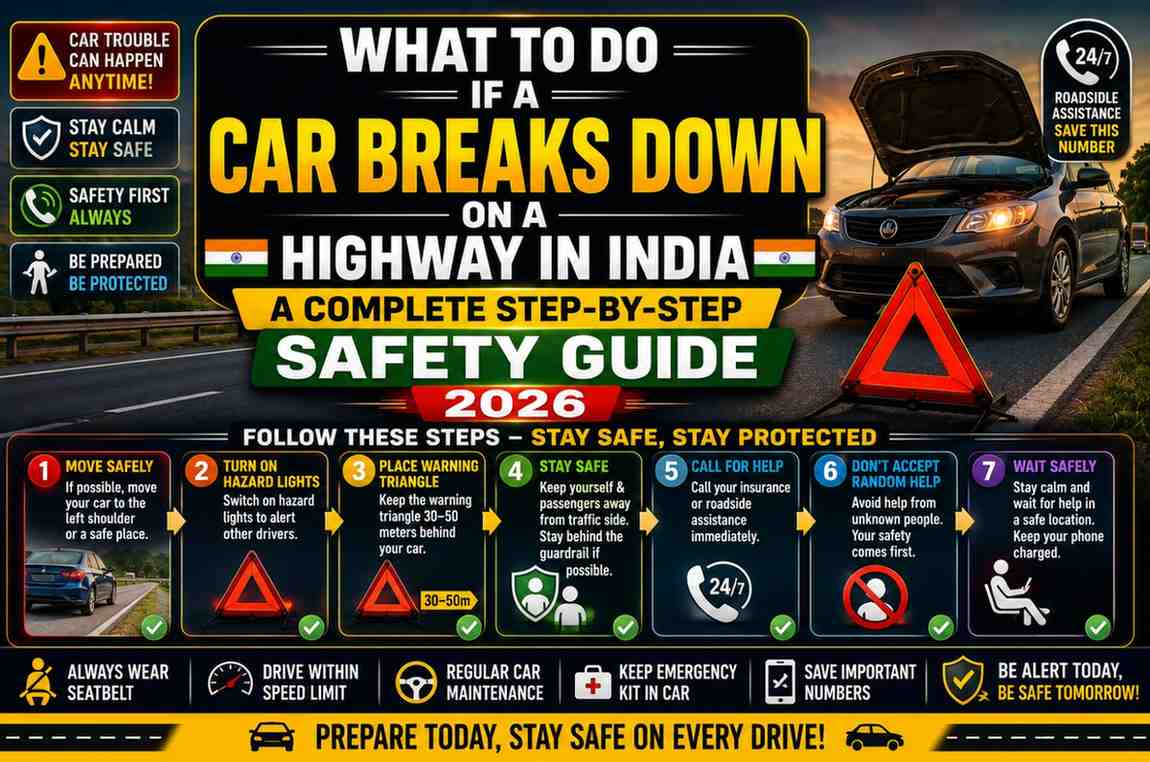
Your car breaking down on a highway is one of the most stressful experiences any driver can face. In the middle of a six-lane expressway at night, with trucks roaring past at 80 km/h and no idea what to do next—the difference between a safe outcome and a tragedy is knowing exactly what to do if a car breaks down on a highway in India. This guide gives you that knowledge, step by step.
What to do if a car breaks down on a highway in India is a sequence of actions—each one building on the last—that protects you, your passengers, and other road users until professional help arrives.
Step 1—Stay Calm and Switch On Hazard Lights Immediately
The moment you feel your vehicle losing power, hear an unusual sound, or notice any warning light indicating a serious problem:
Immediately switch on your hazard lights (emergency flashers). Do this before anything else. Your hazard lights are visible to approaching traffic even before you have stopped, giving them time to adjust.
This is the first and most critical step in what to do if a car breaks down on a highway in India. Every second your hazard lights are on is a second of additional warning to vehicles behind you.
Step 2 — Move to the Road Shoulder or Emergency Lane
While your hazard lights are on, gradually and smoothly steer toward the left road shoulder or emergency stopping lane. On Indian expressways, there is a paved emergency shoulder on the left side—this is your safe zone.
- Do not brake suddenly—this can cause a rear-end collision at highway speeds
- Keep steering smoothly and gradually reduce speed
- Use the left indicator while moving left
- Aim for the widest part of the shoulder, as far from the main carriageway as possible
If you cannot reach the shoulder (vehicle is immobile), stay in your lane with hazard lights on and proceed immediately to Step 4 for rapid safety actions.
Step 3—Switch Off the Engine and Apply Handbrake
Once stopped on the shoulder,
- Switch off the engine
- Keep hazard lights ON
- Apply the handbrake firmly
- If on any gradient, turn the front wheels toward the road edge (prevents the vehicle from rolling into traffic if handbrake fails)
Step 4—Get All Passengers Out of the Vehicle—Away From Traffic
This is the step most Indian drivers skip — and it is the step that determines whether a breakdown becomes a fatality.
Get everyone out of the car immediately and move them to the far side of the safety barrier or as far from the road as possible. Staying inside a stationary vehicle on a highway shoulder exposes everyone to the risk of a distracted driver hitting the car from behind—which happens on Indian highways with tragic regularity.
Move passengers:
- Over the safety barrier (if present) — the safest position
- Up an embankment if no barrier exists
- At minimum, 20–30 metres away from the vehicle on the opposite side from traffic
Children and elderly passengers should be the priority for immediate evacuation.
Step 5 — Place Warning Triangles or Flares Behind the Vehicle
With passengers safe, return to your vehicle to place warning devices:
- Place the first triangle 10–15 metres directly behind the vehicle
- Place the second triangle 50–100 metres behind the vehicle—giving approaching traffic maximum warning time
- At night or in low visibility (fog, rain): use reflective triangles AND emergency flares if available
- If you do not have triangles: tie something bright (scarf, cloth) to the door handle and trunk—any visibility aid helps
This step of what to do if a car breaks down on a highway in India is legally required—and practically critical.
Step 6 — Call for Help — The Right Numbers in the Right Order
With passengers safe and warnings deployed, call for assistance.
Call 1—NHAI Helpline: 1033. Report your breakdown. Give them your highway number, nearest kilometer milestone number (check the green markers), your vehicle description, and the number of passengers. NHAI patrol will be dispatched.
Call 2 — Your Car Manufacturer’s Roadside Assistance Maruti: 1800-102-1800 | Hyundai: 1800-11-4645 | Tata: 1800-209-7979 | Mahindra: 1800-209-6006 | Others are listed in Article 5 of this pack.
Call 3 — Your Insurance Company’s Emergency Helpline If your insurance includes roadside assistance (most comprehensive policies do), it can arrange towing and an emergency garage.
Call 4 — A Trusted Contact Inform someone who knows your route that you have broken down and your location. This creates a safety check-in even if further communication is difficult.
Step 7 — Stay Safe While Waiting for Help
While waiting for assistance, what to do if a car breaks down on a highway in India includes the following:
- Remain outside the vehicle and away from traffic—do not sit inside waiting
- Stay on the far side of the safety barrier if present
- Do not accept lifts from unknown vehicles
- Keep your phone charged (use your power bank if needed)
- If it’s nighttime: use your phone’s torch to increase your visibility to approaching vehicles
- Check every 15–20 minutes whether your warning triangles have been displaced by wind or passing vehicles
- In extreme weather (heat, rain): the safety risk of staying exposed may be managed by returning to the vehicle with doors locked—but prioritise moving to a service area if at all possible
Common Highway Breakdown Scenarios — What to Do
Tyre Blowout at Speed
- Do NOT brake suddenly—grip the wheel, steer straight, ease off accelerator
- Let speed reduce naturally, then gently brake
- Follow Steps 1–7 above once controlled
Engine Overheating
- Pull over immediately when the temperature warning light appears
- Do not open the bonnet until steam has stopped
- Never add cold water to a hot radiator—let it cool completely first
- Call roadside assistance
Electrical Failure / Car Goes Dead
- Coast to the shoulder with steering on
- Apply handbrake before all power is lost
- Manual windows: open before all electrical power dies (cannot open afterwards)
Running Out of Fuel
- Completely preventable—always fill up before 1/4 tank on highways where fuel stations are spaced 20–40 km apart
- If it happens: follow Steps 1–6 and tell NHAI patrol—many carry emergency fuel for exactly this situation
FAQs — What to Do If Car Breaks Down on Highway India
Q1. What is the first thing to do if my car breaks down on an Indian highway? Switch on hazard lights immediately—before anything else. This alerts following traffic to your situation and buys you critical time to steer safely to the shoulder.
Q2. Should I stay in my car while waiting for help on an Indian highway? No. Get yourself and all passengers out of the vehicle and as far from the carriageway as possible. Standing behind a safety barrier is ideal. Stationary vehicles on highway shoulders are at risk of being struck from behind.
Q3. How do I describe my location to NHAI when I call 1033? Use the green kilometer milestone markers you will see every 500 meters on national highways. Tell the operator your highway number and the milestone number (e.g., “NH 48, KM post 234”). This gives rescuers a precise location.
Q4. Can I change a tire myself on the highway shoulder in India? It is safer to call roadside assistance than attempt a tire change on an active highway shoulder. If you must change the tire yourself, deploy warning triangles first, never put yourself between the vehicle and traffic, and keep passengers far away.
Q5. What if my car breaks down in a tunnel or on a bridge? Follow the same steps—hazard lights, move to the emergency lane, and get passengers out through the pedestrian walkway (all Indian highway tunnels have these). Call 1033 immediately—tunnel incidents require rapid response as they block critical infrastructure.
Conclusion
Knowing what to do if a car breaks down on a highway in India is not paranoia—it is preparation. Breakdowns happen. Punctures happen. Electrical failures happen. The difference between a frightening inconvenience and a fatality is the sequence of actions you take in the first 2–3 minutes.
Hazard lights on. Move left. Passengers out. Warning triangles out. Call 1033. Stay safe.
Print this guide or save it on your phone. Share it with every person in your family who drives. Preparation is the best safety device you have.
Image Suggestions:
- Image 1 — After the introduction: A car stopped on an Indian highway shoulder with hazard lights on and red warning triangles placed behind it. ALT text: what to do if car breaks down on a highway in India—hazard lights and warning triangles
- Image 2 — After the Call for Help section: A smartphone showing the NHAI 1033 helpline being called. ALT text: what to do if car breaks down on a highway in India — calling NHAI 1033
External Links: