 admin@prodriver.in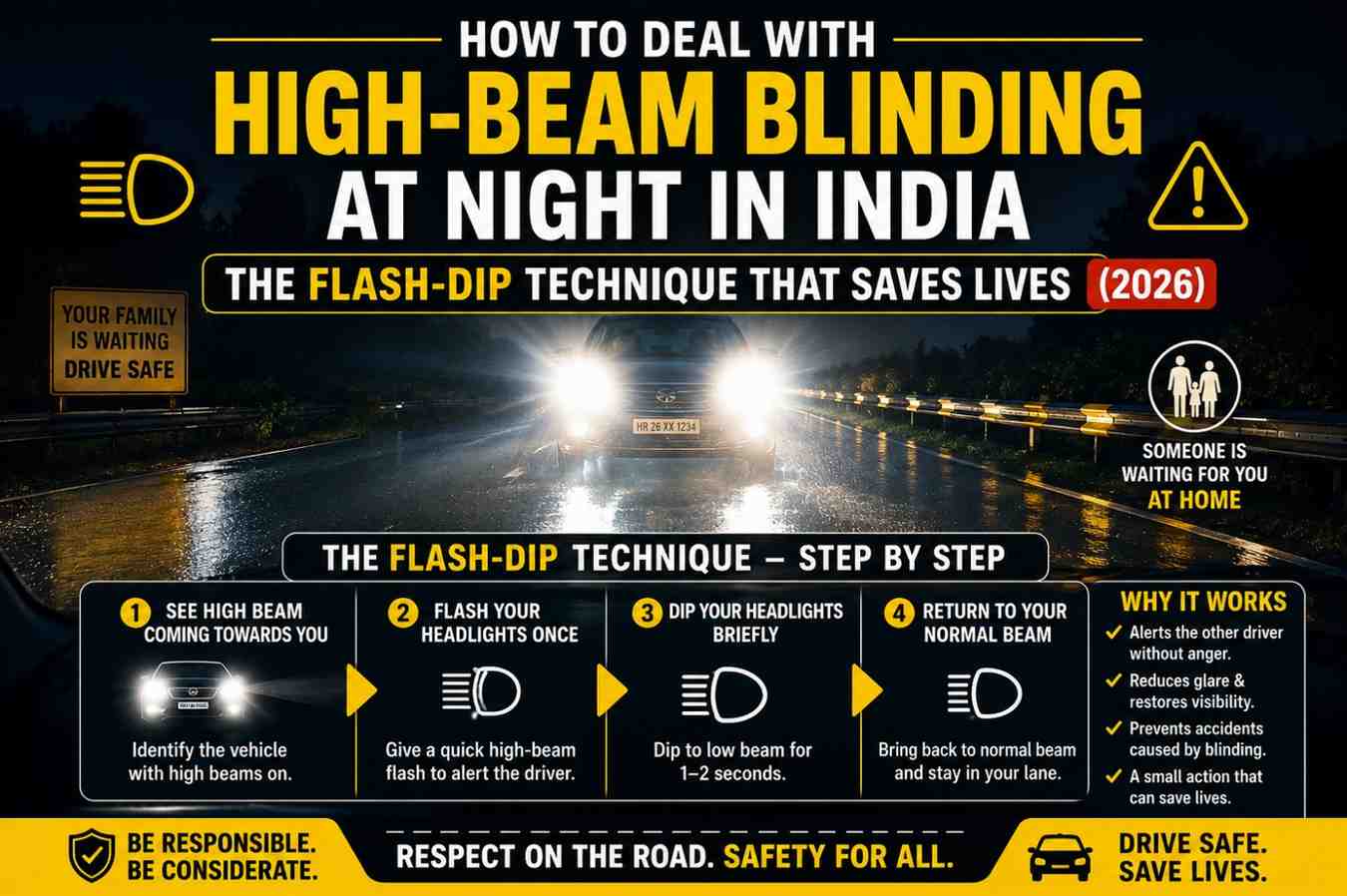
Ask any experienced night driver about their biggest fear on Indian highways, and the answer is almost always the same—being blinded by oncoming high beams. How to deal with high-beam blinding at night in India is one of the most practically important driving skills you can learn, because it happens every few minutes on rural Indian highways after dark, and the consequences of a wrong response can be fatal.
This guide covers exactly how to deal with high-beam blinding at night in India—the technique that works, the legal framework around it, the equipment that genuinely helps, and the common mistakes that make the situation more dangerous, not less.
Why High Beam Blinding Is So Dangerous on Indian Roads
India has one of the world’s most pronounced “high-beam” culture problems. Studies show that on rural Indian highways after dark, the majority of oncoming vehicles use high beams—either because of habit, lack of awareness, or deliberately to “see better” without regard for oncoming traffic.
Understanding how to deal with high-beam blinding at night in India requires knowing what high beams actually do to your eyes:
- Temporary blindness duration: 5–12 seconds after a high beam passes
- At 80 km/h, 10 seconds = 222 metres travelled effectively blind
- Pupil dilation recovery takes 30–45 seconds for full night vision to return
- The older the driver, the longer the recovery—a driver over 50 takes significantly longer to recover from high-beam blinding than a 25-year-old
These numbers explain why knowing how to deal with high-beam blinding at night in India is a genuine survival skill, not just a driving comfort preference.
The Flash-Dip Technique — How to Deal With High-Beam Blinding at Night India
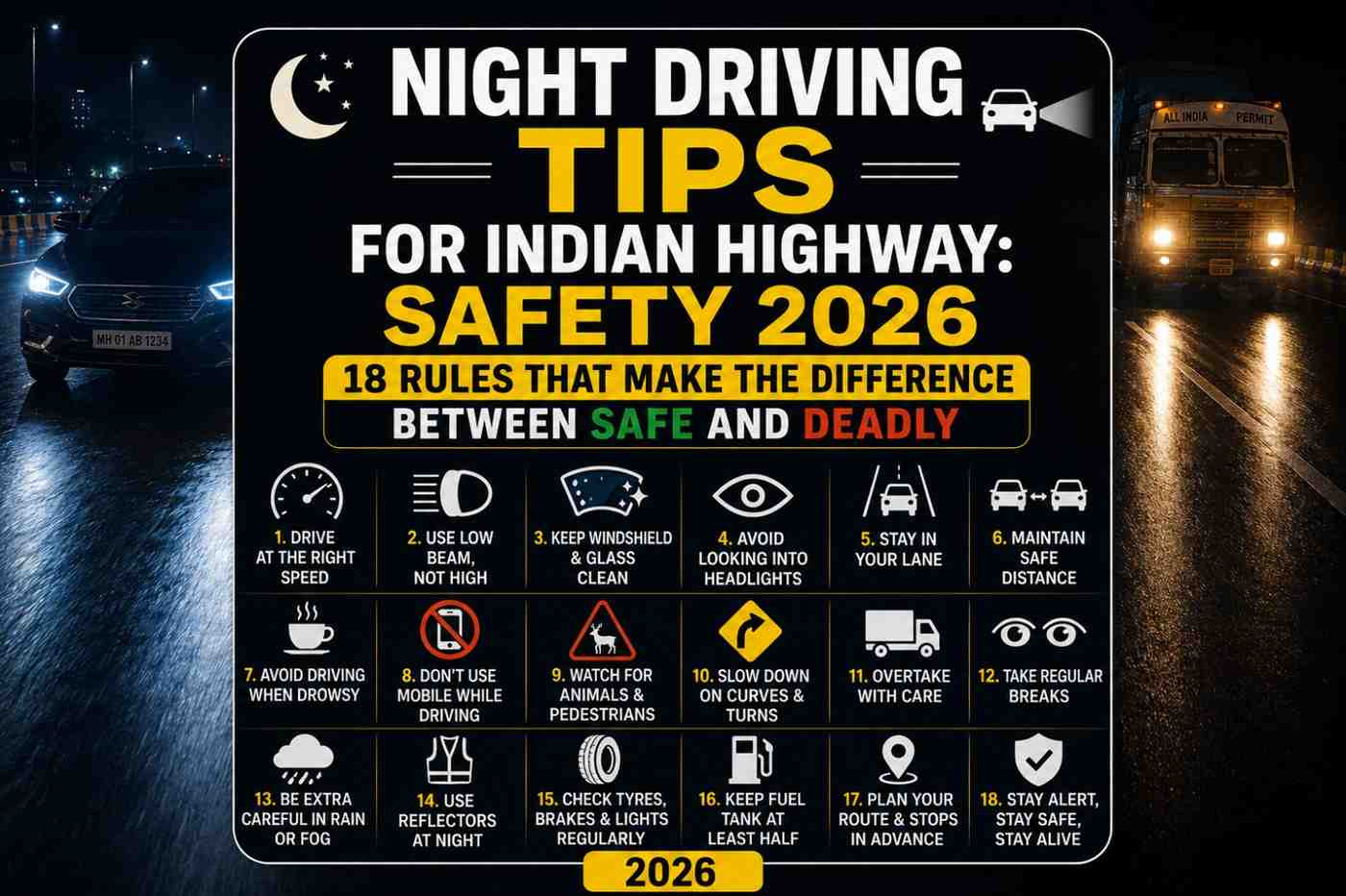
The flash-dip technique is the standard response taught by defensive driving instructors for how to deal with high-beam blinding at night in India. It is a two-part communication and protection system:
Part 1 — The Flash (Communication)
When you see an oncoming vehicle approaching on high beams:
- Flash your headlights once or twice—this signals to the oncoming driver that their high beam is blinding you and requests them to dip (switch to low beam)
- Wait 2–3 seconds to see if they respond by dipping their lights
Most courteous drivers will dip when flashed. The flash is the internationally recognized signal for “please dip your high beam.”
Important: Flash only briefly—holding your own high beam on in response is aggressive, creates mutual blinding, and dramatically increases accident risk. One or two brief flashes is the correct signal.
Part 2 — The Dip (Protection)
If the oncoming driver does not respond to your flash:
- Immediately switch to your low beam—do not maintain your own high beam in retaliation
- Slow down — reduce speed by 15–20 km/h
- Look at the left edge of your lane—specifically at the white line, rumble strip, or road edge marking. Use this as your navigation reference.
- Do NOT look at the oncoming headlights—staring into a high beam source maximises the blinding effect and extends recovery time
- Move slightly left within your lane—not onto the shoulder, just away from the centre line
- Maintain this position until the vehicle passes and has moved away
Recovery After High-Beam Blinding
Once the oncoming vehicle has passed, how to deal with high-beam blinding at night in India continues with the recovery phase:
- Do not immediately restore full speed—your eyes need time to readjust to darkness
- Keep looking slightly right of center—not at road edges where animals may be
- Wait until you can clearly see the road ahead before restoring normal speed—typically 5–10 seconds
- Your high beam can be restored once full vision has recovered
Where to Look When Being Blinded — The Technique in Detail
The most common mistake drivers make when dealing with high-beam blinding at night in India is looking directly at the source of blinding light. This is instinctive but catastrophically wrong.
The correct gaze technique:
- Look at the LEFT road edge—the painted white line, the road edge, or the verge
- Use your peripheral vision to track the oncoming vehicle
- Look slightly downward—at the road surface in your lane, not at the horizon where the blinding light is strongest
- Never look to the right—you may instinctively steer toward your gaze direction (a phenomenon called “target fixation”).
This technique keeps you tracking your lane accurately while minimizing the blinding effect of the oncoming lights.
Anti-Glare Equipment That Genuinely Helps
Beyond technique, several equipment solutions address how to deal with high-beam blinding at night in India:
Auto-Dimming Rearview Mirror
Most modern Indian cars come with a manual rearview mirror that can be tilted to reduce glare from following vehicles. Some premium cars have auto-dimming mirrors that use a photosensor to automatically reduce reflected glare. If your car has the manual anti-glare position (tilt the mirror slightly down), use it at night.
Electrochromic (Auto-Dimming) Exterior Mirrors
Available as an aftermarket upgrade, auto-dimming exterior mirrors reduce glare from overtaking vehicles that shine into your door mirrors. Useful but less critical than the rearview mirror fix.
Anti-Glare Night Driving Glasses
Yellow-tinted anti-glare lenses claim to reduce high-beam blinding. Their effectiveness is debated—see Article 4 in this pack for a detailed honest assessment.
Windshield Coating
Certain hydrophobic and anti-reflection windshield coatings (Rain-X and Teflon-based coatings) reduce the glare scatter caused by raindrops or a dirty windshield. These coatings primarily help in wet night driving conditions.
The Legal Position on High Beam Use in India
India’s Motor Vehicles Act is clear on this issue, yet enforcement is minimal. Understanding the law is part of how to deal with high-beam blinding at night. India constructively:
- Section 112 MV Act: It is illegal to use high beam when within 200 metres of an oncoming vehicle
- Penalty: ₹500–₹1,000 for improper use of lights at night
- Enforcement: Extremely rare in practice, especially on rural highways
The practical reality is that legal remedies do not help you in the moment of being blinded. The flash-dip technique and correct gaze management are your real tools.
What NOT to Do When High Beams Blind You
These are the dangerous wrong responses to avoid:
- Do not retaliate with your own high beam—this creates mutual blinding and dramatically increases accident risk
- Do not brake suddenly—risk of rear-end collision from following vehicles
- Do not swerve—target fixation can cause you to steer toward the blinding light
- Do not close your eyes—obviously dangerous but instinctive in some people
- Do not stop on the carriageway—creates a stationary obstacle
FAQs — How to Deal With High Beam Blinding at Night India
Q1. What is the most effective way to deal with high-beam blinding at night in India? The flash-dip technique is to flash once to request dipping, then switch to your own low beam, look at the left road edge, slow down slightly, and allow your eyes to recover after the vehicle passes.
Q2. Is it illegal to use high beams near other vehicles in India? Yes—Section 112 of the Motor Vehicles Act prohibits high beam use within 200 meters of oncoming vehicles. However, enforcement is rare, and you cannot rely on the law for immediate protection.
Q3. Do anti-glare night driving glasses help with high-beam blinding? They help slightly with general glare and contrast but do not significantly reduce the blinding effect of a direct high beam. Proper technique (looking at the road edge) is more effective. See Article 4 for a detailed assessment.
Q4. How long does it take for your eyes to recover from high-beam blinding? Basic vision recovery is 5–10 seconds. Full night vision restoration can take 30–45 seconds. During the 5–10 second initial recovery, reduce speed and rely on road edge markings for navigation.
Q5. Should I flash aggressively at drivers who do not dip their lights? Flash once or twice as a polite signal. If they do not respond, do not escalate to aggressive repeated flashing — this creates a road rage risk. Apply the dip-and-look technique and focus on protecting yourself.
Conclusion
Knowing how to deal with high-beam blinding at night in India is not about changing other drivers—you cannot control their behavior. It is about giving yourself the best possible response technique so that when it happens—and it will happen, repeatedly, on any Indian highway after dark—you respond with skill rather than panic.
Flash once. Dip your own beam. Look left. Slow down. Recover. This sequence, practiced until it is automatic, is what separates experienced night drivers from vulnerable ones.
Share this article with every driver you know who uses Indian highways at night. The flash-dip technique takes 30 seconds to learn and could save a life.
Image Suggestions:
- Image 1—After the Flash-Dip section: A diagram showing the correct gaze direction (toward road edge) when facing oncoming high beams. ALT text: how to deal with high-beam blinding at night India — gaze technique diagram
- Image 2—After the Equipment section: A car rearview mirror in anti-glare position at night. ALT text: how to deal with high-beam blinding at night India — anti-glare rearview mirror
External Links: