 admin@prodriver.in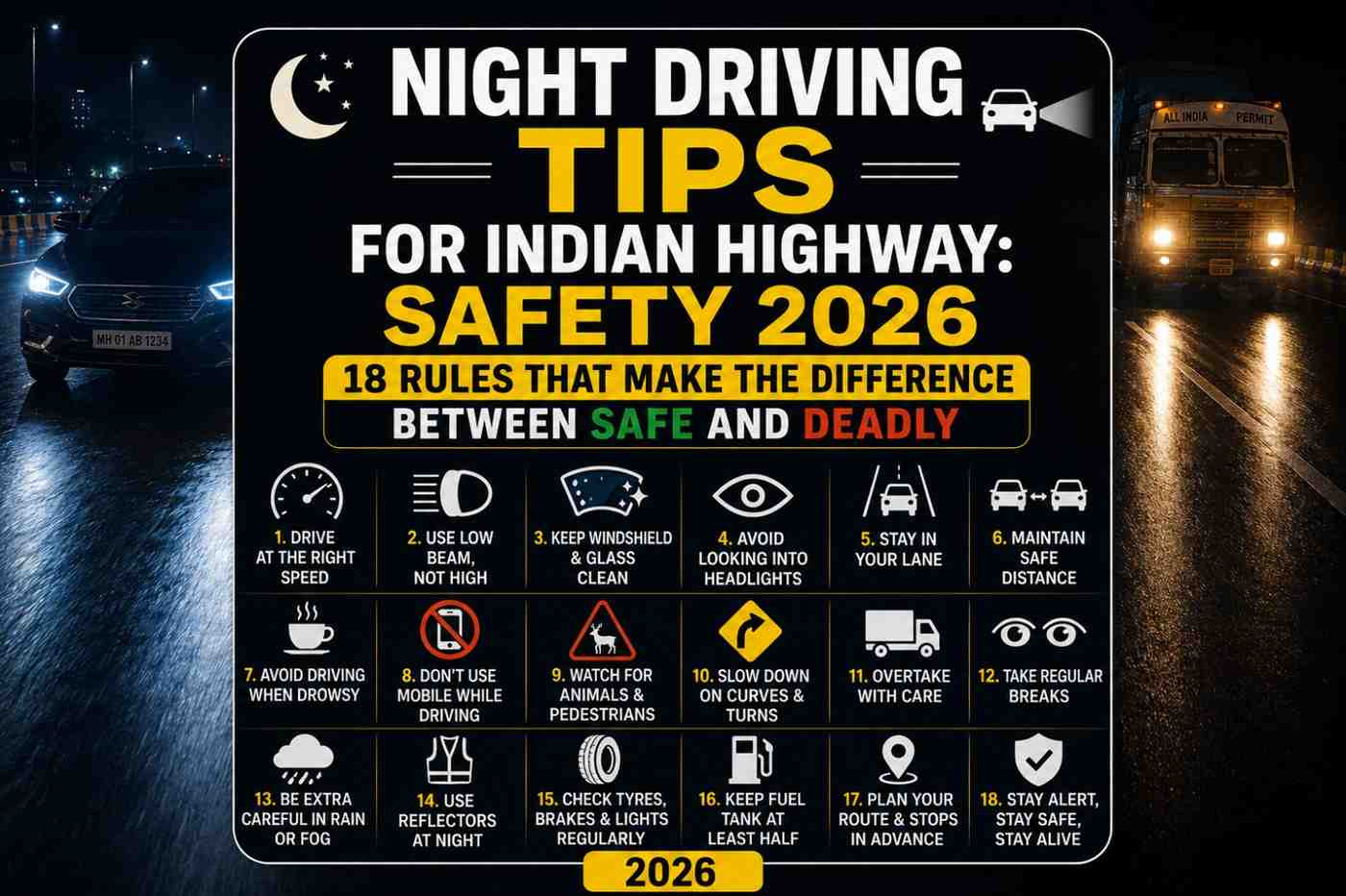
Night driving on Indian highways is one of the most dangerous activities any driver can engage in. According to MoRTH data, over 40% of all fatal road accidents in India happen at night—despite significantly lower traffic volumes after dark. That number alone makes Night Driving Tips for Indian Highway Safety 2026 not just useful but essential for every driver who has ever started a long road trip after sunset.
The good news is that night driving danger is not inevitable. With the right preparation, the right habits, and the right knowledge, night driving tips for Indian highway safety 2026 can dramatically reduce your risk—on expressways, national highways, and state roads alike. These 18 rules are based on accident data, traffic engineering research, and the hard-won experience of India’s most experienced long-distance drivers.
Why Night Driving in India Is Statistically More Dangerous
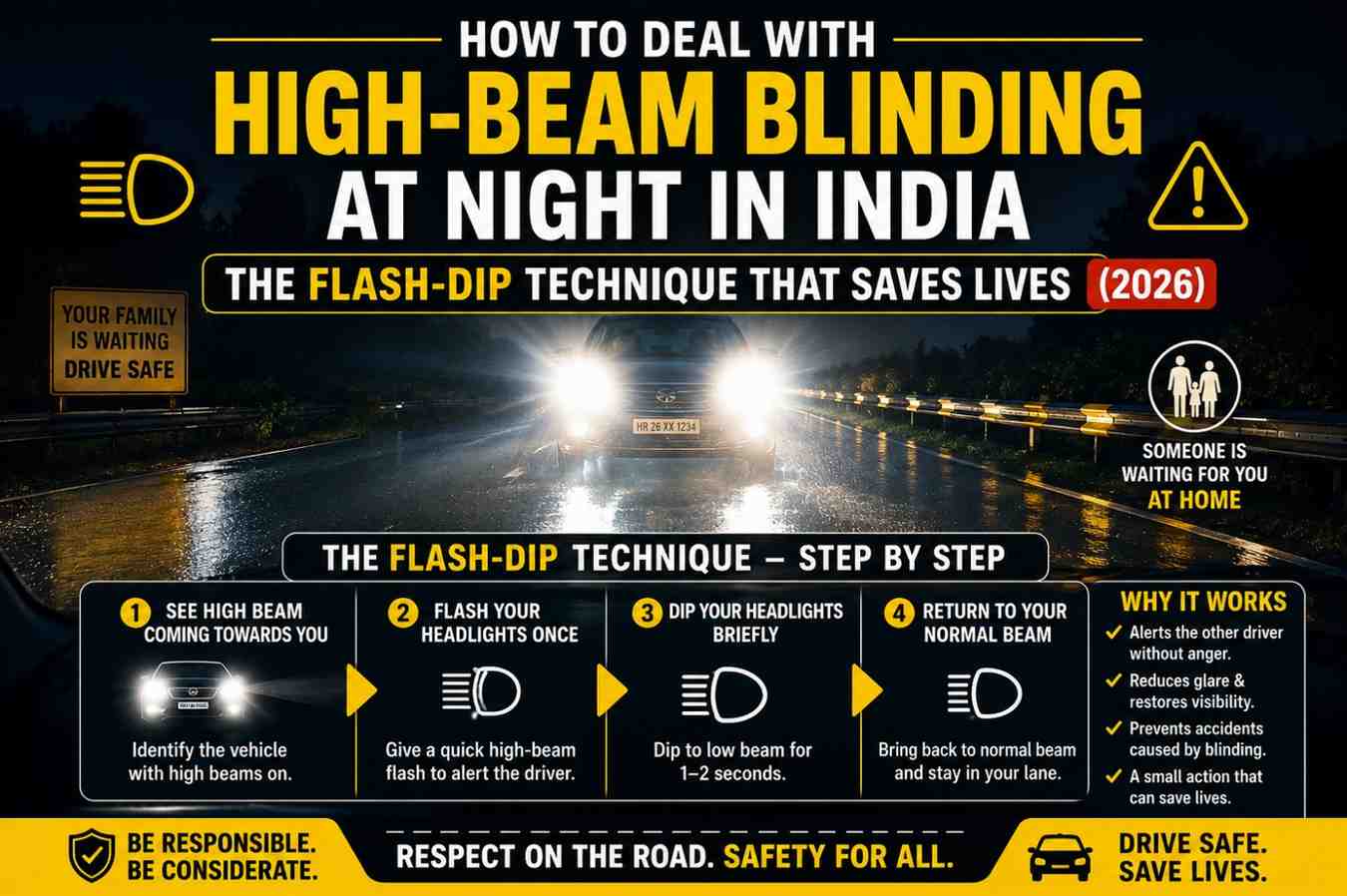
Before the rules, understanding the risk makes you take them more seriously. Night driving tips for Indian highway safety in 2026 are rooted in these realities:
- Reduced visibility—human eyes take 30–45 minutes to fully adapt to darkness, and headlight range is a fraction of daytime visibility
- Truck dominance — over 70% of India’s long-haul trucking happens at night. Trucks are slower, wider, and driven by fatigued drivers after hours on the road
- Animal crossings—cattle, dogs, pigs, deer, and nilgai on highways are nearly invisible at night until you are dangerously close
- Driver fatigue—the 2am–5am window is when human alertness is at its physiological lowest
- High beam blinding—India’s high beam culture creates temporary blindness for oncoming drivers multiple times per kilometre on rural highways
- Unlit vehicles—broken-down trucks without reflectors, cyclists without lights, and pedestrians in dark clothing are genuine night hazards
- Reduced emergency response—police patrols, medical facilities, and NHAI patrol are less active between midnight and 5am on many routes
Every night driving tip India highway safety 2026 in this guide addresses one or more of these specific risk factors.
The 18 Night Driving Tips Indian Highway Safety 2026
Rule 1 — Never Start a Long Night Drive on Less Than 6 Hours of Sleep
Sleep debt is cumulative and dangerous. If you slept 4 hours the previous night and plan to drive from 10pm to 6am, you are combining chronic fatigue with the body’s natural low-alertness period. No amount of coffee compensates for this. Night driving tips for Indian highway safety 2026: start before you get in the car—start with adequate sleep.
Rule 2 — Clean Your Windshield Inside and Out Before Every Night Drive
A dirty windshield creates glare halos around every headlight—turning approaching vehicles’ headlights into blinding starbursts. Night driving tips for Indian highway safety in 2026 include cleaning the inside of the windshield too—a thin film of nicotine, dust, or dashboard outgassing accumulates on the inside glass and dramatically amplifies glare. Use a microfiber cloth with a glass cleaner on both surfaces.
Rule 3 — Check All Your Lights Before Starting
This is one of the most basic night driving tips in India’s highway safety 2026 but also the most frequently neglected:
- Check both headlights (low beam and high beam)
- Check both taillights
- Check both indicator lights (front and rear)
- Check brake lights (ask someone to stand behind while you press the pedal)
- Check fog lights if your car has them
A single blown taillight makes your vehicle almost invisible to following traffic and dramatically increases rear-end accident risk.
Rule 4 — Use Low Beam in Built-Up Areas and Within 200m of Oncoming Traffic
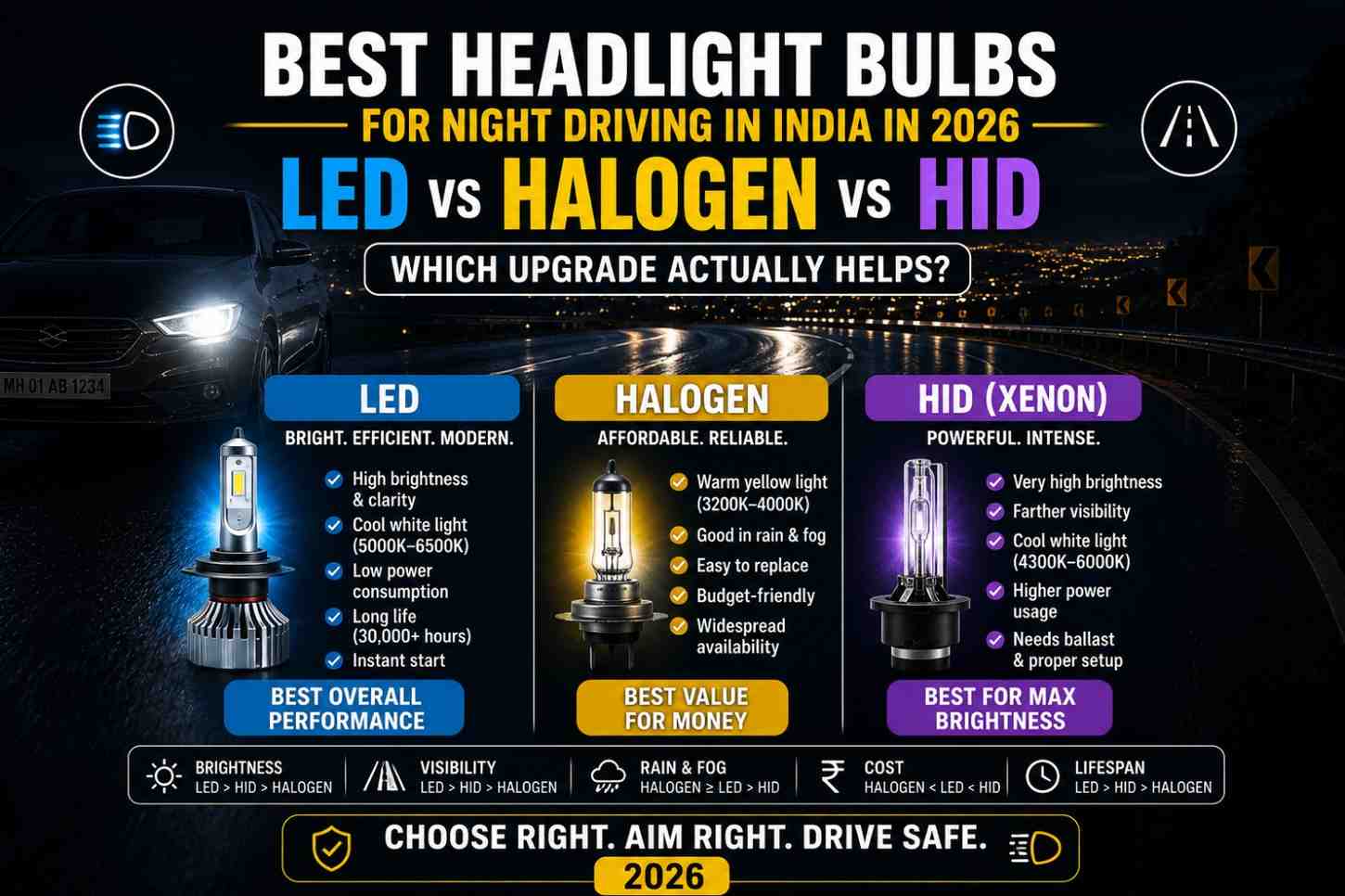
India has a pervasive high-beam culture that is one of the leading causes of night-driving accidents. Night driving tips for Indian highway safety 2026 are clear on this: use low beam whenever there is oncoming traffic or when you are within 200 meters of a vehicle ahead of you. High beams at close range blind other drivers for 5–10 seconds—enough time for a fatal accident.
High beams are appropriate only on:
- Open rural highways with no oncoming traffic visible
- Dark sections where low beam is insufficient to see road hazards ahead
Rule 5 — Reduce Speed by 20–30% After Sunset
At 100 km/h on low beam, your headlights illuminate approximately 50–60 meters ahead. Your stopping distance at 100 km/h is approximately 70–80 meters. This means you are overdriving your headlights—travelling faster than you can safely stop within your visible range.
Night driving tips for Indian highway safety 2026 recommend reducing speed to 70–80 km/h on national highways after dark. This keeps your stopping distance within your visible range.
Rule 6 — Increase Following Distance to 5–7 Seconds at Night
At night, your ability to detect hazards ahead is reduced. Increasing following distance to 5–7 seconds (from the daytime standard of 3 seconds) gives you additional reaction time when the vehicle ahead brakes suddenly for an unseen obstacle—an animal, a pothole, or a broken-down truck without lights.
Rule 7—Watch the Road Edge, Not Oncoming Headlights
When blinded by oncoming high beams—one of the most critical night driving tips in India’s highway safety 2026—do not stare at the headlights. Look at the left edge of your lane (the road marking or road edge) and use it as your navigation guide until the blinding vehicle passes. Your peripheral vision handles the rest.
Rule 8 — Use Hazard Lights Sparingly and Correctly
Many Indian drivers use hazard lights while driving in rain or at high speeds — this is incorrect and dangerous. Night driving tips for Indian highway safety 2026 on hazard lights:
- Hazard lights are for stationary vehicles or extremely slow-moving emergencies only
- Using hazard lights while moving cancels your turn signals, making your lane change intentions invisible to other drivers
- If you must drive very slowly, maintain hazard lights. If you are driving at normal speed in rain or fog, use headlights only.
Rule 9 — Be Especially Alert for Trucks Without Rear Reflectors
This is one of the most specific and important night driving tips for Indian highway safety 2026. A significant percentage of Indian trucks have non-functional or absent rear reflectors and lights. These vehicles are effectively invisible on unlit highway sections until you are dangerously close.
Strategy: When you see a truck ahead on a lit section, note its position and track it. On dark sections, slow down and scan for the silhouette of vehicles that may be unlit.
Rule 10—Avoid Driving Between 2am and 5am if Possible
This window — sometimes called the “dead zone” — is when human circadian alertness is at its absolute lowest, even for people who have slept well. Night driving tips for Indian highway safety in 2026 consistently identify this window as the highest-risk driving period. If your route requires covering this time, plan to stop and rest before 1am and restart after 5am.
Rule 11 — Take a Break Every 90 Minutes at Night (Not 2 Hours)
At night, fatigue accumulates faster than during daytime driving. Night driving tips for Indian highway safety 2026: reduce the standard 2-hour stop rule to 90 minutes for night driving. At every stop, get out of the car, walk for 5 minutes, and splash cold water on your face.
Rule 12 — Keep Cabin Temperature Cool
A warm car interior accelerates drowsiness dramatically. Night driving tips for Indian highway safety in 2026 recommend keeping your cabin temperature at 18–22°C. Periodically open windows for 2–3 minutes to introduce fresh air — even on cold nights.
Rule 13 — Travel with a Co-Driver for Night Trips Over 300km
Solo night driving over long distances is one of the highest-risk activities on Indian roads. Night driving tips for Indian highway safety 2026 strongly recommend a co-driver for any night trip over 300 km—alternating 90-minute driving shifts, with the resting driver staying awake to monitor the driver and road.
Rule 14 — Save Emergency Numbers Before Starting
NHAI 1033, Ambulance 108, Police 100, and your car manufacturer’s roadside assistance number should be saved and accessible before you start any night drive. Night driving tips for Indian highway safety 2026 emphasize this because at night, the calm to search for a number in an emergency is often not there.
Rule 15 — Use Your Horn Before Blind Bends on Rural Highways
On unlit rural highways and mountain roads, the horn is a critical safety tool at night. Night driving tips for Indian highway safety in 2026 on rural roads: sound your horn briefly before every blind bend to alert any oncoming vehicle on the wrong side of the road—a common occurrence on rural Indian roads at night.
Rule 16 — Avoid Sudden Braking — Use Progressive Braking
At night, following drivers have less time to react to your brake lights because overall visibility is reduced. Night driving tips for Indian highway safety in 2026 recommend always applying brakes progressively—a light initial touch followed by increasing pressure—rather than sudden hard braking. This gives the following vehicles maximum warning time.
Rule 17 — Watch for Animals Crossing — Especially After Midnight
Animals on Indian highways after midnight are a genuine and frequently fatal hazard. Cattle, dogs, nilgai, pigs, and wild animals cross highways at night and are nearly invisible until your headlights are close. Night driving tips for Indian highway safety 2026: scan far ahead, not just directly in front of your car. Look for eyeshine—the reflective glow of animal eyes in your headlight beam. It appears at 50–100 meters and is your earliest warning.
Rule 18 — If in Doubt — Stop
The final of our night driving tips for India highway safety 2026 is the most powerful: if you feel unsafe—tired, blinded repeatedly, disoriented, or anxious—pull over at the next safe opportunity and stop. Rest for 30–60 minutes. No destination, no schedule, and no expectation is worth your life.
Night Driving Tips on Indian Highway Safety 2026 — Quick Reference Card
| Rule | One-Line Summary |
|---|---|
| 1 | Sleep 6+ hours before night driving |
| 2 | Clean windshield inside and out |
| 3 | Check all lights before starting |
| 4 | Use low beam near oncoming traffic |
| 5 | Reduce speed 20–30% after dark |
| 6 | Increase following distance to 5–7 seconds |
| 7 | Look at road edge, not oncoming lights |
| 8 | Use hazard lights only when stationary |
| 9 | Watch for unlit trucks |
| 10 | Avoid 2am–5am driving |
| 11 | Stop every 90 minutes at night |
| 12 | Keep cabin cool |
| 13 | Travel with a co-driver for 300km+ |
| 14 | Save emergency numbers before starting |
| 15 | Honk before blind bends on rural roads |
| 16 | Use progressive braking |
| 17 | Watch for animal eyeshine |
| 18 | When in doubt, stop |
FAQs — Night Driving Tips India Highway Safety 2026
Q1. What is the most dangerous time to drive on Indian highways at night? 2am to 5am is statistically the most dangerous window—combining peak driver fatigue with minimum traffic (so fewer witnesses and slower emergency response) and the highest animal crossing activity.
Q2. How much should I reduce my speed at night on Indian highways? Reduce by 20–30% from your daytime speed. If you cruise at 100 km/h during the day, drive at 70–80 km/h at night to keep your stopping distance within your headlight’s visibility range.
Q3. Are expressways safer than national highways for night driving in India? Yes, access-controlled expressways have no animal crossings, no pedestrians, no cyclists, and better lighting in many sections. They are significantly safer for night driving than open national highways or state highways.
Q4. What should I do when blinded by high beams from an oncoming vehicle? Do not look at the headlights. Focus your gaze on the left edge of your lane and use it as a guide until the vehicle passes. Slow down gently and do not swerve.
Q5. Is it safe to do a solo night drive of 500km on Indian highways? It is high-risk. If unavoidable, plan mandatory 90-minute stops, avoid the 2am–5am window, carry a power bank, save emergency numbers, and have someone aware of your route and checking in regularly.
Conclusion
Night driving tips for Indian highway safety in 2026 are not about eliminating night driving—they are about doing it with discipline, preparation, and awareness. India’s highways are not equally dangerous at night for all drivers. The drivers who crash are overwhelmingly those who drive too fast, drive too long without stopping, drive with poor visibility equipment, or drive during the body’s lowest-alertness hours.
Follow these 18 rules. Share them with everyone who drives at night. Because the difference between safe and deadly on an Indian highway after dark is knowledge—and the decision to use it.
Which of these night driving tips surprised you most? Share in the comments—and drive safe tonight.
Image Suggestions:
- Image 1 — After the introduction: A nighttime highway in India showing glowing headlights, illuminated road markings, and dark surroundings. ALT text: night driving tips India Highway Safety 2026—Indian highway at night with headlights
- Image 2 — After the Quick Reference Card: An infographic-style layout of the 18 rules on a dark background. ALT text: night driving tips India highway safety 2026—18 rules quick reference
External Links: