 admin@prodriver.in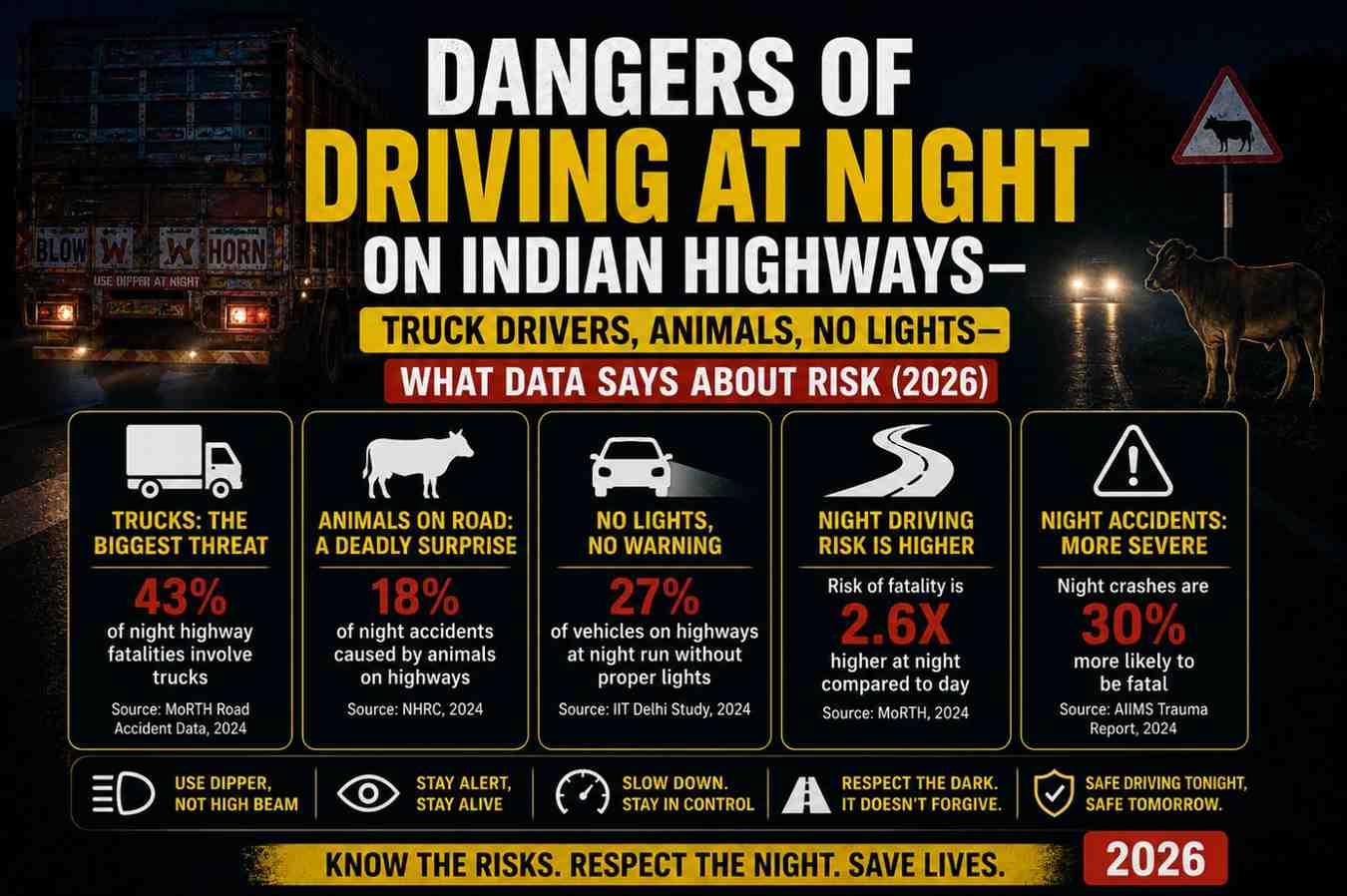
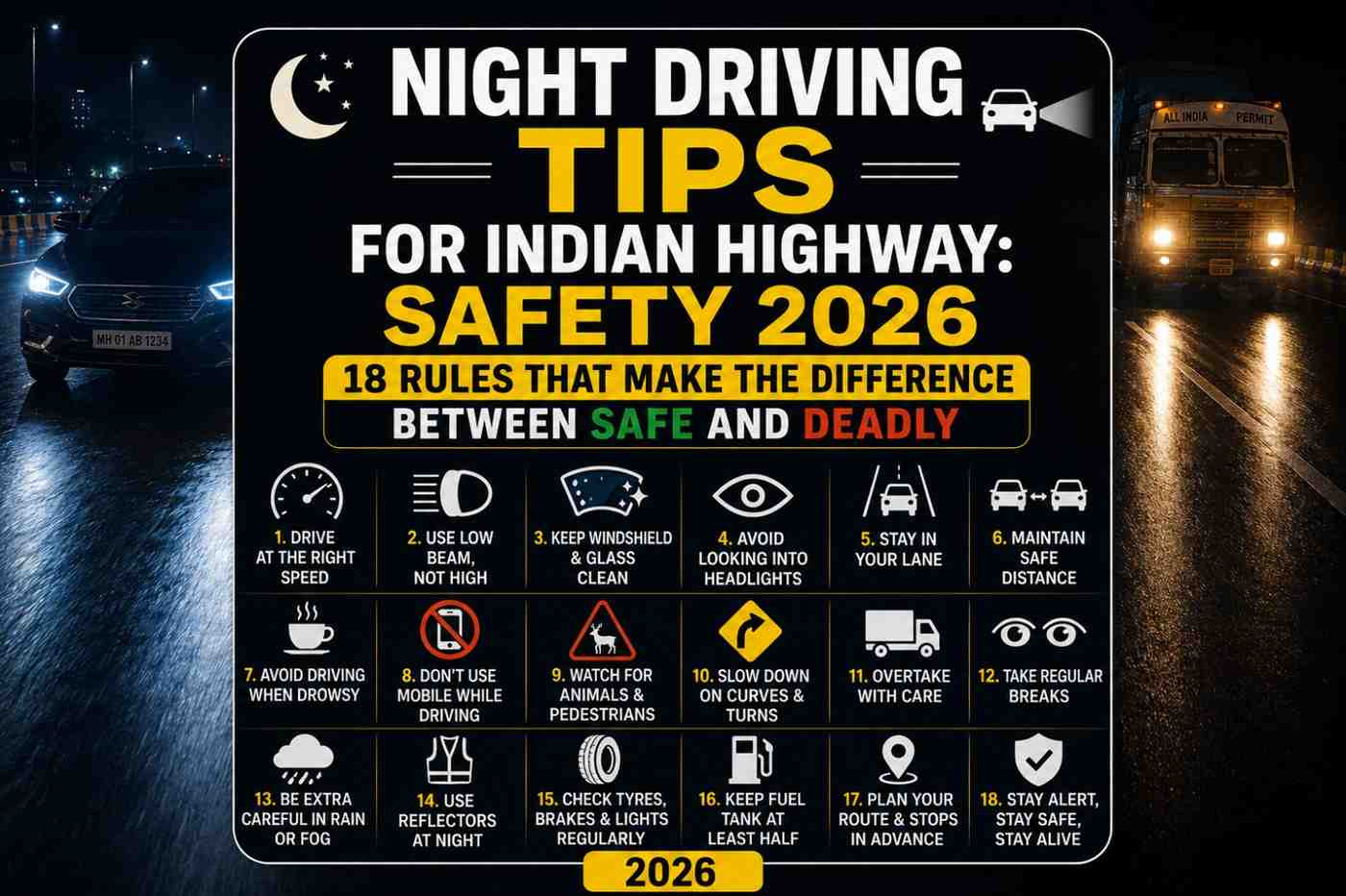
India’s road accident statistics tell a story that should make every night driver pause. More than 40% of all fatal highway accidents in India occur between sunset and sunrise — a period that accounts for only 30–35% of total traffic volume. The dangers of driving at night on Indian highways are not a perception—they are documented, quantified, and deeply sobering.
This guide examines the specific dangers of driving at night on Indian highways using accident data, traffic research, and ground-level realities—from fatigued truck drivers to animals on the road, from unlit broken-down vehicles to the unique hazard of India’s highway pedestrian problem after dark.
The Data—What India’s Road Accident Statistics Say About Night Driving
The dangers of driving at night on Indian highways are most powerfully illustrated by the numbers:
- MoRTH Annual Report 2023–24: 42% of fatal road accidents occur between 6pm and 6am
- Night accident severity: Accidents occurring at night are 2.3x more likely to result in fatality than daytime accidents, even when controlling for speed
- Truck involvement: 68% of night highway fatalities involve at least one heavy commercial vehicle
- Animal-related accidents: Over 85% of animal-related highway accidents occur between 8pm and 5am
- Fatigue-related accidents: Estimated 25–30% of all night highway accidents involve driver fatigue as a primary or contributing factor
- Unlit vehicle accidents: Broken-down or illegally parked vehicles without lights are implicated in approximately 12% of night highway fatalities
Each of these data points represents a specific, identifiable danger of driving at night on Indian highways — and each has a specific mitigation strategy.
Danger 1 — Fatigued Truck Drivers
This is the most statistically significant of all dangers of driving at night on Indian highways. Indian truck drivers are chronically overworked — many drive 18–22 hours continuously under pressure from fleet operators and delivery schedules. Fatigue impairs a driver as significantly as alcohol; at extreme levels, it causes microsleep—brief, uncontrolled sleep episodes lasting 1–5 seconds.
At 80 km/h, a 3-second microsleep covers 66 meters of road with the driver completely unconscious.
The danger to you: A 40-tonne truck drifting across the center line at highway speed gives you zero reaction time if you are traveling at speed in the opposite direction.
Mitigation: Increase following distance dramatically behind trucks, especially between midnight and 5am. Watch for lane drift—a truck that is slowly weaving within its lane is likely being driven by a fatigued operator. Flash your lights and give maximum clearance.
Danger 2 — Animals on Indian Highways
Cattle, dogs, nilgai, wild boar, deer, pigs, and monkeys cross Indian highways constantly—but the dangers of driving at night on Indian highways from animal crossings are multiplied because
- Animals are nearly invisible at night until headlights illuminate them at close range
- Animals freeze when caught in headlights—they do not move away
- Animal eyeshine (reflective tapetum) is often the only warning, visible at 50–100 meters.
- Open national highways (non-access-controlled) have no fencing to prevent animal crossings
- Rural communities still allow cattle to graze road verges and move between fields across highways at night
The mitigation: Reduce speed to 70–80 km/h on open national highways at night. Actively scan the road edges for eyeshine. On roads known for animal crossings (ask locals or check highway forums), reduce speed further. Never swerve suddenly for a small animal—the accident from swerving is often worse than hitting the animal.
Danger 3 — Unlit and Illegally Parked Vehicles
Among the most preventable yet persistent dangers of driving at night on Indian highways is the broken-down or illegally stopped vehicle without lights or reflectors. This includes:
- Trucks broken down with no functioning rear lights or reflectors
- Vehicles stopped in emergency lanes without hazard lights
- Overloaded vehicles parked on road shoulders blocking sight lines
- Agricultural vehicles (tractors, carts) using the road at night without lights
Many Indian highway fatalities involve cars running full speed into the back of an unlit stationary truck — an accident that produces catastrophic results because of the massive speed differential.
Mitigation: Scan far ahead for silhouettes on dark highway sections. If something appears to be stationary, treat it as an unlit vehicle until confirmed otherwise. The moment you see brake lights ahead—even at a distance—reduce speed. At night, always drive within your ability to stop within your visible range.
Danger 4 — Pedestrians on Indian Highways After Dark
This is perhaps the most culturally specific of all dangers of driving at night on Indian highways. India has a significant highway pedestrian problem—people walking along, across, or sitting on national highways at night, including:
- Migrant labourers walking between towns
- Villagers crossing highways between settlements
- People involved in previous accidents waiting for help
- Drunk pedestrians on roads adjacent to establishments
At night, a pedestrian in dark clothing on an unlit highway is invisible to a driver at 100 km/h until they are within 15–20 meters—well within any car’s stopping distance at speed.
Mitigation: Use high beams aggressively on dark, empty stretches of open highway. Look for the reflection of any fabric, shoes, or skin in your headlamp beam. On sections near villages, reduce speed to 60 km/h even if the road appears empty.
Danger 5 — High Beam Culture and Vision Impairment
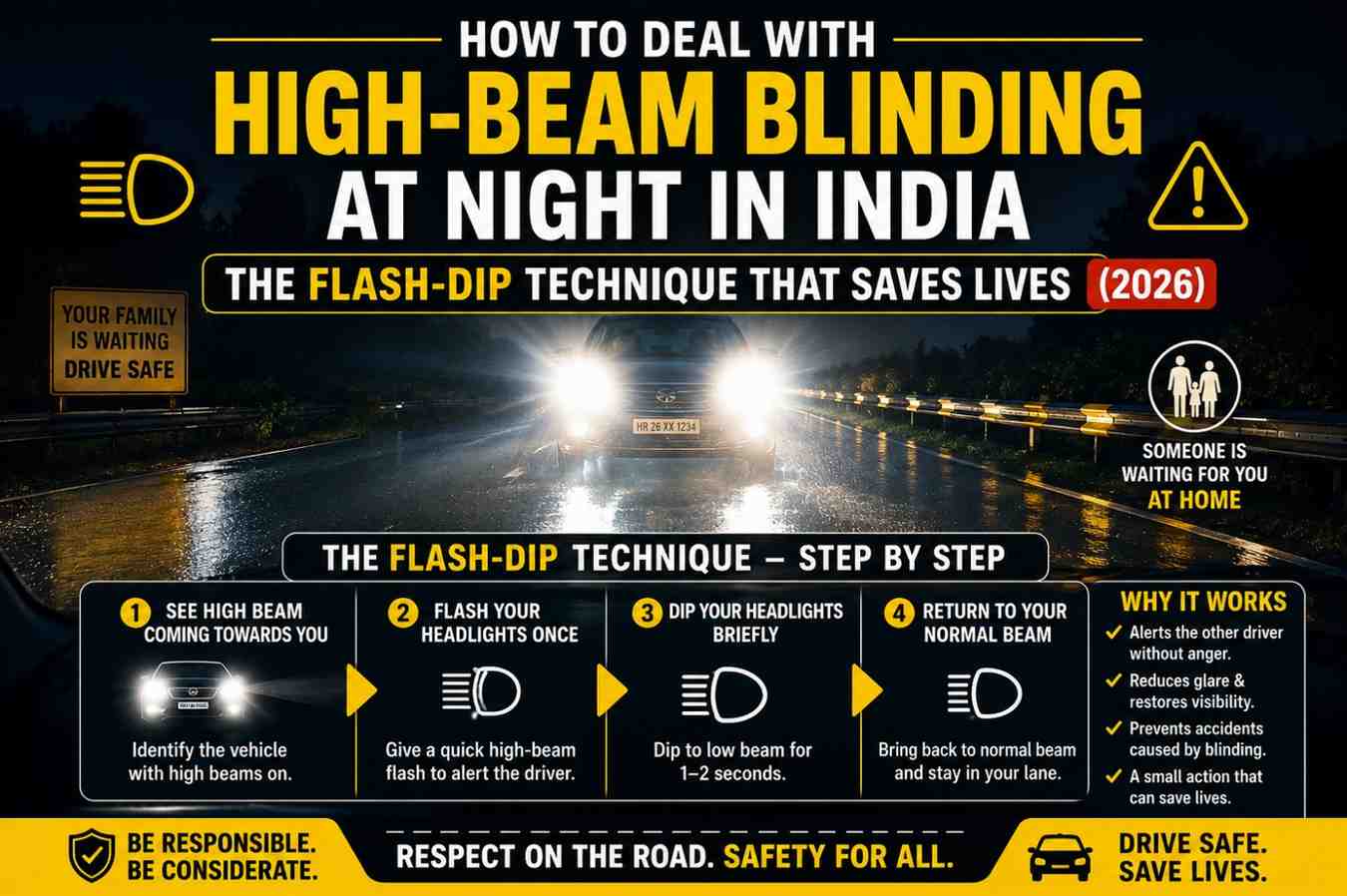
The dangers of driving at night on Indian highways from mutual high-beam blinding are significant and continuous on rural roads. Every blinding encounter creates 5–12 seconds of seriously impaired vision—during which an animal, a stopped vehicle, or a pedestrian could appear in your path without warning.
This danger is particularly acute on two-lane national highways where oncoming traffic is constant and both lanes are in use simultaneously.
Mitigation: The flash-dip technique (Article 2). Looking at the road edge rather than oncoming lights. Reducing speed to 60–70 km/h on two-lane rural highways at night, where high-beam encounters are frequent.
Danger 6 — Wrong-Way Drivers and U-Turn Accidents
Indian highways — particularly older national highways without access control — have designated U-turn points. At night, some drivers miss these and make illegal U-turns or enter the highway going the wrong way. Wrong-way highway driving creates a head-on collision scenario at combined approach speeds of 160–200 km/h—universally fatal.
Mitigation: At night, if you see a vehicle approaching on what appears to be your side of the road, immediately move as far left as possible and reduce speed rapidly. A vehicle with headlights on the wrong side of a divided highway is a genuine emergency requiring immediate defensive action.
Danger 7 — Construction Zones at Night
Highway construction in India frequently continues at night—and construction zones at night represent some of the most concentrated dangers of driving at night on Indian highways:
- Suddenly changed lane positions without adequate marking
- Workers on the road surface in dark clothing
- Unlit machinery and equipment on the carriageway
- Uneven surfaces and sudden level changes
- Temporary barriers without reflective marking
Mitigation: Reduce speed to 40 km/h in any marked construction zone. In unmarked or poorly marked construction zones (identifiable by cone patterns and road surface changes), treat every person ahead as a worker and slow dramatically.
FAQs — Dangers of Driving at Night on Indian Highways
Q1. What percentage of Indian highway accidents happen at night? Over 40% of fatal highway accidents in India occur between 6pm and 6am, despite lower traffic volumes—making night driving significantly more dangerous per kilometer traveled than daytime driving.
Q2. Why are truck-related accidents more common at night on Indian highways? Most of India’s long-haul freight movement happens at night. Truck drivers are often fatigued after many continuous hours of driving, and fatigue significantly impairs steering control, reaction time, and lane discipline.
Q3. What is the most dangerous section of night on Indian highways? 2am to 5am — combining peak driver fatigue, maximum truck traffic, lowest emergency service activity, and the body’s natural alertness trough. This is statistically the highest-risk window for night highway driving in India.
Q4. Are expressways safer than national highways at night? Yes—access-controlled expressways eliminate animal crossings, pedestrians, agricultural vehicles, illegal U-turns, and most unlit vehicle hazards through design. They are significantly safer for night driving than open national or state highways.
Q5. How do I protect myself from unlit truck dangers on Indian highways at night? Maintain longer following distances, actively scan for silhouettes ahead on dark stretches, drive within your ability to stop within your headlight range, and never drive on high beam behind a truck—your lights reflect off their mirrors and reduce your own forward visibility.
Conclusion
The dangers of driving at night on Indian highways are real, statistically documented, and specific. They are not random bad luck — they follow identifiable patterns involving fatigued truck drivers, animal crossings, unlit hazards, and driver fatigue. Every danger has a mitigation strategy. Together, these strategies do not eliminate night driving risk—but they reduce it to a manageable level for drivers who apply them consistently.
Know the dangers. Use the strategies. And when the destination can wait—let it wait until morning.
Share this article with drivers in your family and friend circle. Night highway safety is not discussed enough in India—and every conversation about it saves lives.
Image Suggestions:
- Image 1—After the Data section: A darkened Indian highway showing a truck with dim rear lights and a car approaching—illustrating the unlit vehicle danger. ALT text: dangers of driving at night on Indian highways — unlit truck on dark highway
- Image 2 — After the Animal section: Cattle standing on an Indian highway at night illuminated by headlights. ALT text: dangers of driving at night on Indian highways—animals on Indian highway at night
External Links: