 admin@prodriver.in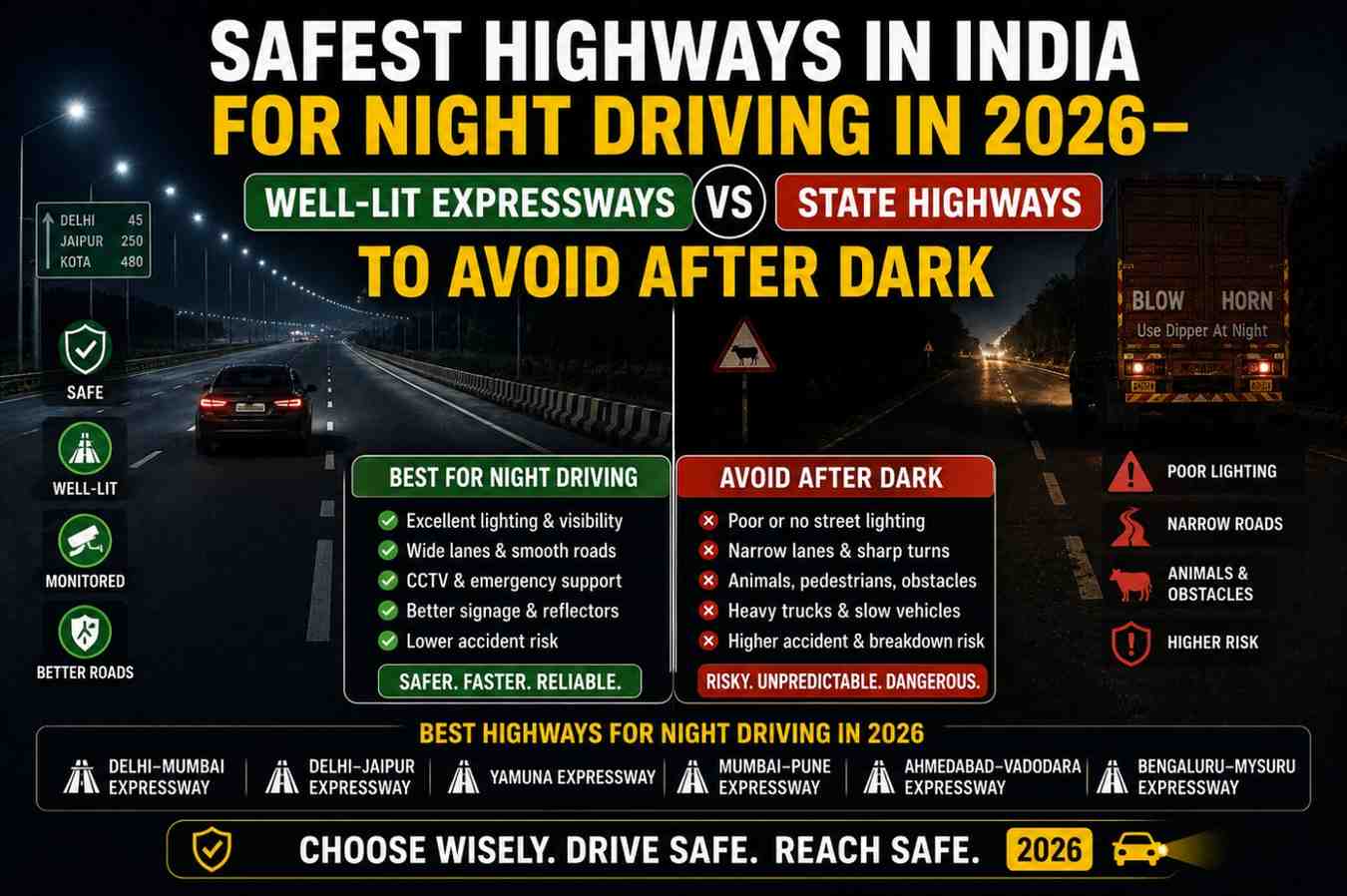
Not all Indian highways are equally dangerous at night. The safest highways in India for night driving in 2026 share specific characteristics—access control, lighting, emergency infrastructure, and road surface quality—that make them dramatically safer than open national highways or state roads after dark. Conversely, there are stretches that experienced drivers actively avoid after sunset.
This guide identifies the safest highways in India for night driving in 2026, explains what makes them safer, compares the expressway versus open highway debate honestly, and identifies the categories of roads you should specifically avoid for night driving where alternatives exist.
What Makes a Highway Safe for Night Driving in India 2026
The safest highways in India for night driving in 2026 share these characteristics:
- Access control—entry and exit only via dedicated ramps, no at-grade crossings
- Animal exclusion fencing—prevents cattle and wildlife from entering the carriageway
- Continuous lighting — at minimum at interchanges, toll plazas, and major bridges
- Emergency stopping lanes — paved shoulders for breakdown management
- NHAI patrol presence — regular highway patrol vehicles with active monitoring
- Road surface quality — consistent surface with clear lane markings and functional reflectors
- Speed enforcement — active cameras that discourage dangerous driving
Safest Highways India for Night Driving 2026 — Top Expressways
1. Yamuna Expressway (Delhi–Agra)—Among the Safest
The Yamuna Expressway is consistently cited as one of the safest highways in India for night driving in 2026. As a fully access-controlled 6-lane expressway with:
- Animal exclusion fencing the entire 165 km length
- Emergency calling stations every 2 km
- Active highway patrol 24/7
- Speed enforcement cameras
- Well-maintained reflective lane markings
- Emergency stopping lane throughout
Night driving risk rating: Low (for an Indian highway) Recommended maximum night speed: 90–100 km/h
2. Mumbai–Pune Expressway — Well-Patrolled Mountain Route
The Mumbai–Pune Expressway is one of the safest highways in India for night driving in 2026 in Maharashtra, though the ghat sections require speed reduction at night.
- Access-controlled throughout
- Active Maharashtra State Highway Police patrol
- Tunnel sections are fully lit
- Emergency phone boxes at regular intervals
- Good surface quality and clear markings
Night driving consideration: The Khopoli–Khandala ghat section requires a 60 km/h maximum at night due to curves and gradient. Outside the ghats, conditions are excellent.
Night driving risk rating: Low to medium (ghat sections)
3. Bangalore–Mysuru Expressway — South India’s Safest Night Drive
The newest and possibly safest expressway in South India in 2026:
- 10-lane access-controlled design
- Full perimeter fencing excluding animals
- LED streetlighting at key sections
- Active NHAI patrol
- High-quality reflective markings throughout
Night driving risk rating: Very low Recommended: One of the safest highways in India for night driving 2026 for families and inexperienced night drivers
4. Lucknow–Agra Expressway — UP’s Safest Night Corridor
- 6-lane access-controlled with complete fencing
- Regular NHAI patrol with tow vehicles
- Medical assistance points at intervals
- Well-maintained surface with reflective studs
- Speed cameras active throughout
Night driving risk rating: Low
5. Ahmedabad–Vadodara Expressway — Gujarat’s Consistent Performer
One of India’s oldest access-controlled expressways and still among the safest highways in India for night driving. 2026:
- Low truck density compared to major national highways
- Good emergency infrastructure
- Consistent road surface quality
- Active Surat-Vadodara corridor safety improvements in 2025–26
Night driving risk rating: Low
Highway Categories to Avoid for Night Driving in India 2026
While the safest highways in India for night driving in 2026 are expressways, several categories of roads should be actively avoided for night driving where alternatives exist:
Avoid—Undivided Two-Lane National Highways (Non-Expressway)
Undivided two-lane highways with oncoming traffic in the opposite lane are the single most dangerous road type for night driving in India. Head-on collisions on these roads are common and almost always fatal at highway speeds. If your route includes significant stretches of undivided two-lane highway, plan to cover these sections during daylight.
Examples of routes with significant undivided sections: Parts of NH53, NH27, NH44 north of Delhi, NH30 (Bihar sections)
Avoid State Highways at Night
State highways in India are significantly less safe for night driving than national highways due to the following:
- No NHAI patrol—state highways are monitored by state PWD, with less systematic patrol
- Lower road surface quality on average
- More at-grade crossings and intersections
- Less reflective marking maintenance
- More frequent pedestrian and animal access
Avoid Two-Lane Roads Through Forested Areas
Forested sections of national or state highways have elevated animal crossing risk—particularly between 8pm and 5am. In states like Maharashtra (Vidarbha forests), Madhya Pradesh, Uttarakhand, and Rajasthan (desert wildlife areas), night driving through forested sections significantly increases animal collision risk.
Avoid — Poorly Lit Urban Bypass Sections
Many Indian cities have highway bypass roads that technically qualify as national highways but pass through semi-urban areas with pedestrian access, unlit sections, and unmarked speed bumps. At night, these sections are disproportionately dangerous.
Expressway vs Open Highway Night Driving — Honest Comparison
| Safety Factor | Access-Controlled Expressway | Open National Highway |
|---|---|---|
| Animal crossings | None (fenced) | Frequent and dangerous |
| Oncoming vehicle conflict | None (divided) | Constant — high-beam encounters |
| Pedestrian risk | None (controlled) | Significant |
| U-turn and wrong-way risk | None (ramp-only access) | Present—illegal U-turns occur |
| Emergency infrastructure | Comprehensive | Variable |
| Road surface quality | High (managed) | Inconsistent |
| Speed enforcement | Active cameras | Sporadic |
| NHAI patrol frequency | High | Moderate |
| Overall night safety | Significantly higher | Significantly lower |
The data is clear: the safest highways in India for night driving in 2026 are access-controlled expressways. When planning any night drive, prioritize expressway sections and minimize time on open highway sections.
FAQs — Safest Highways in India for Night Driving 2026
Q1. Which is the single safest highway for night driving in India in 2026? The Bangalore–Mysuru Expressway and Yamuna Expressway are consistently rated the safest in their respective regions—both feature full access control, animal exclusion fencing, and active 24/7 patrol.
Q2. Are national highways safer than state highways for night driving in India? Generally yes — national highways have better NHAI oversight, more consistent road quality, and better emergency infrastructure. However, access-controlled expressways are significantly safer than either.
Q3. What makes an expressway safer than a regular highway for night driving? Access control eliminates animal crossings, pedestrian access, illegal U-turns, and head-on collision risk from oncoming traffic. These are the primary causes of nighttime highway fatalities in India.
Q4. Is the Delhi–Mumbai Expressway (under construction/newly opened sections) safe for night driving? The completed sections with full access control and fencing are among the safest highways in India for night driving 2026. Avoid sections where construction is ongoing — safety standards are significantly lower in construction zones.
Q5. How do I find which sections of my route are access-controlled before a night drive? Use MapMyIndia — it specifically identifies access-controlled expressway sections. NHAI’s website also maintains route information for all national highways under its management.
Conclusion
The safest highways in India for night driving 2026 are not random—they are the result of deliberate engineering decisions: access control, fencing, lighting, patrol, and surface quality. When you have a choice, choose the expressway. When you do not have a choice, apply every night driving safety technique in this guide.
Plan your routes using expressways wherever possible. Download offline maps. Identify your rest stops. Check your vehicle. And stay on the safest road available.
Which Indian expressway do you find safest for night driving? Share your experience in the comments.
Image Suggestions:
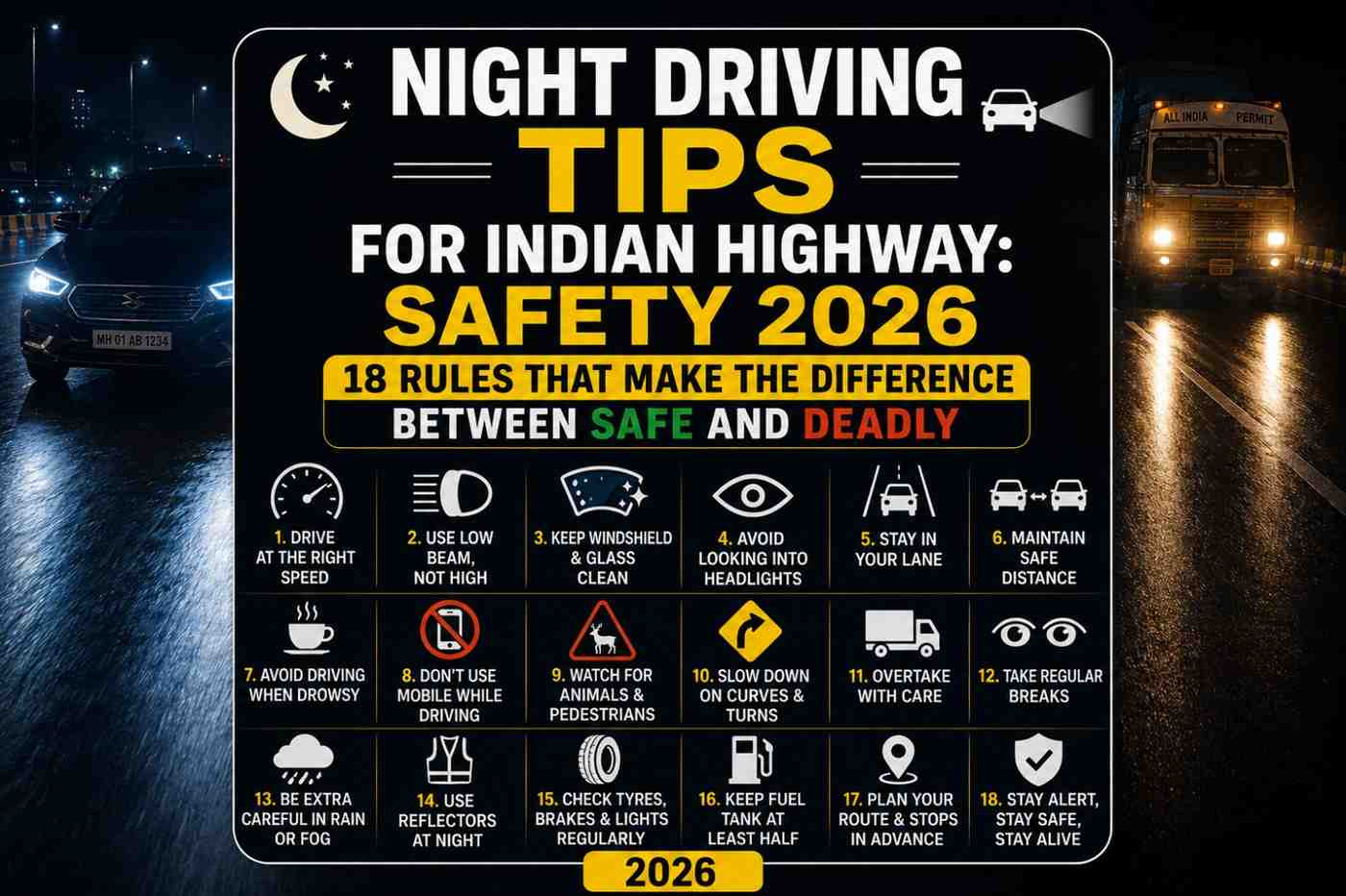
- Image 1 — After the introduction: A well-lit access-controlled expressway at night with clear lane markings and safety barriers. ALT text: safest highways in India for night driving 2026 — well-lit expressway at night
- Image 2 — After the Comparison Table: A dark, poorly lit open national highway with an unlit truck creating a hazard — contrast with the expressway image. ALT text: safest highways in India for night driving 2026 — dangerous open highway at night
External Links: