 admin@prodriver.in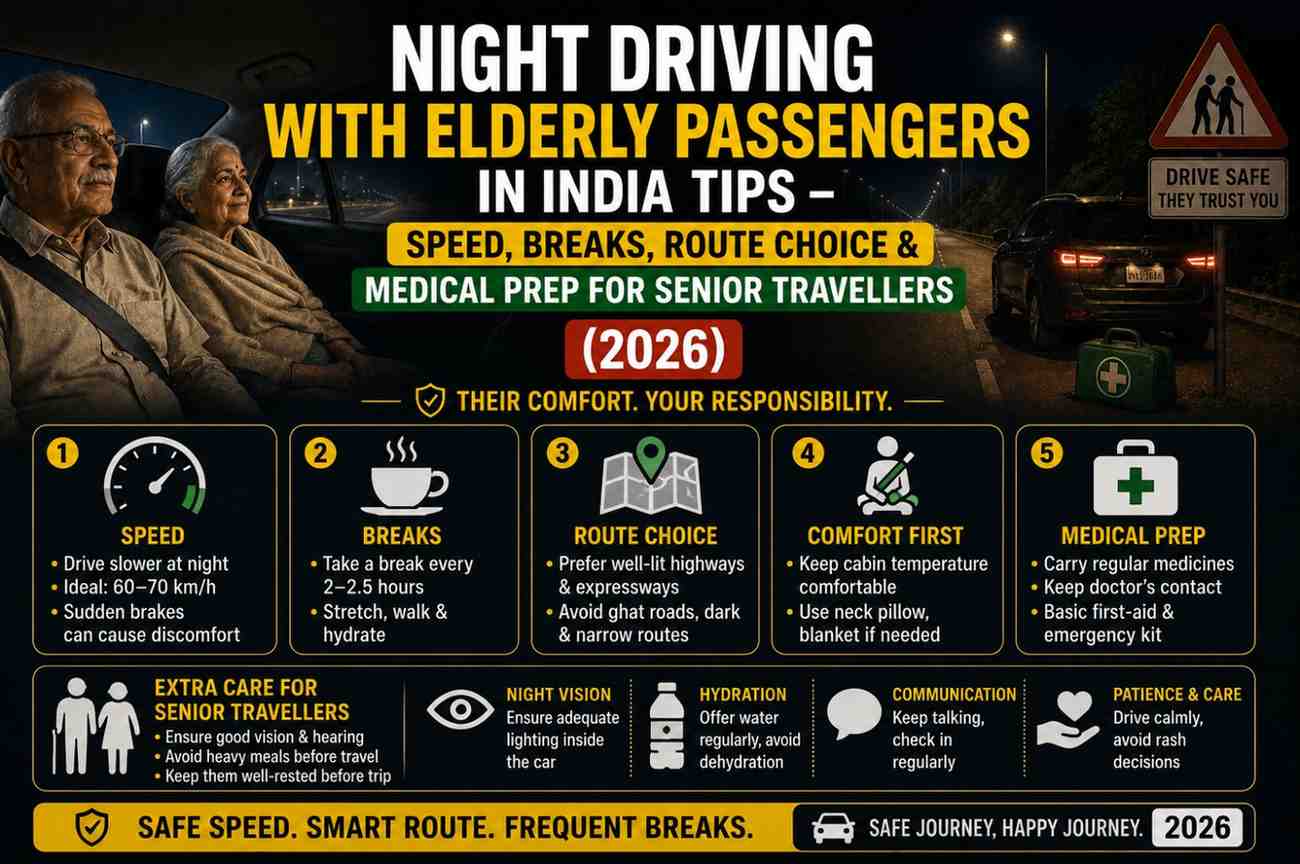
Driving at night with elderly passengers—parents, in-laws, grandparents—adds a layer of responsibility that goes beyond normal night driving care. Night driving with elderly passengers in India tips addresses a specific combination of needs: the vulnerability of elderly travelers to road stress, the longer recovery time from disrupted sleep, the medical considerations of pre-existing conditions, and the comfort adaptations that make a night journey manageable rather than exhausting for senior occupants.
This guide covers everything you need for night driving with elderly passengers in India—from pre-journey medical checks to in-car comfort, route choice, rest stop frequency, speed management, and emergency preparation specific to senior travelers.
Why Night Driving With Elderly Passengers Requires Different Planning
Night driving with elderly passengers India tips exist because elderly travelers have specific physiological differences from younger passengers:
- Vision changes: Older eyes take longer to adjust to darkness (up to 60 minutes for full adaptation vs 30 minutes for younger eyes) and are more severely affected by high-beam blinding
- Temperature sensitivity: Elderly passengers feel cold more intensely—especially at night and at altitude
- Bladder frequency: Most elderly passengers need bathroom stops more frequently—every 1.5–2 hours rather than 2–3 hours
- Medication schedules: Many elderly passengers take medications that must be administered at specific times, regardless of travel
- Motion sickness: More common in elderly passengers, particularly on winding roads at night
- Deep vein thrombosis (DVT) risk: Prolonged sitting in a car increases DVT risk significantly in elderly passengers, particularly those with cardiovascular conditions
- Anxiety about night travel: Many elderly Indians have heightened anxiety about highway travel, particularly at night—awareness and communication matter
Each of these factors has a specific response in night driving with elderly passengers in India.
Pre-Journey Medical Preparation — Night Driving With Elderly Passengers India Tips
Medication Check
Before any night journey with elderly passengers:
- List all medications the passenger takes, including dosage and timing
- Pack all medications in a clearly labelled bag that is accessible from the passenger seat—not in the boot
- Pack 1–2 extra days of supply beyond the journey’s expected duration
- Include any emergency medications—nitroglycerin for angina, bronchodilators for asthma, glucose tablets for diabetes
- Note the nearest hospital to your midway rest stop and destination in your phone
Pre-Journey Medical Consultation
For night driving with elderly passengers in India, in cases of significant medical conditions (recent cardiac events, poorly controlled diabetes, mobility issues, severe hypertension), consult the passenger’s doctor before planning a night highway journey. Some conditions genuinely contraindicate long highway travel, particularly at night when medical facilities are less accessible.
Check the Passenger’s own comfort assessment.
Ask the elderly passenger directly: Do they feel comfortable with a night journey? Many elderly Indians will not volunteer discomfort out of deference to the driver or family. A direct, caring question about comfort and concerns before departure establishes trust and allows adjustments before the journey starts.
Route Planning — Night Driving With Elderly Passengers India Tips
Route choice is one of the most impactful night driving with elderly passengers India tips.
Prefer Expressways Over Open National Highways
For all the reasons covered in Article 8 (safest highways in India for night driving 2026), access-controlled expressways are dramatically safer for night driving with elderly passengers. Their consistent surface, absence of animal crossings, and better emergency infrastructure reduce journey stress for both drivers and passengers.
Identify Medical Facilities Along the Route
Before departing, map the locations of:
- Government hospitals or multispecialty hospitals within 15–20 km of the route
- 24-hour pharmacies near planned rest stops
- The nearest hospital to the overnight destination
For night driving with elderly passengers in India, tips: this information should be in your phone—not something you search for in an emergency.
Avoid Routes Known for Poor Road Quality
For elderly passengers, poor road surfaces mean more vibration, more discomfort, and for passengers with spinal or joint conditions—genuine pain. Choose the smoothest, best-maintained route even if it adds distance.
Speed Management — Night Driving With Elderly Passengers: India Tips
Night driving with elderly passengers in India: tips on speed are specific:
- Reduce target speed to 70–80 km/h — lower than solo or younger-passenger night driving. This reduces vibration, allows gentler braking, and reduces the physical stress of the journey on elderly passengers.
- Brake earlier and more gently—elderly passengers feel sudden braking more acutely, and the forward lurch of hard braking can be uncomfortable for passengers with cervical or lumbar issues.
- Accelerate gradually — avoid aggressive acceleration that pushes passengers back into their seats.
- Anticipate bends and slow early—lateral G-forces in curves are uncomfortable for elderly passengers and can cause nausea on winding roads at night.
Rest Stop Planning — Night Driving With Elderly Passengers India Tips
Rest stop frequency is the most practically important of all night driving with elderly passengers. India tips:
- Stop every 90 minutes — more frequently than solo night driving
- Ensure stops have accessible toilets — at petrol stations, dhabas, or highway wayside amenities. Check MapMyIndia or Google Maps for toilet-accessible stops along your route before departing.
- Allow 20–30 minutes at each stop—elderly passengers need more time to get out of the car, use facilities, and re-board comfortably
- Never rush elderly passengers at stops—haste causes falls, and a fall in a dark car park at night is a serious medical event
- Bring a small portable torch for illuminating car park areas at rest stops where lighting is poor—a common situation at dhaba stops on Indian highways at night
In-Car Comfort Management — Night Driving With Elderly Passengers India Tips
Seating and Posture
Night driving with elderly passengers India tips for seating:
- The front passenger seat is generally more comfortable for elderly passengers—better leg room, easier entry and exit, and less motion sickness than rear seats
- Recline the seat slightly (10–15°) for long journeys—this reduces lower back strain
- Bring a small travel pillow for neck support—cervical discomfort is common in elderly passengers on long night drives
- A thin seat cushion adds comfort for passengers with coccyx or hip joint issues
Temperature Management
Elderly passengers are consistently more cold-sensitive than younger passengers.
- Keep the cabin warmer than you might prefer for yourself—24–26°C is typical for comfortable elderly passenger temperature
- Have a light blanket available—even if the AC is set comfortably, some elderly passengers prefer the reassurance of a wrap
- Avoid directing AC vents toward elderly passengers—particularly those with arthritis, as cold air on joints causes discomfort
Motion Sickness Prevention
Night driving with elderly passengers India tips for motion sickness:
- Seat the passenger where they experience least motion—the front seat is best
- Ensure they look forward through the windshield rather than at a phone or book
- On winding roads, reduce speed and take curves as smoothly as possible
- Keep windows slightly cracked for fresh air if nausea begins
- Carry motion sickness medication (Avomine/Stemetil) on advice of their doctor
Emergency Preparation — Night Driving With Elderly Passengers: India Tips
Night driving with elderly passengers India’s tips for emergency situations are more detailed than for standard journeys:
- Save the passenger’s doctor’s number in your phone before departure
- Know the passenger’s blood type if possible—relevant in emergency situations
- Carry a basic medical history summary—medications, allergies, and existing conditions written on paper in the glove box
- Know the signs of a cardiac event: chest pain, left arm pain, jaw pain, severe breathlessness—call 108 immediately and do not drive further
- Know the signs of a stroke (FAST): Face drooping, Arm weakness, Speech difficulty, Time to call 108
- Save NHAI 1033 and 108 as phonebook entries before departure
FAQs — Night Driving With Elderly Passengers India Tips
Q1. What is the maximum recommended continuous driving duration for a journey with elderly passengers at night? 90 minutes maximum before a meaningful stop of 20–30 minutes. Never more than 4 hours of total driving before an extended rest of at least 1 hour.
Q2. Is it safe for elderly passengers to travel on Indian highways at night? With proper preparation — medical check, route selection preferring expressways, frequent stops, lower speed, and emergency preparation — night driving with elderly passengers is manageable. For passengers with serious cardiac or mobility conditions, daytime travel on the same route is significantly preferable.
Q3. How do I handle a medical emergency with an elderly passenger on an Indian highway at night? Call 108 immediately. Switch on hazard lights and move to the road shoulder. Keep the passenger still and calm. Call NHAI 1033 to request emergency assistance and provide your kilometer milestone location. If a hospital is nearby on MapMyIndia, assess whether driving to it (within 5–10 minutes) is safer than waiting for the ambulance.
Q4. What is the best seat for an elderly passenger on a long Indian highway night drive? The front passenger seat has better legroom, easier boarding and alighting, less motion sickness, and is more comfortable for extended journeys than rear seats.
Q5. Should elderly passengers eat before a night highway journey in India? A light meal 1–2 hours before departure is ideal. Avoid heavy meals immediately before or during the journey—post-meal drowsiness affects drivers too, and heavy food can cause discomfort in elderly passengers on moving vehicles. Pack light, easily digestible snacks (fruits, biscuits, and nuts) for during the journey.
Conclusion
Night driving with elderly passengers India tips come down to one fundamental principle: your elderly passengers deserve the slowest speed, the smoothest driving, the most frequent stops, the warmest cabin, and the most thorough emergency preparation of any journey you will ever make. They have trusted you with their safety—and the adjustments required are modest: lower speed, more stops, and better preparation.
The destination is always secondary to the well-being of the people in your car. Drive gently, prepare thoroughly, and bring them home safely.
—collectiveTraveling with elderly parents or grandparents on Indian highways? Share your own tips and experiences in the comments — collective wisdom from Indian families helps everyone plan safer journeys.
External Links: