 admin@prodriver.in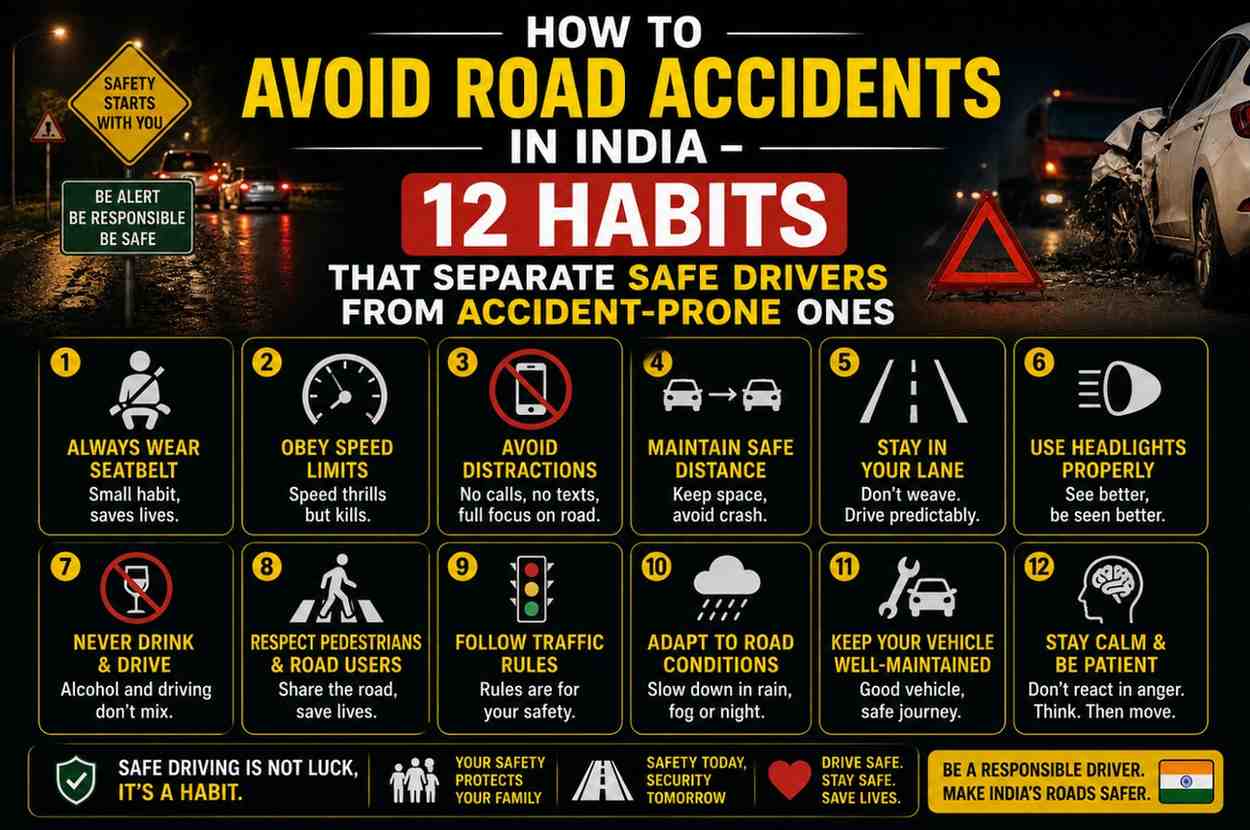
India loses more lives on its roads than any other country in the world. In 2023, 168,491 people died in road accidents—a figure that continues to grow year on year. Understanding how to avoid road accidents in India is therefore not merely a matter of personal safety. It is a civic responsibility shared by every driver on every road, every day.
The critical question for every Indian driver is this: what separates drivers who go decades without a serious accident from those who seem to attract danger? The answer to how to avoid road accidents in India lies not in luck, special talent, or expensive cars—but in a consistent set of learnable, repeatable habits that any driver can adopt today.
In this guide, we examine 12 evidence-backed habits that directly address India’s most common accident causes. Each habit in this how-to-avoid-road-accidents-in-India framework is drawn from MoRTH accident data, international defensive driving research, and analysis of India’s specific road conditions.
Understanding India’s Road Accident Landscape
Any guide on how to avoid road accidents in India must begin with the data—because knowing where accidents happen, when they happen, and why they happen is the foundation of prevention.
Key MoRTH 2023 Data Points:
- Overspeeding: Cited in 68.3% of all road accidents
- Driving on the wrong side: Second leading cause
- Drunken driving: Responsible for 3.1% of accidents but 11.4% of deaths
- Use of mobile phones: Rising rapidly — now a factor in 1 in 4 urban accidents
- Time: 54% of fatal accidents occur between 6 PM and 6 AM
- Location: National Highways account for just 2% of India’s road network but 32% of all accident deaths
- Vehicle type: Two-wheelers account for 44.5% of accident deaths
These statistics define the battlefield for how to avoid road accidents in India. The 12 habits below directly target the most lethal risk factors.
12 Habits That Define How to Avoid Road Accidents in India
Habit 1 — Drive at Appropriate Speed, Not Just Legal Speed
The most important principle in how to avoid road accidents in India is understanding that speed limits are maximum allowed speeds, not recommended speeds. In rain, fog, night conditions, school zones, or high-pedestrian areas, the appropriate speed may be 30–40% below the legal limit.
Physics of speed and accident severity:
- At 40 km/h, a pedestrian hit by a car has a 10% chance of death
- At 60 km/h, that rises to 45%
- At 80 km/h, it becomes 85%
Every km/h reduction in average speed reduces accident frequency by 3–5% and accident fatality by 6–8%.
Habit 2 — Maintain Absolute Attention — No Multitasking
Safe drivers give roads 100% of their attention, 100% of the time. This means:
- No mobile phone (even hands-free calls reduce attention by 37%)
- No eating or drinking while driving
- No extended conversations with passengers in complex traffic
- No adjusting music or navigation while in motion
The answer to how to avoid road accidents in India in urban traffic is simple: if you can’t give the road your full attention, stop doing the other thing.
Habit 3 — Scan 12–15 Seconds Ahead at All Times
Beginner drivers look 2–3 seconds ahead — just far enough to react to what’s immediately in front. Safe, experienced drivers continuously scan 12–15 seconds ahead — the distance they’ll cover in the next quarter minute.
This habit gives you time to:
- Notice brake lights building ahead
- Identify a pedestrian about to cross
- See a pothole or animal on the road
- Observe a vehicle pulling out of a side road
This extended forward awareness is central to how to avoid road accidents in India on both city roads and highways.
Habit 4 — Always Have an Escape Route
Every safe driver maintains a mental escape route at all times—a space they could swerve into if the car ahead stopped suddenly. This habit is about never boxing yourself in:
- Don’t drive in a vehicle’s blind spot for extended periods
- Maintain side clearance—don’t hug the kerb or the central divider
- Avoid driving directly alongside another vehicle for long periods on multi-lane roads
Knowing how to avoid road accidents in India requires always having somewhere to go if the unexpected happens.
Habit 5 — Practice Defensive Overtaking
Wrong-side overtaking and reckless passing are India’s second most common accident cause. Safe drivers follow these overtaking rules rigidly:
- Never overtake on a blind curve or hill crest
- Never overtake near a junction, pedestrian crossing, or school zone
- Always ensure clear road ahead for at least 300 metres before overtaking on a highway
- Signal before beginning and after completing the overtake
- Never overtake more than one vehicle at a time
Habit 6 — Prepare for the Unpredictable: Expect the Unexpected
A core principle in how to avoid road accidents in India is accepting that other road users will not always behave predictably. Anticipate:
- Animals crossing without warning on rural roads
- Two-wheelers appearing from between parked vehicles
- Pedestrians crossing middle of the road away from zebra crossings
- Vehicles reversing out of driveways without checking mirrors
The safest Indian drivers build a mental model of everything that could happen and are already adjusting before it does.
[IMAGE 1 — Place after Habit 6]
Suggested Image: A split-screen road illustration showing two scenarios—the left side shows an accident-prone driver: speeding, on phone, following closely, on the wrong side. The right side shows a safe driver: correct speed, phone away, safe gap, proper lane—same road conditions. ALT Text: “How to avoid road accidents in India—split-screen illustration contrasting accident-prone driver behavior vs. safe driver behaviour on the same Indian road”
Habit 7 — Manage Fatigue Actively
Fatigue is one of the most underestimated factors in how to avoid road accidents in India. Studies show that being awake for 18 hours creates driving impairment equivalent to a blood alcohol level of 0.05% — at or above India’s legal limit.
Fatigue management protocol:
- Never drive between 2 AM and 6 AM if avoidable (natural circadian low point)
- Rest stop every 2 hours on highway trips (minimum 15 minutes)
- If you feel sleepy, no amount of coffee or fresh air is a substitute for sleep
- Travelling in pairs and rotating drivers on long trips is the safest approach
Habit 8 — Handle Monsoon Roads as a Different Driving Environment
India’s monsoon transforms roads in ways that directly test your knowledge of how to avoid road accidents in India:
- Reduce speed by 30–40% on wet roads
- Increase following distance to 6–8 seconds
- Avoid sudden braking—apply brakes slowly and progressively
- Avoid puddles of unknown depth—they may conceal potholes
- Watch for flooded roads—never attempt to drive through water of unknown depth
- Turn on headlights even during daytime monsoon rain (legal requirement in many states)
Habit 9 — Maintain Your Vehicle Proactively
Mechanical failure causes a significant percentage of Indian highway accidents—particularly tire blowouts and brake failures. Avoiding vehicle-related accidents is a key part of how to avoid road accidents in India:
- Tyre pressure check: monthly and before every long trip
- Brake inspection: every 10,000 km or if any sponginess or noise appears
- Tyre tread depth: replace when tread reaches 1.6mm (minimum legal depth)
- Lights: check all lights before every night drive
Habit 10 — Use Roundabouts and Intersections Correctly
A disproportionate number of urban accidents happen at intersections. The discipline of how to avoid road accidents in India at junctions includes the following:
- Approaching intersections at reduced speed
- Never assuming a green light means the junction is clear (cross-traffic violations are common)
- Looking left-right-left before entering any unmarked crossing
- Slowing and being prepared to stop at all unmarked junctions
Habit 11 — Respect Two-Wheelers and Pedestrians
Two-wheelers account for 44.5% of Indian road fatalities. Many involve multi-vehicle accidents where a car driver failed to check for motorbikes. How to avoid road accidents in India involving two-wheelers:
- Always check for motorcycles in your blind spot before lane changes
- Give extra lateral space when passing cyclists and two-wheelers
- Never cut in front of a two-wheeler suddenly
- Be especially vigilant at night—many two-wheelers have dim or malfunctioning lights
Habit 12 — Never Assume — Always Verify
The final and perhaps most philosophical habit in how to avoid road accidents in India is never assuming another driver, pedestrian, or animal will do what you expect. Assume instead that they will do the most dangerous thing possible—and drive accordingly.
- Don’t assume the pedestrian has seen you
- Don’t assume the indicator means the car will actually turn
- Don’t assume the truck knows you’re in its blind spot
- Don’t assume the road is clear because it looks clear
[IMAGE 2 — Place before FAQs]
Suggested Image: A vertical infographic showing India’s 5 top accident causes with statistics (overspeeding 68%, wrong-side driving, mobile use, drunk driving, and fatigue) with a corresponding “safe habit” counter-action arrow pointing from each cause to its prevention habit. ALT Text: “How to avoid road accidents in India—infographic showing India’s top 5 accident causes with MoRTH statistics and corresponding safe driving habits to prevent each”
FAQs: How to Avoid Road Accidents in India
Q1: What is the single most effective way to avoid road accidents in India? A: Controlling speed is the most effective single intervention. Overspeeding is cited in 68.3% of all Indian road accidents. A driver who consistently respects speed limits and adjusts speed for conditions eliminates the leading cause of accidents immediately.
Q2: How to avoid road accidents in India during the monsoon season specifically? A: Reduce speed by 30–40%, increase following distance to 6–8 seconds, avoid sudden braking, keep headlights on, avoid unknown-depth puddles, and never attempt flooded roads. Monsoon driving demands treating wet roads as a fundamentally different driving environment.
Q3: Is understanding how to avoid road accidents in India different for highway vs. city driving? A: Yes. City driving requires managing unpredictable pedestrians, two-wheelers, and intersection hazards at low speeds. Highway driving requires managing high speed, fatigue, overtaking discipline, and animal crossings at night. Both require the same foundational habits applied in different contexts.
Q4: How to avoid road accidents in India involving two-wheelers? A: Always check mirrors and blind spots before lane changes; give extra lateral clearance when passing; never cut in front of two-wheelers; and be especially vigilant at night when many bikes have poor lighting.
Q5: Does knowing how to avoid road accidents in India mean you’ll never have an accident? A: Safe driving habits dramatically reduce accident probability but cannot eliminate it entirely because other road users may still make dangerous choices. The goal is to maximize your ability to identify and avoid hazards created by others while eliminating all self-created risks.
Conclusion
How to avoid road accidents in India ultimately comes down to 12 consistent, repeatable habits — not luck, not reflexes, and not vehicle technology. Speed management, full attention, fatigue awareness, defensive overtaking, and constant anticipation of the unexpected are the disciplines that separate safe drivers from accident-prone ones on India’s roads.
India’s road death toll will only fall when enough individual drivers choose to drive defensively, responsibly, and with the awareness that every trip is a shared responsibility. The knowledge of how to avoid road accidents in India is freely available. The choice to apply it every single day is yours.
Share this guide with every driver in your family and community—because the habit of safe driving, once spread, protects everyone on the road.
External Links
- https://morth.nic.in/road-accident-in-india — MoRTH Road Accident Annual Report India
- https://www.who.int/teams/social-determinants-of-health/safety-and-mobility/road-safety — WHO Global Road Safety
- https://roadsafety.transport.nsw.gov.au — NSW Defensive Driving Guide
- https://www.nithe.nic.in — National Institute for Training of Highway Engineers India
- https://www.irtad.net — International Road Traffic and Accident Database