 admin@prodriver.in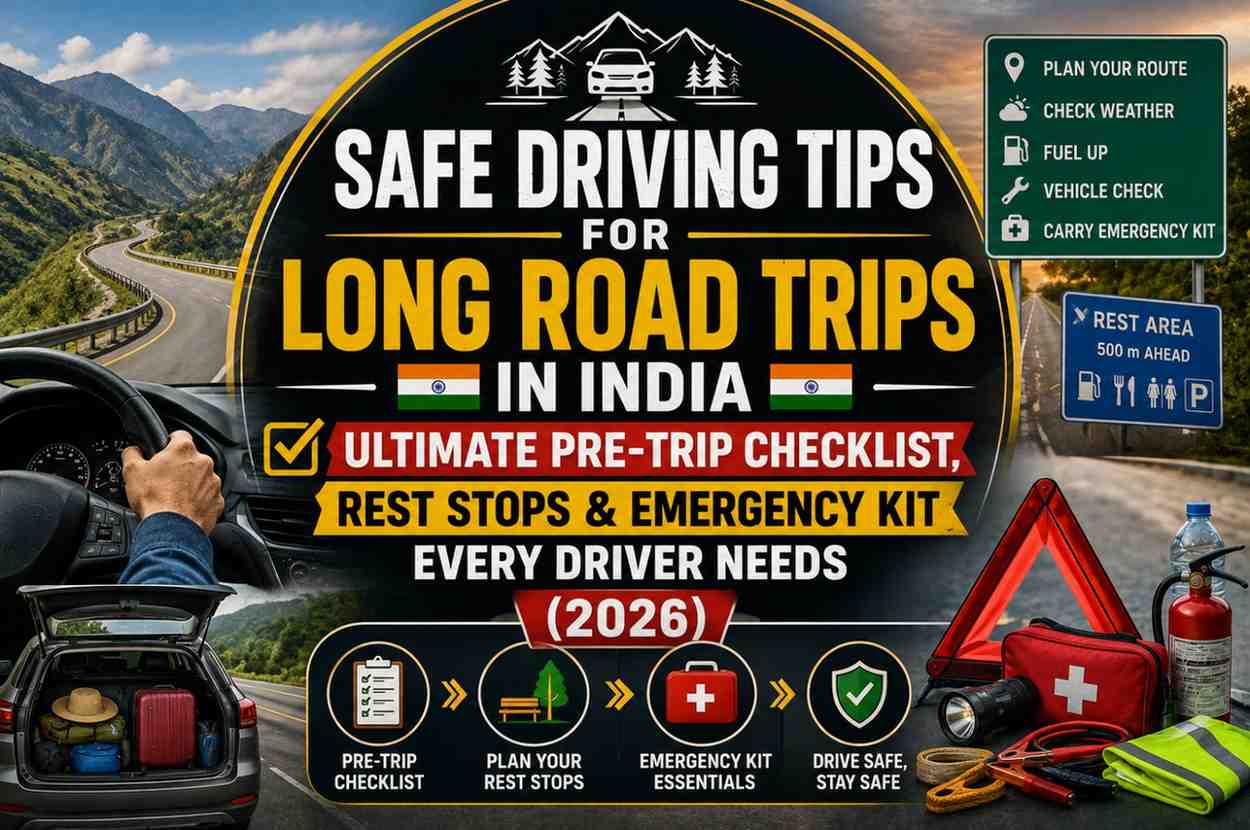
Long road trips across India’s expanding highway network are one of the great joys of the modern Indian travel experience. From Mumbai to Goa, Delhi to Manali, Bengaluru to Coorg — the open road offers freedom and adventure. But without proper preparation, that adventure can become a tragedy. Safe driving tips for long road trips in India are not about being cautious to the point of timidity—they’re about being prepared to the point where nothing can stop you from enjoying every kilometer.
India’s national highway network has grown to over 146,000 km in 2026. Highway speeds have increased. Traffic has grown. And with more families and young travelers choosing road trips over flights, the need for safe driving tips for long road trips in India has never been more urgent. MoRTH data shows that highway accidents cause disproportionately more fatalities than city accidents because of higher speeds and reduced medical response times.
In this complete guide, you’ll find safe driving tips for long road trips in India covering vehicle preparation, route planning, fatigue management, weather considerations, and a comprehensive emergency kit list that every Indian highway driver should carry.
Before You Leave: The Pre-Trip Vehicle Checklist
The most important of all safe driving tips for long road trips in India happens before the car ever moves. A thorough pre-trip vehicle inspection takes 20 minutes and can prevent breakdowns, accidents, and life-threatening situations on remote Indian highways.
Tyres — Most Critical Pre-Trip Check
Pressure: Check all four tires and the spare when cold (not driven in the last 3 hours). Correct pressure is listed on the tire placard on the driver’s door jamb. Note: Highway driving at sustained speeds requires tire pressure to be at the higher end of the recommended range—not reduced.
Tread depth: Insert a 1-rupee coin into the tread grooves. If the outer ring of the coin is fully visible, tread depth is critically low—replace before the trip.
Visual inspection: Look for any bulging, cracking, or embedded objects. A tire that looks suspicious at home will fail on the highway.
Spare tire: Verify it is inflated to full pressure and that the jack and wheel brace are present and functional.
Brakes
Apply the brakes firmly in a safe area at 40 km/h. The car should stop straight without pulling left or right. Any sponginess, grinding noise, or vibration indicates an issue requiring professional inspection before the highway trip.
Engine Fluids
Check engine oil (dipstick), coolant level (overflow reservoir), brake fluid (reservoir under the bonnet), and power steering fluid. A long highway trip at sustained speeds stresses all cooling and fluid systems more than city driving.
Lights
Test all lights — headlights (low and high beam), brake lights, turn indicators (front and rear), hazard lights, and reverse lights. Night driving on Indian highways with a malfunctioning brake light is extremely dangerous.
[IMAGE 1 — Place after pre-trip checklist]
Suggested Image: A clean illustrated pre-trip inspection checklist displayed over a car outline—tire with pressure gauge at each wheel, engine hood open with fluid checks, lights illuminated, seatbelts visible, spare tire in the boot, first aid kit—all in green checkmark style. ALT Text: “Safe driving tips for long road trips India—illustrated pre-trip vehicle inspection checklist showing tyre pressure, fluid levels, lights, spare tyre, and first aid kit with checkmarks”
Route Planning: Safe Driving Tips for Long Road Trips India
Smart route planning is fundamental to safe driving tips for long road trips in India:
Plan for Time, Not Distance Calculate your arrival time based on realistic average speeds — not Google Maps’ best-case estimate. On Indian highways in 2026, realistic average speed, accounting for tolls, rest stops, and variable traffic, is 70–80 km/h on good stretches. Plan accordingly and add 20–30% buffer time.
Identify Rest Stop Locations The most important route planning aspect of safe driving tips for long road trips India: identify NHAI rest areas, dhabas, petrol stations, and towns where you’ll stop every 2 hours. Pre-planning rest stops removes the temptation to “push on” when fatigue builds.
Download Offline Maps Cellular coverage remains inconsistent on remote Indian highways. Download offline Google Maps or Maps.me for your entire route before leaving home with Wi-Fi.
Know Your Emergency Numbers
- National Highway Emergency: 1033
- Police: 100
- Ambulance: 108
- General Emergency: 112
- NHAI helpline: 1800-11-6886
Check Road and Weather Conditions
- Check for highway closures, landslide reports, or weather alerts before departure
- Monsoon alerts: NDRF website, India Met Department (mausam.imd.gov.in)
- Real-time highway conditions: Google Maps traffic, NHAI website
The Fatigue Management Protocol: Core Safe Driving Tips for Long Road Trips India
Fatigue is the dominant risk factor on long Indian highway trips. These safe driving tips for long road trips in India for fatigue management are non-negotiable:
The 2-Hour Rule: Drive no more than 2 consecutive hours without stopping. Park completely, exit the vehicle, walk for 10 minutes, and stretch. Research consistently shows that driver performance begins degrading after 90–120 minutes of continuous driving.
Rotate Drivers: If traveling with another licensed driver, rotate every 2 hours. Two alert drivers sharing driving duty is the single most effective fatigue-prevention strategy for long trips.
Night Driving — The High-Risk Window: The period between 2 AM and 5 AM represents the highest fatigue risk — it aligns with the natural circadian trough when sleepiness is most intense regardless of previous sleep. Avoid driving during this window if possible.
Warning Signs That Mean Stop Now:
- Eyelids feeling heavy
- Drifting within lane
- Missing road signs or landmarks
- Difficulty maintaining speed
- Head nodding
If any of these appear, pull over immediately to the next safe rest area or service station.
What Doesn’t Work:
- Loud music (provides temporary alertness, not real relief)
- Opening windows (temporary at best)
- Coffee (delays sleep onset by 30–60 minutes but doesn’t restore driving capability)
- Willpower (neurologically impossible to overcome severe sleep deprivation)
Only genuine rest restores safe driving capability.
Weather-Specific Safe Driving Tips for Long Road Trips India
Monsoon Road Trips: The safe driving tips for long road trips in India during monsoon deserve special emphasis:
- Reduce highway speed by 30–40% on wet roads
- Increase following distance to 6–8 seconds
- Be prepared for sudden road submersion—never drive through floodwater of unknown depth
- Landslide zones (Western Ghats, Himalayas, Northeast): check NDRF alerts before and during the journey
- Carry a waterproof torch, extra drinking water, and non-perishable food in case of a forced stop
Winter Fog (North India, November–February): Fog on Delhi-Agra-Jaipur highways causes multiple fatal pile-ups every winter:
- Use fog lights (not high beams—high beams reflect back in fog)
- Reduce speed dramatically—visibility can drop to under 10 metres
- If visibility falls below 30 metres, pull completely off the road
- Keep hazard lights on if stopped
The Highway Emergency Kit: Essential Safe Driving Tips for Long Road Trips India
Every vehicle on a long Indian road trip must carry these items:
Safety and Breakdown Kit:
- Warning triangles × 2 (mandatory by law; place 50m behind vehicle)
- Reflective vest for driver (visible when exiting at night)
- Tow rope
- Jumper cables (for dead battery)
- Basic tool kit (spanners, screwdrivers, pliers)
- Tyre inflator/portable compressor
- Spare engine oil (1 litre)
First Aid Kit:
- Sterile bandages, gauze, medical tape
- Antiseptic solution and wipes
- Paracetamol, antacid, anti-allergy tablets
- Digital thermometer
- First aid manual
- Prescription medications for all travellers
Communications and Navigation:
- Fully charged power bank (minimum 20,000 mAh)
- Emergency phone charger (car adapter + cable)
- Physical map/road atlas (backup for no-signal zones)
- Emergency contact list written on paper (not just in phone)
Comfort and Sustenance:
- Water (2 litres minimum per person)
- Non-perishable snacks (nuts, energy bars, dry fruits)
- Blanket (for unexpected night stops)
- Spare glasses/contacts for driver
[IMAGE 2 — Place after emergency kit]
Suggested Image: A flat-lay overhead illustration of a car boot with all emergency kit items neatly arranged and labelled—warning triangles, first aid kit, tow rope, jumper cables, tire inflator, power bank, water bottles, and blanket—with the boot of an Indian hatchback/sedan visible around them. ALT Text: “Safe driving tips for long road trips India—overhead flat-lay illustration of complete highway emergency kit in car boot showing warning triangles, first aid kit, tow rope, a tire inflator, power bank, and water.”
FAQs: Safe Driving Tips for Long Road Trips India
Q1: What are the most important safe driving tips for long road trips in India for first-time highway drivers? A: Complete the pre-trip checklist, plan rest stops every 2 hours, download offline maps, carry the emergency kit, and never drive after 2 AM if fatigued. These five elements of safe driving tips for long road trips in India cover the majority of long-trip risk factors.
Q2: How many hours of continuous driving are safe according to safe driving tips for long road trips in India? A: A maximum of 2 hours before a 15-minute break. Total daily driving should not exceed 8–10 hours. Beyond 10 hours of driving in a single day, fatigue-related accident risk rises dramatically regardless of experience level.
Q3: Do safe driving tips for long road trips in India change during monsoon season? A: Significantly. Monsoon trips require 30–40% speed reduction, a 6–8 second following distance, NDRF weather alert checks before each day’s drive, and additional emergency supplies for potential forced stops due to flooding or landslides.
Q4: Is solo long-distance driving covered in safe driving tips for long road trips in India? A: Solo driving significantly increases fatigue risk as there’s no co-driver to share the duty or notice warning signs. Solo drivers on long highway trips should follow a strict 90-minute (not 2-hour) drive-then-rest cycle and avoid driving between 2 AM and 5 AM under any circumstances.
Q5: What phone app is most useful alongside safe driving tips for long road trips in India? A: Google Maps (offline downloaded) for navigation, the NHAI One app for highway incidents and services, and the 112 India emergency app for rapid access to all emergency services. These three apps together provide comprehensive support for safe long road trips in India.
Conclusion
Safe driving tips for long road trips in India transform a potentially risky journey into a controlled, enjoyable adventure. The pre-trip checklist, fatigue management protocol, route planning, and emergency kit together address the leading causes of highway accidents and breakdowns on Indian roads.
Indian highways in 2026 are better than they’ve ever been — wider, smoother, better lit, and better serviced. With the right preparation and the right habits, a long road trip across India is an experience to celebrate, not fear.
Complete your pre-trip checklist before your next journey, build your emergency kit this weekend, and hit the road with the confidence that comes from genuine preparation. Safe travels!
External Links
- https://morth.nic.in — Ministry of Road Transport and Highways India
- https://nhai.gov.in — NHAI: National Highway Services and Emergency
- https://mausam.imd.gov.in — India Meteorological Department: Weather Alerts
- https://www.ndrf.gov.in — National Disaster Response Force: Road Alerts
- https://roadsafety.transport.nsw.gov.au/going-on-a-road-trip — NSW Roads: Long Trip Safety Guide