 admin@prodriver.in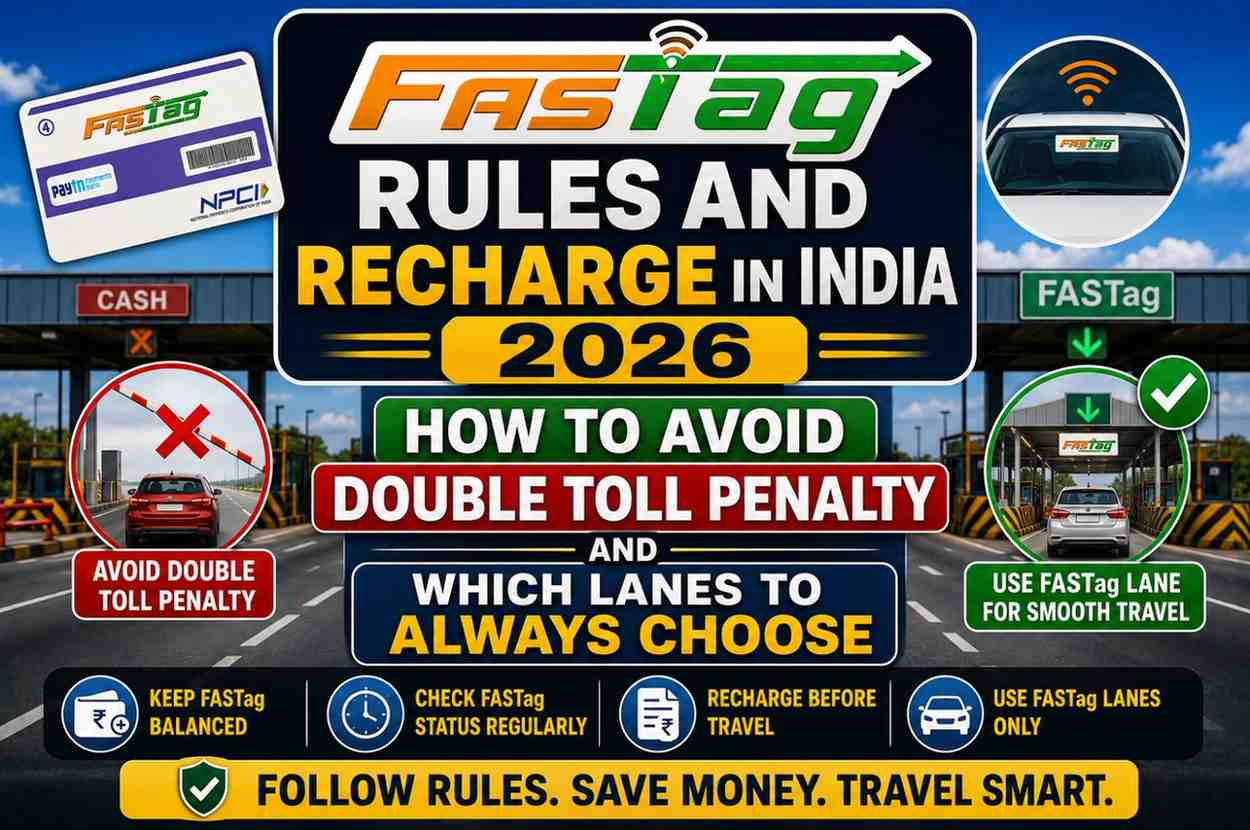
Nothing kills the joy of a highway drive faster than a dispute at a toll booth. In 2026, FASTag rules and Recharge in India 2026 are more important than ever—because the penalties for getting it wrong are steep, the queues at toll plazas are unforgiving, and the system has evolved significantly from when FASTags were first introduced.
Whether you are a new driver getting your first FASTag or an experienced highway traveler trying to understand the latest 2026 rules, this complete guide on FASTag rules and recharge India 2026 covers everything—from how FASTag actually works to recharge options, lane selection, blacklist rules, and how to avoid the dreaded double penalty.
How FASTag Works in India 2026
FASTag is a Radio Frequency Identification (RFID) tag that is affixed to your vehicle’s windshield. When you approach a FASTag-enabled toll plaza, a scanner reads the tag, deducts the applicable toll from your linked bank account or prepaid wallet, and the barrier opens automatically—all within 2–4 seconds.
FASTag rules and recharge in India 2026 operate under the following system:
- FASTag is issued by 32+ authorised banks and payment platforms
- The tag is linked to a prepaid wallet maintained with the issuing bank
- Toll deduction is automatic—no physical payment needed
- You receive an SMS and app notification after every deduction
- The tag is vehicle-specific—one FASTag per vehicle, permanently affixed to the windshield
Understanding this system is the foundation of all FASTag rules and recharge in India 2026.
FASTag Rules India 2026 — The Non-Negotiables
Rule 1 — FASTag is Mandatory for All Vehicles
Since February 2021, FASTag has been mandatory for all four-wheelers on national highways in India. In 2026, enforcement has been extended to state highways and toll plazas in most states. Vehicles without a valid, active FASTag pay double the applicable toll at designated cash lanes.
Rule 2 — Minimum Balance Requirements
For your FASTag to function correctly, you must maintain a sufficient balance:
- Minimum balance: ₹100–₹150 depending on issuing bank
- Recommended balance before a highway trip: ₹500–₹1,000 for a day trip ₹2,000+ for a long road trip
- Blacklisting threshold: If your balance falls below the minimum, your FASTag is flagged—you will pay double toll and your vehicle may be stopped
Rule 3 — Double Toll Penalty Situations
These are the specific FASTag rules and recharge India 2026 scenarios where double toll is charged:
- Insufficient balance — tag is valid but wallet has no funds
- Blacklisted FASTag — due to prolonged zero balance or KYC non-compliance
- FASTag tag not affixed on windshield—driving into a FASTag lane without the tag properly mounted
- Using FASTag of a different vehicle—the tag does not matching the vehicle class (e.g., car tag used in truck lane)
- Entering a FASTag lane with a non-functional tag—damaged or delaminated tags
Rule 4 — FASTag KYC Compliance 2026
NHAI mandated full KYC compliance for all FASTags from January 2024. In 2026, FASTags without complete KYC may be deactivated. Ensure your FASTag has:
- Valid Aadhaar-linked mobile number
- Vehicle RC details matching the tag
- KYC documents uploaded with issuing bank
How to Recharge Your FASTag — All Methods 2026
FASTag rules and recharge in India 2026 give you multiple convenient options:
Method 1 — Bank’s Official App (Recommended)
Most FASTag-issuing banks — SBI, HDFC, ICICI, Axis, Paytm Payments Bank, Kotak, and others — have FASTag recharge built directly into their mobile banking apps.
Steps: Open app → FASTag section → Recharge → Enter amount → Pay via UPI, debit card, or net banking
Processing time: Instant
Method 2 — NPCI’s One97 / My FASTag App
The official IHMCL-backed app allows recharge for FASTags from multiple banks.
App: My FASTag (available on Android and iOS) Processing time: Instant to 30 minutes
Method 3 — Google Pay / PhonePe / Paytm
All major UPI platforms support FASTag recharge under their “Recharge & Bill Pay” or “FASTag” sections.
Steps: Open app → Recharge → FASTag → Enter vehicle number → Select issuing bank → Enter amount → Pay
Processing time: Instant to 15 minutes
Method 4 — Net Banking
Log into your issuing bank’s net banking portal and use the FASTag section to recharge.
Processing time: Instant
Method 5 — Customer Care / SMS
Some banks offer SMS-based recharge or top-up through customer care. Check your bank’s FASTag customer care number (printed on the tag or on your bank’s website).
Important FASTag rules and recharge in India 2026 tip: Always recharge at least 2–4 hours before a long highway trip. While most recharges are instant, some transactions may take up to 2 hours to reflect in the toll deduction system.
Which Lane to Choose at Indian Toll Plazas—2026 Guide
This is one of the most confusing FASTag rules and recharge areas in India for drivers in 2026. Here is the clear breakdown:
Lane Types at Indian Toll Plazas
| Lane Type | Marking | Who Should Use It | Payment Method |
|---|---|---|---|
| FASTag Lane | Yellow board with FASTag logo | All FASTag vehicles | Automatic RFID deduction |
| Hybrid Lane | Orange board | FASTag vehicles AND cash payers | Both FASTag and cash |
| Cash Lane | White/blue board | Vehicles without FASTag ONLY | Cash payment |
| Exempt Lane | Green board | Emergency, government, exempt vehicles | No payment |
The Golden Rules for Lane Selection
Always use the FASTag lane—it is the fastest (2–4 second processing) and avoids any manual payment.
Use the hybrid lane if:
- Your FASTag balance is insufficient and you cannot recharge before the toll
- Your FASTag is not working and you need to pay cash
Never use the FASTag lane if:
- Your FASTag balance is zero or insufficient—you will block the lane, face the barrier, and potentially pay double penalty
How to Check Your FASTag Balance and Transaction History
Staying updated on your balance is central to FASTag rules and recharge in India 2026. Methods:
- SMS alerts — every deduction triggers an automatic SMS from your issuing bank
- Bank app — real-time balance visible in the FASTag section
- NHAI FASTag Portal—netc. It allows balance check for all FASTags
- Missed call balance check—most banks offer a missed call number for balance enquiry (check your bank’s website for the specific number)
- Toll plaza display — the LED display at the FASTag barrier shows your remaining balance after each deduction
How to Get a New FASTag or Replace a Damaged One
Getting a New FASTag
- Online: Through your bank’s app or website, or via Amazon/Flipkart
- Offline: At NHAI’s Point of Sale counters at petrol stations, bank branches, and Common Service Centres
- Documents needed: Vehicle RC, Aadhaar/PAN for KYC, passport photo
- Cost: ₹100–₹500 (includes initial security deposit and minimum balance)
Replacing a Damaged FASTag
If your FASTag is damaged, delaminating, or non-functional:
- Contact your issuing bank’s customer care
- Request a replacement—the old tag is deactivated and a new one issued
- Do not attempt to peel and re-stick a FASTag—this damages the antenna and makes it non-functional
FAQs — FASTag Rules and Recharge India 2026
Q1. What happens if my FASTag has insufficient balance at a toll plaza? Your FASTag will be flagged and you will be charged double the applicable toll. You must pay in cash at the hybrid or cash lane. Recharge your FASTag before continuing.
Q2. How do I know if my FASTag is blacklisted? You will receive an SMS from your issuing bank. You can also check status on the NETC FASTag portal (netc.in) or by calling your bank’s customer care.
Q3. Can I use one FASTag for multiple vehicles? No. Each FASTag is linked to one specific vehicle by its registration number. Using a FASTag on a different vehicle is not allowed and will result in transaction failure.
Q4. How long does FASTag recharge take to reflect? Most recharges are instant. However, during server maintenance or high-traffic periods, it can take up to 2 hours. Recharge at least 2–3 hours before your trip for guaranteed availability.
Q5. What is the minimum balance needed on a FASTag before a long highway trip? Keep at least ₹500–₹1,000 for a day trip and ₹2,000+ for an overnight road trip covering multiple toll plazas.
Conclusion
FASTag rules and recharge in India 2026 are straightforward once you understand the system. Keep your balance topped up, always use the FASTag lane, ensure your KYC is complete, and check your balance before every highway trip. Follow these FASTag rules and recharge India 2026 guidelines, and you will never face a double penalty or a barrier that refuses to open.
Have a FASTag question that was not covered here? Ask in the comments — and help fellow drivers with your own experience!
Image Suggestions:
- Image 1 — After the introduction: A well-lit Indian toll plaza showing yellow FASTag lanes, hybrid lanes, and the overhead signage. ALT text: FAST ag rules and recharge India 2026 — toll plaza FASTag lanes
- Image 2 — After the Recharge Methods section: A smartphone screen showing FASTag recharge on Google Pay or Paytm. ALT text: FASTag rules and recharge India 2026 — recharge via UPI app
External Links: