 admin@prodriver.in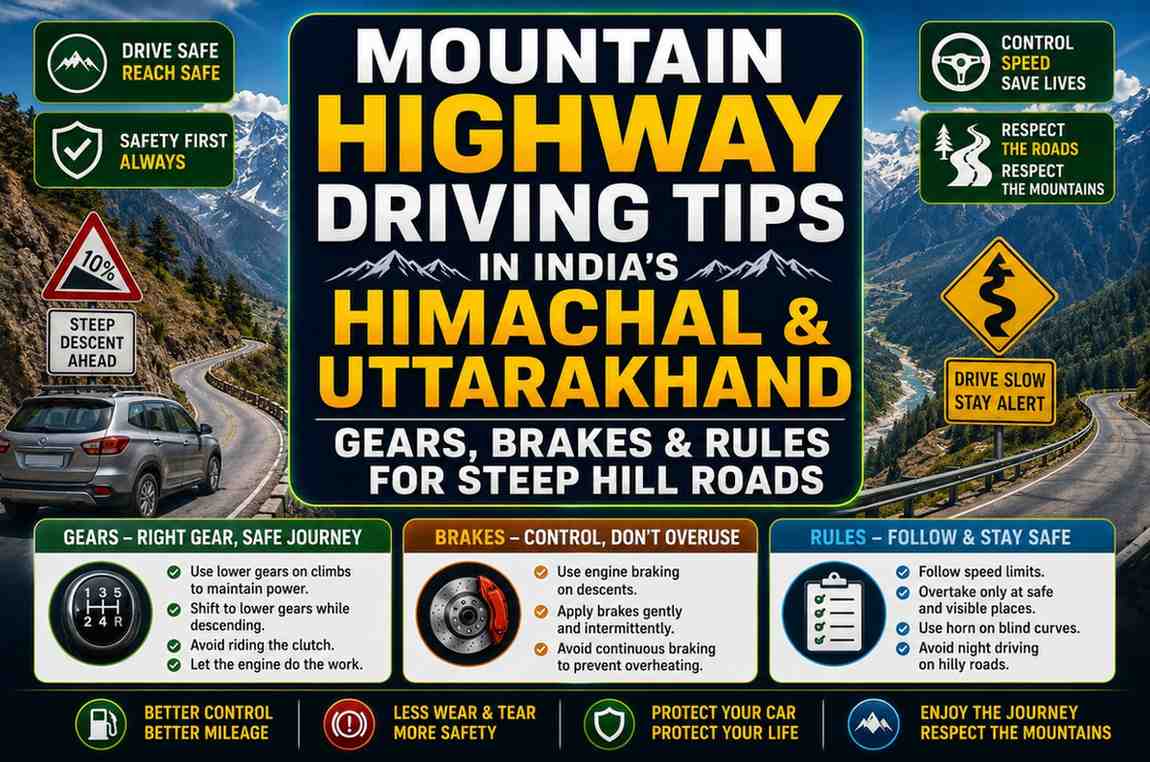
Driving through the mountains of Himachal Pradesh and Uttarakhand is among the most spectacular experiences India offers. Narrow roads carved into cliff faces, hairpin bends with dramatic valley views, high-altitude passes shrouded in cloud—and the ever-present reality that a driving error here has consequences that are measured not in dents and insurance claims but in survival. Mountain highway driving tips in India’s Himachal and Uttarakhand are therefore not optional knowledge—they are essential preparation for every driver who takes these roads.
This comprehensive guide on mountain highway driving tips in India’s Himachal and Uttarakhand covers vehicle preparation, gear usage, brake management, road etiquette on narrow mountain roads, weather adaptations, and the specific rules that apply only to hill driving.
Why Mountain Highway Driving India Requires Different Skills
Mountain highway driving tips India Himachal and Uttarakhand are necessary because mountain roads are fundamentally different from plains highways in every important way:
- Narrow roads—many Himalayan roads are single-track or one-and-a-half lane width
- Hairpin bends—require specific low-speed, high-control driving technique
- Steep gradients—both ascents and descents—require different gear and brake management
- Blind corners—visibility around bends is zero; honking becomes a safety tool
- Unstable surfaces—landslides, gravel, ice, water seepage, and potholed sections are common
- High altitude — above 2,500 metres, engine performance drops and the consequences of engine failure are more serious
- Limited emergency support—NHAI patrol and mobile connectivity are limited in deep mountain terrain
Each of these factors requires specific mountain highway driving tips in Himachal, Uttarakhand, India.
Vehicle Preparation — Mountain Highway Driving Tips India Himachal, Uttarakhand
Before entering mountain terrain, your vehicle must be properly prepared. These mountain highway driving tips for Himachal, Uttarakhand, India, for vehicle prep can prevent a breakdown in a place where rescue is hours away.
Essential Pre-Trip Vehicle Checks
- Brakes — mountain descents put enormous stress on brakes. Have brake pads and brake fluid checked before any Himalayan road trip. If brakes are worn at 50%, replace before mountain driving.
- Tires—minimum 4 mm tread depth for mountain roads. For winter routes (Rohtang, Manali–Leh, Kedarnath approach in late season), carry snow chains or use M+S (Mud and Snow) tires.
- Engine coolant — uphill driving at altitude generates more heat. Check coolant level and condition.
- Clutch condition—mountain driving involves significantly more clutch use than plains driving. A worn clutch on a steep gradient is a genuine safety risk.
- Engine oil — fresh oil before a Himalayan road trip is cheap insurance.
- Spare tire—ensure it is inflated and functional. A puncture on a remote mountain road with a flat spare is a potentially dangerous situation.
- Fuel — fill up at every fuel station on mountain routes. Stations are spaced 60–100+ km apart on many Himalayan routes. Never enter a remote mountain section with less than half a tank.
Gear Usage on Mountain Roads — Core Mountain Highway Driving Tips India Himachal Uttarakhand
Understanding correct gear usage is the most important technical skill in all mountain highway driving tips in India, Himachal, and Uttarakhand. Most accidents on Himalayan roads involving Indian vehicles occur because drivers do not understand when and why to use lower gears.
Ascending (Climbing Uphill)
- Use 2nd or 3rd gear for most climbing sections—not 4th or 5th
- Maintain a steady, consistent speed — do not accelerate aggressively into climbs and then lose power at the top
- Do not change gear mid-corner on a hairpin—change gear before the bend, not during it
- If you stall on a climb—apply the handbrake first, restart in 1st gear, and release the handbrake gradually as you release the clutch. Practice hill starts before mountain driving.
Descending (Going Downhill) — The Most Critical Section
Descents are where the most serious Himalayan driving accidents occur. The core principle of mountain highway driving tips India Himachal and Uttarakhand for descents:
Use engine braking — not your foot brake — as your primary speed control on long descents.
Engine braking means using a low gear (1st or 2nd on steep descents, 2nd or 3rd on moderate descents) to let the engine’s compression slow the vehicle. Your foot brake is used only to make fine adjustments.
Why this matters: Continuous use of the foot brake on long descents causes brake fade—the brakes heat up, brake fluid vaporizes, and your brakes lose effectiveness progressively. At the bottom of a 15-km descent into a valley, faded brakes mean no brakes. This is how the majority of serious Himalayan road accidents involving brake failure occur.
The rule: Go down the hill in the same gear you would use to come up it.
Automatic Transmission on Mountain Roads
For automatic cars, mountain highway driving tips in Himachal, India, and Uttarakhand require using the manual/sequential mode or the L/1/2 settings:
- On descent: Use L or 1 for steep descents and 2 for moderate descents. Do not leave in Drive (D) on long descents—it will not provide adequate engine braking.
- On ascent: Use the Sport mode or sequential manual control to prevent the gearbox from upshifting at low speeds on steep gradients.
Hairpin Bend Technique — Mountain Highway Driving Tips India Himachal Uttarakhand
Hairpin bends are the defining feature of Himalayan driving and require a specific technique:
- Slow down well before the bend — not mid-bend
- Select the correct gear before the bend—1st or 2nd for tight hairpins
- Hug the inside of the bend—on a right hairpin, stay close to the right edge; on a left hairpin, stay close to the left edge
- Do not cut corners—oncoming vehicles may be in the space you are entering
- Sound horn before blind hairpins—this is not rude; it is the mountain road safety protocol. Honk to announce your presence before every blind bend.
- Look for oncoming vehicle headlights at night—even before you can see the vehicle
Right of Way Rules on Mountain Roads
Mountain highway driving tips India Himachal and Uttarakhand include specific right-of-way rules that differ from plains highway rules:
| Situation | Right of Way |
|---|---|
| Uphill vehicle vs downhill vehicle on single track | The uphill vehicle has right of way—the downhill vehicle reverses to a widening |
| Vehicle on narrow road vs oncoming traffic | A larger vehicle OR vehicle with safer reversing option yields |
| Bus/truck vs car | The vehicle requiring more space to manoeuvre has practical priority—the smaller vehicle reverses to passing bay |
| Loaded vehicle vs empty vehicle | A loaded vehicle has right of way—stopping and restarting a loaded vehicle on a gradient is harder |
The general mountain driving protocol in India is that whoever can reverse more safely to the nearest passing bay does so. Ego has no place on mountain roads.
Weather Adaptation — Mountain Highway Driving Tips India Himachal Uttarakhand
Mountain weather changes dramatically and rapidly. These mountain highway driving tips for weather in India’s Himachal and Uttarakhand are essential for Himalayan road trips:
Rain
- Reduce speed to 20–30 km/h on wet mountain roads
- Increase following distance—wet gravel and road seepage dramatically reduce grip
- Watch for fresh landslide debris—a rain overnight can deposit rocks on the road
Fog
- Use fog lights (front and rear)—not high beams (reflect off fog and reduce visibility)
- Reduce speed to under 20 km/h in dense fog
- Sound horn every 30 seconds to announce presence
Snow and Ice
- Do not attempt snowy or icy mountain passes in a non-4WD vehicle without snow chains
- Drive in 1st or 2nd gear on snow at walking speed
- Test brakes gently before each descent section to verify grip
- Check Border Roads Organisation (BRO) or state PWD websites for road opening/closure status before heading to high passes
Night Driving
Avoid night driving on mountain roads where possible. These mountain highway driving tips for India, Himachal, and Uttarakhand are absolute for night conditions—use high beams on straight sections, dip to low on bends, and drive at a speed where you can stop within your visible distance.
Essential Items for Mountain Highway Driving India Himachal, Uttarakhand
Beyond the standard emergency kit, mountain highway driving tips in Himachal, India, and Uttarakhand require these additional items:
- Snow chains (for high-altitude winter routes)
- Extra fuel (jerrycan for remote stretches)
- Tow rope
- Extra warm clothing—even in summer, Himalayan weather can drop to 5°C at altitude
- High-calorie food (biscuits, dry fruits) — in case you are stranded
- Satellite messenger device or PLB (Personal Locator Beacon) for truly remote routes like Manali–Leh or Spiti Valley
- Vehicle tool kit including tyre inflator and basic spares
FAQs — Mountain Highway Driving Tips India Himachal Uttarakhand
Q1. What is the most important driving technique for mountain roads in Himachal and Uttarakhand? Engine braking on descents — using low gear to control speed rather than continuous foot braking. This prevents brake fade, which is the leading cause of serious mountain road accidents in India.
Q2. Can automatic cars handle Himalayan mountain roads? Yes — but drivers must use the manual mode or L/1/2 settings on descents. In Drive (D) mode, automatic gearboxes upshift and do not provide adequate engine braking. Modern automatic cars with paddle shifters handle mountain roads well when used correctly.
Q3. Who has the right of way on a narrow single-track mountain road—the uphill or downhill vehicle? The uphill-bound vehicle has the right of way. The downhill vehicle should reverse to the nearest passing bay because restarting an uphill vehicle from a dead stop on a steep gradient is more difficult and risky than a downhill vehicle reversing.
Q4. Is 4WD necessary for Himachal and Uttarakhand mountain highway driving? Not for standard tourist routes in summer (Manali, Shimla, Mussoorie, Nainital). 4WD is strongly recommended for high passes (Rohtang, Baralacha La, Niti Pass) and any route in monsoon or winter conditions.
Q5. What should I do if my brakes overheat on a mountain descent? Look for an emergency escape ramp (available on many major Himalayan descents)—these are loose gravel runoffs designed for exactly this situation. If no ramp is available: find a safe spot to stop, switch off the engine, and wait 20–30 minutes for the brakes to cool before continuing. Do not drive on failed brakes.
Conclusion
Mountain highway driving tips India Himachal and Uttarakhand distill years of accumulated wisdom from drivers who have learned—sometimes the hard way—what works on these roads and what does not. The mountains of North India are magnificent, and the roads through them are some of the most memorable drives in Asia. But they demand respect, preparation, and specific skills.
Use low gears on descents. Honk before blind bends. Give way with grace. Prepare your vehicle properly. And never underestimate a mountain road.
The mountains will be there next season too. Drive safely and come back for more.
Share your Himachal or Uttarakhand road trip experience in the comments — and add any tips that kept you safe on the mountain roads!
External Links: