 admin@prodriver.in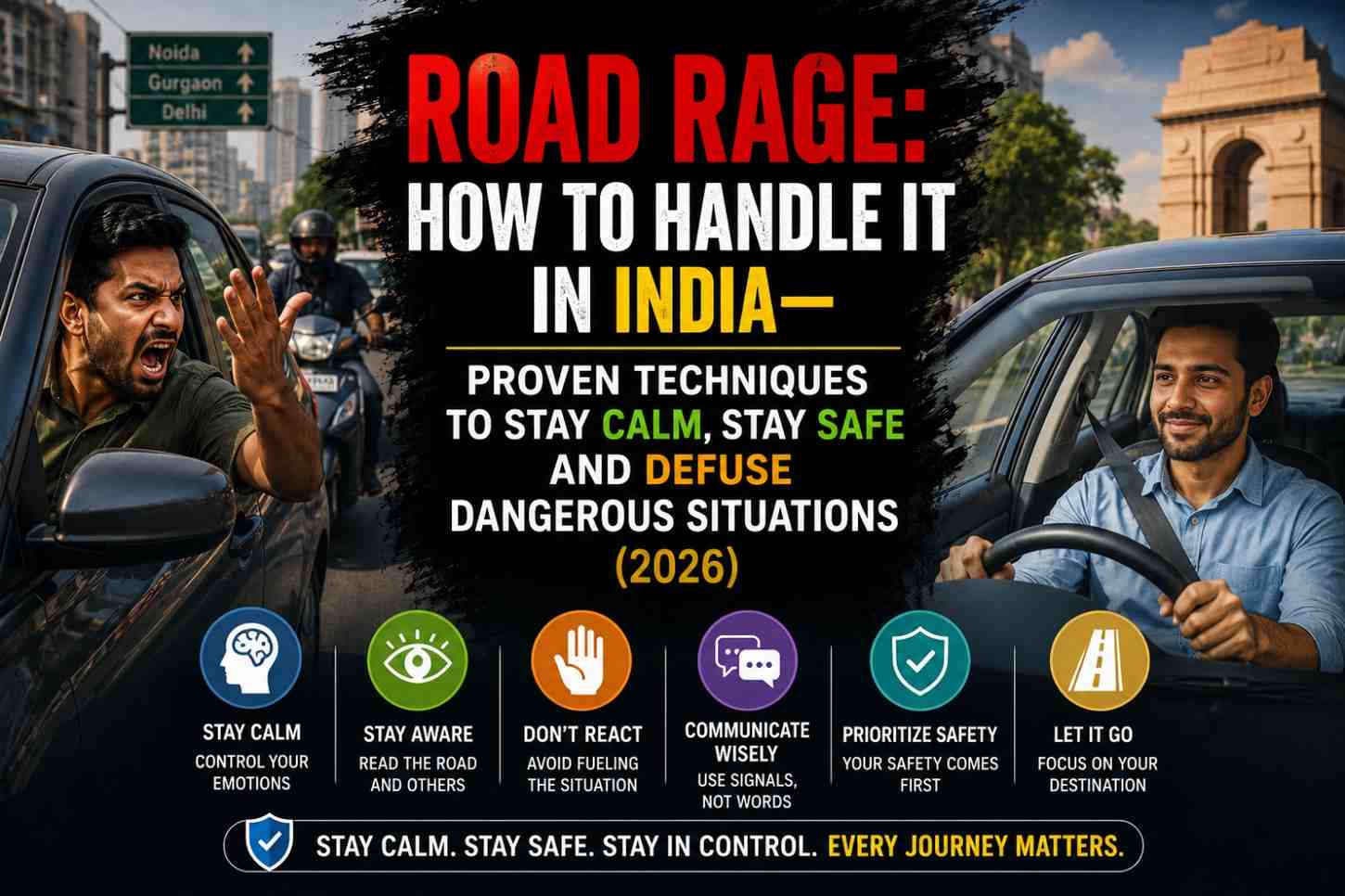
Indian roads are among the most stressful driving environments in the world. High traffic density, lane indiscipline, constant horn use, heat, congestion, and time pressure combine to create the perfect conditions for anger behind the wheel. Road rage: How to handle it in India is not a question of weakness or sensitivity—it is a genuine safety skill that separates drivers who reach their destinations safely from those who turn a minor traffic irritant into a dangerous confrontation.
Road rage: How to handle it. Indian incidents have risen sharply in the post-COVID years as vehicle ownership surged and road infrastructure struggled to keep pace with growth. MoRTH data indicates that aggressive driving behavior is now a contributing factor in over 15% of serious urban accidents. More alarmingly, violent road rage confrontations—involving physical altercations, vehicles used as weapons, and even fatalities—have become a regular feature of news reports from every major Indian city.
This complete guide on road rage and how to handle it in India covers what road rage is, why it happens, what to do when another driver is aggressive toward you, how to manage your own anger behind the wheel, and the legal consequences of road rage in India in 2026.
What Is Road Rage? Understanding the Psychology
Road rage: How to handle it in India requires first understanding what drives this behavior.
Road rage is aggressive or violent behavior by a driver of a vehicle, triggered by a traffic dispute or driving-related frustration. It exists on a spectrum:
Level 1 — Mild Frustration: Muttering, gripping the wheel tighter, or feeling irritated. This is normal and manageable.
Level 2—Aggressive Behavior: Excessive honking, tailgating intentionally, flashing lights aggressively, cutting off other vehicles, and yelling from inside the vehicle.
Level 3—Confrontational Behavior: Blocking vehicles, getting out of the vehicle to confront other drivers, threatening gestures.
Level 4—Violent Road Rage: Physical assault, using the vehicle as a weapon, and weapon use. This is criminal behavior.
Most road rage situations in India occur at Level 2 and can be de-escalated. Levels 3 and 4 require specific self-protection responses.
Why Road Rage Is More Common on Indian Roads
Road rage: How to handle it in India. Knowledge must account for the specific environmental triggers present:
- Traffic density: Major Indian cities have some of the world’s worst traffic-to-road-space ratios
- Lane discipline breakdown: The absence of lane discipline means constant near-misses that feel like personal slights
- Horn culture: The frequent, aggressive use of horns—even when unnecessary—creates ambient stress
- Heat: High ambient temperatures are scientifically linked to increased aggression
- Time pressure: The culture of overloaded schedules means many Indian drivers are perpetually running late
- Mixed traffic: High-speed vehicles sharing space with two-wheelers, pedestrians, and cattle creates constant near-confrontations
Understanding these systemic causes helps in the road rage how-to-handle-it India framework because knowing that the aggression is driven by environment rather than personal intent reduces the emotional charge.
What to Do When Another Driver Shows Road Rage Toward You
The most critical section of road rage how to handle it in India is the response protocol when another driver becomes aggressive:
Step 1 — Do Not Engage
The most important rule in road rage how to handle it. India: do not match aggression with aggression. Do not:
- Return aggressive honking
- Make eye contact with the intent to challenge
- Make hand gestures
- Yell back
- Brake-check the aggressor
Engagement escalates. Non-engagement diffuses.
Step 2 — Create Physical Distance
Put as much space between your vehicle and the aggressor as possible:
- Change lanes if safe to do so
- Slow down to allow them to pass
- Pull into a petrol station, mall, or public area if being followed
Physical separation is the most effective de-escalation in every road rage how-to-handle-it India scenario.
Step 3 — Do Not Stop in Isolated Areas
If an aggressive driver is following you, do not stop on a deserted road or in an isolated area. Drive to the nearest:
- Police station (most direct protection)
- Petrol station (staffed, lit, has CCTV)
- Shopping mall or market (public space with witnesses)
Step 4 — Call for Help
If you feel genuinely threatened:
- Call 100 (police) or 112 (emergency)
- Share your live location with a family member
- Stay in your locked vehicle until help arrives
Step 5 — If Confrontation Occurs Despite Your Efforts
If another person exits their vehicle and approaches yours:
- Keep doors locked and windows up
- Do not exit your vehicle
- Drive away if safe to do so—even over a kerb if necessary
- If unable to drive, use the horn continuously to attract attention
- Call 100 immediately
Managing Your Own Road Rage — The Other Side of Road Rage: How to Handle It India
Road rage: How to handle it. India also requires honest self-examination—because many people who’d never consider themselves aggressive drivers find themselves behaving aggressively under stress.
Recognize Your Triggers: What makes you angriest? Tailgating? Cutting in line? Drivers on phones? Being honked at unnecessarily? Identifying your specific triggers allows you to manage your emotional response when they occur.
The 10-Second Rule: When something on the road makes you angry, count 10 seconds before reacting. By the end of 10 seconds, the situation has usually changed—the offending driver has moved on, and the irritant has passed. Most road anger is directed at situations that are already over.
Perspective Reframe: The driver who cut you off may be rushing to a hospital. The auto that stopped suddenly may have seen a child in the road. The truck hogging the lane may be tired and frightened. This reframe doesn’t excuse dangerous behavior, but it depersonalizes it—preventing the “they did it to ME” thinking that drives escalation.
Pre-Drive Preparation:
- Leave early enough that you’re not time-pressured
- Listen to calming music or podcasts rather than aggressive talk radio or loud music
- Avoid driving in the immediate aftermath of a major personal argument or stressful event
Legal Consequences of Road Rage in India 2026
Road rage: How to handle it in India in the legal context:
| Act | Applicable Law | Penalty |
|---|---|---|
| Threatening behaviour on road | IPC Section 504 | Up to 2 years imprisonment |
| Assault during road rage | IPC Section 323/325 | Up to 1–3 years imprisonment |
| Vehicular assault (using car as weapon) | IPC Section 307/304 | Up to 10 years imprisonment |
| Causing death during road rage | IPC Section 302/304 | Life imprisonment / death penalty |
| Rash and negligent driving | Motor Vehicles Act S. 184 | Fine ₹5,000 + 6 months imprisonment |
Courts in India have increasingly treated road rage incidents as serious criminal matters rather than minor traffic disputes. Several high-profile cases from Delhi, Mumbai, and Bengaluru in 2023–2025 resulted in significant imprisonment terms for aggressors.
FAQs: Road Rage How to Handle It India
Q1: What is the most important principle in road rage, and how do you handle it in India? A: Non-engagement. The most dangerous escalation in road rage situations occurs when both parties match each other’s aggression. Not responding — not making eye contact, not gesturing, not honking back — removes the fuel that escalates road rage from verbal frustration to physical confrontation.
Q2: Is road rage, how to handle it in India, a criminal offense for the aggressor? A: Yes. Threatening behavior, assault, and vehicular aggression during road rage are all criminal offenses under the Indian Penal Code. Causing death during a road rage incident can attract murder charges under IPC 302 with potential life imprisonment.
Q3: What should I do if I recognize my own road rage tendency in road rage? How do I handle it in Indian situations? A: Leave earlier to eliminate time pressure, identify your specific triggers, practice the 10-second pause before reacting, and consider a defensive driving course that includes anger management components. If road anger significantly impacts your life, consulting a counselor about stress management is a positive step.
Q4: Should I report road rage and how to handle Indian incidents to the police? A: Yes, for any Level 3 or Level 4 incident (confrontational or violent behavior). File a complaint at the nearest police station with the vehicle registration number, time, location, and any dashcam footage. Many Indian cities now have dedicated traffic helplines where road rage can be reported.
Q5: Does dashcam footage help in road rage, how to handle it, and Indian legal situations? A: Significantly. Dashcam footage is admissible as evidence in Indian courts and traffic police proceedings. It documents the aggressor’s behavior, clears innocent parties, and has been decisive in several road rage criminal prosecutions in India. Consider installing a dashcam with front and rear recording.
Conclusion
Road rage: how to handle it in India is a skill that protects not just the driver who applies it but also everyone on the road around them. The decision to not engage, to create distance, and to de-escalate is not weakness — it is the highest expression of road safety consciousness.
India’s traffic challenges are real and significant. The stress they generate is legitimate. But allowing that stress to escalate into aggression risks criminal consequences, physical harm, and accidents—outcomes that no traffic frustration is worth. Every time you choose calm over confrontation, you make Indian roads safer.
Share this guide with everyone in your network—because in road rage situations, the driver who stays calm isn’t just protecting themselves; they’re protecting everyone around them.
External Links
- https://morth.nic.in/road-accident-in-india — MoRTH: Aggressive Driving Accident Data
- https://www.who.int/roadsafety — WHO: Road Rage and Aggressive Driving
- https://parivahan.gov.in — Parivahan: Motor Vehicles Act Road Rage Penalties
- https://www.aaa.com/stop-the-rage — AAA Foundation: Road Rage Research and Prevention
- https://www.apa.org/topics/anger/road-rage — American Psychological Association: Road Rage Psychology