 admin@prodriver.in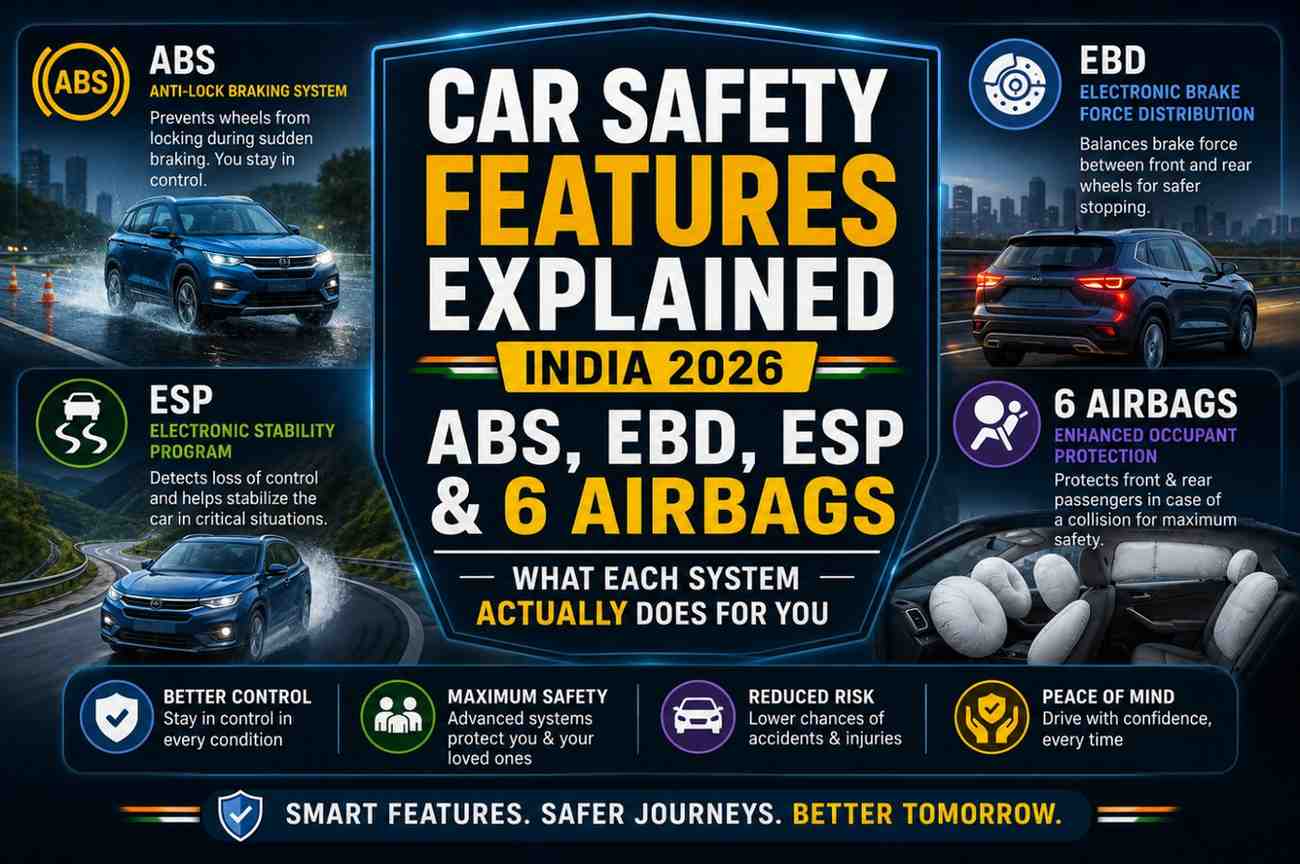
You’ve seen the acronyms on car brochures and dealer showroom posters—ABS, EBD, ESP, TPMS, ADAS, ESC. But do you know what each of these systems actually does when your car is sliding toward a collision at 80 km/h? “Car Safety Features Explained: India 2026” in plain, practical language gives every Indian car buyer and owner the knowledge to understand what they’re actually paying for—and how each system works to protect them in real emergencies.
The car safety features explained India’s 2026 landscape, which has changed dramatically. Bharat NCAP (New Car Assessment Programme) was formally launched in India in 2023 and has already changed manufacturer behavior—forcing safety features that were previously optional extras into the base specification of mainstream Indian cars. In 2026, features like 6 airbags, ABS+EBD, ESC, and TPMS are either mandatory or standard in every new vehicle sold in India.
This complete car safety features explained India 2026 guide covers every major active and passive safety system—what it does, when it activates, what it cannot do, and which Indian car models offer it.
Active vs Passive Safety: The Foundation of Car Safety Features Explained India 2026
Car safety features explained: India 2026 begins with the two fundamental categories of vehicle safety:
Active Safety Systems: These work to prevent an accident from happening. They monitor conditions and intervene in real time. Examples: ABS, EBD, ESC/ESP, TPMS, and ADAS (Lane Keep Assist and Automatic Emergency Braking).
Passive Safety Systems: These protect occupants when a crash occurs. They cannot prevent the accident but can minimize injury severity. Examples: Airbags, seatbelts with pre-tensioners and load limiters, crumple zones, ISOFIX child seat anchors.
The best-equipped vehicles in car safety features, explained in the India 2026 context, combine multiple layers of both active and passive systems.
ABS — Anti-Lock Braking System
No car safety features explained. India 2026 guide is complete without starting with ABS—the foundational active safety technology.
What it does: In a panic stop, an untrained driver stamps on the brakes fully. Without ABS, the wheels lock—the tire slides across the road instead of rolling. A sliding tire generates less friction than a rolling tire (counterintuitive but true), so stopping distance INCREASES. More critically, locked wheels mean the driver has NO steering control—the car goes straight regardless of where the wheel is turned.
ABS pulses the brakes rapidly (up to 15 times per second), preventing wheel lock while maintaining the maximum safe braking force. This allows the driver to steer around an obstacle while braking hard.
When it’s most valuable on Indian roads:
- Emergency braking to avoid hitting a vehicle or pedestrian
- Braking on wet, monsoon-soaked roads
- Braking when approaching a pothole at speed
- Gravel or loose-surface roads (common in rural India)
Mandatory status: ABS has been mandatory on all new passenger vehicles in India since April 2019.
What ABS cannot do: ABS does not reduce stopping distance on all surfaces. On deep gravel or loose sand, a locked wheel actually stops faster (the locked tire digs in). ABS is optimized for normal road surfaces.
EBD — Electronic Brakeforce Distribution
Car safety features explained in India 2026 for EBD:
EBD is a system that works alongside ABS to optimize how braking force is distributed between front and rear wheels.
The physics: In a braking event, weight transfers to the front of the vehicle. The rear wheels become lighter, making them more susceptible to locking. Applying maximum braking force to the rear wheels simultaneously with the front wheels wastes potential braking energy and destabilizes the vehicle.
EBD automatically calculates the ideal brake force for each wheel based on the following:
- Speed
- Load (how heavy the vehicle is and how weight is distributed)
- Surface grip at each wheel
Practical benefit: EBD is particularly valuable in fully loaded vehicles—five passengers, full luggage—where weight distribution changes significantly from an empty car. Without EBD, braking stability in a loaded car degrades considerably.
Indian relevance: High passenger loads are common in Indian vehicles, particularly on family road trips—making EBD’s load-sensing capability particularly valuable for car safety features, explained the India 2026 context.
ESC / ESP — Electronic Stability Control / Electronic Stability Programme
Car safety features explained in India 2026 for ESC/ESP—the most important active safety technology after ABS:
What it does: ESC/ESP continuously monitors whether the car is going where the driver is steering. Using wheel speed sensors, steering angle sensors, and a yaw rate sensor (measures rotation around the vertical axis), it detects when the car begins to oversteer (rear slides out) or understeer (car plows straight despite turning the wheel).
When it detects a slide:
- It selectively applies individual wheel brakes to generate corrective force
- It may also reduce engine power
- It brings the car back toward the intended path
When it saves lives on Indian roads:
- Sudden lane changes at highway speed (evasive manoeuvres)
- Skidding during monsoon rain
- Oversteer on mountain ghat roads
- Loss of control after hitting a pothole at speed
Research impact: ESC/ESP has been shown to reduce single-vehicle fatal accidents by approximately 35–40%. A vehicle with ESC is approximately 50% less likely to roll over than a vehicle without it.
Mandatory status in India: ESC/ESP became mandatory for new passenger vehicles from October 2022.
[IMAGE 1 — Place after ESP section]
Suggested Image: A top-down car diagram showing three scenarios—normal cornering (car follows intended path), understeer (car ploughs straight, ESC brakes rear inner wheel), and oversteer (rear swings out, ESC brakes front outer wheel)—with arrows showing intended path vs actual path and which brakes ESC applies in each case. ALT Text: “Car safety features explained India 2026—top-down diagram showing how ESC/ESP corrects understeer and oversteer by selectively braking individual wheels to return car to intended path.”
Airbags — How the System Actually Works
Car safety features explained in India 2026 for the airbag system:
The 6-Airbag Standard: India made 6 airbags mandatory in all new passenger vehicles from October 2023. The six airbags are:
- Driver front airbag
- Passenger front airbag
- Driver side curtain airbag
- Passenger side curtain airbag
- Driver side torso airbag
- Passenger side torso airbag
How airbags deploy: Crash sensors (accelerometers) detect the deceleration signature of a collision—typically within 15–30 milliseconds of impact. The airbag control unit triggers a chemical reaction that inflates the nylon bag with nitrogen gas in approximately 30 milliseconds — faster than the blink of an eye. The bag then deflates through venting holes in 100–200 milliseconds, cushioning and then releasing the occupant.
A critical truth about airbags and seatbelts: An airbag deploys at approximately 300 km/h. An unbelted occupant who has already moved forward in the fraction of a second before deployment is struck by the deploying airbag at this speed, which can cause severe injury. Airbags are designed to work with seatbelts — always.
What airbags cannot protect against:
- Rear collisions (front airbags don’t deploy in rear-end accidents)
- Rollovers (curtain airbags help but full rollover protection requires occupants to be belted)
- Very low-speed collisions (typically don’t meet deployment threshold)
TPMS—Tire Pressure Monitoring System
Car safety features explained in India 2026 for TPMS:
What it does: TPMS uses pressure sensors at each wheel to continuously monitor tire pressure and alert the driver when any tire drops below the safe threshold (typically 25% below recommended pressure).
Why it matters on Indian roads: Under-inflated tires are the leading cause of highway tire blowouts in India. Heat from Indian summers combined with highway driving accelerates the dangerous effects of under-inflation. TPMS provides the early warning that was previously only available by manually checking tire pressure.
Types of TPMS:
- Direct TPMS: Pressure sensor at each wheel sends real-time data. Displays exact pressure for each tire on the dashboard.
- Indirect TPMS: Uses wheel speed sensors (shared with ABS) to detect pressure loss by comparing rotational speeds. Less precise but simpler.
Mandatory status: TPMS became mandatory for new passenger vehicles in India from 2025, with full enforcement in 2026 under Bharat NCAP and AIS norms.
ADAS — Advanced Driver Assistance Systems
The most advanced category in car safety features explained India 2026: ADAS encompasses a suite of camera- and radar-based systems that actively assist the driver:
Lane Departure Warning (LDW): A camera monitors lane markings and alerts the driver if the vehicle drifts across without signaling.
Lane Keep Assist (LKA): Goes further—actively steers the vehicle back into the lane if the driver doesn’t respond to the LDW alert.
Automatic Emergency Braking (AEB): Radar and camera detect vehicles or pedestrians ahead and automatically apply brakes if a collision is imminent and the driver hasn’t responded. Most effective at speeds under 60 km/h.
Adaptive Cruise Control (ACC): Maintains a set following distance from the vehicle ahead automatically, adjusting speed without driver input.
Blind Spot Monitoring (BSM): Radar detects vehicles in blind spots and alerts you via mirror indicator when you signal to change lanes.
Forward Collision Warning (FCW): Alerts the driver when closing speed on a vehicle ahead creates imminent collision risk.
Indian ADAS caveat: ADAS systems are calibrated for road environments with clear lane markings, reliable road surfaces, and predictable road users. Indian roads frequently have faded markings, animals, and unconventional road users—which means ADAS must be treated as an assistance system, never a replacement for driver attention.
Bharat NCAP 2026: What the Ratings Mean
Understanding car safety features explained for India 2026 requires knowing what Bharat NCAP tests:
Bharat NCAP Star Rating Categories:
- ⭐ — Marginal protection — avoid
- ⭐⭐ — Moderate — below standard
- ⭐⭐⭐ — Acceptable — minimum recommended
- ⭐⭐⭐⭐ — Good — recommended
- ⭐⭐⭐⭐⭐ — Excellent — highest safety standard
What is tested:
- Adult Occupant Protection (frontal offset, side impact, pole test)
- Child Occupant Protection (child dummy crash tests)
- Safety Assist (ESC, AEB, seatbelt reminders)
[IMAGE 2 — Place before FAQs]
Suggested Image: A car side-cutaway illustration labelling all safety systems visible in position—front airbags at the steering wheel and dashboard, side curtain airbags along the roofline, torso airbags in the seat, seatbelt pre-tensioners, ABS sensors at the wheels, ESC/EBD module in the engine bay, TPMS sensors at each tire, and a front camera and radar for ADAS—each with a label line and brief function description. ALT Text: “Car safety features explained India 2026—car cutaway illustration showing positions and labels of all safety systems: airbags, ABS, ESC, TPMS, seatbelt pre-tensioners, and ADAS camera/radar.”
FAQs: Car Safety Features Explained India 2026
Q1: Which car safety features explained for India 2026 are now mandatory for all new vehicles? A: As of 2026, mandatory features include 6 airbags, ABS + EBD, ESC/ESP, TPMS, seatbelt reminders for all positions, and ISOFIX child seat anchors. These are required for all new passenger vehicles under the Central Motor Vehicles Rules.
Q2: What is the difference between ABS and ESC in car safety features explained in India 2026? A: ABS prevents wheel lock-up during braking—keeping the car steerable while stopping. ESC prevents the entire car from skidding or spinning during cornering and evasive maneuvers—it selectively brakes individual wheels to maintain directional stability. Both systems work together but address different accident scenarios.
Q3: Do airbags work without seatbelts in car safety features explained in the India 2026 context? A: Airbags work most effectively when the occupant is held in position by a properly worn seatbelt. An unbelted occupant may already be moving forward before the airbag deploys, meaning the bag strikes them at a wrong angle—potentially causing additional injury. Airbags are supplemental restraints, not primary ones.
Q4: How does Bharat NCAP help understand car safety features explained in India 2026? A: Bharat NCAP provides crash-test star ratings from 1 to 5 stars for each vehicle model sold in India. These ratings allow buyers to compare the actual structural protection and safety feature performance of different vehicles under identical test conditions—going beyond manufacturer specifications.
Q5: Are ADAS features reliable on Indian roads in car safety features explained in India 2026? A: ADAS features provide genuine assistance on Indian highways but must be treated as driver aids rather than autonomous safety systems. Lane Keep Assist and Automatic Emergency Braking may behave unpredictably on roads with faded markings, animals, or unusual road users. Always maintain full driver attention regardless of ADAS activation.
Conclusion
Car safety features explained: India 2026 demystifies the engineering that stands between you and harm on India’s roads. ABS keeps you steering during emergency braking. ESC prevents the spin that turns a monsoon corner into a rollover. Airbags cushion the impact that would otherwise be fatal. TPMS warns you before a tire blowout happens. And Bharat NCAP ensures you can compare these systems across vehicles with independent, verified data.
The most important takeaway from car safety features explained in India 2026 is that these systems reduce the consequences of accidents—they don’t prevent them. The driver who never needs any of these systems to activate because they drive carefully, maintain appropriate speed, and give full attention to the road is safer than any amount of technology can make an inattentive driver.
Check your current vehicle’s safety ratings on the Bharat NCAP website. If buying a new car, demand the full safety feature sheet and insist on a 4–5 star NCAP rating as your minimum standard. Your safety is worth it.
External Links
- https://www.bharatncap.gov.in — Bharat NCAP Official: Indian Car Safety Ratings
- https://www.globalncap.org — Global NCAP: Worldwide Crash Test Data
- https://morth.nic.in/vehicle-safety — MoRTH: Vehicle Safety Regulations India
- https://www.nhtsa.gov/vehicle-safety/safety-technology — NHTSA: Vehicle Safety Technology Explained
- https://www.euroncap.com/en/vehicle-safety/the-ratings-explained — Euro NCAP: Safety System Explanations