 admin@prodriver.in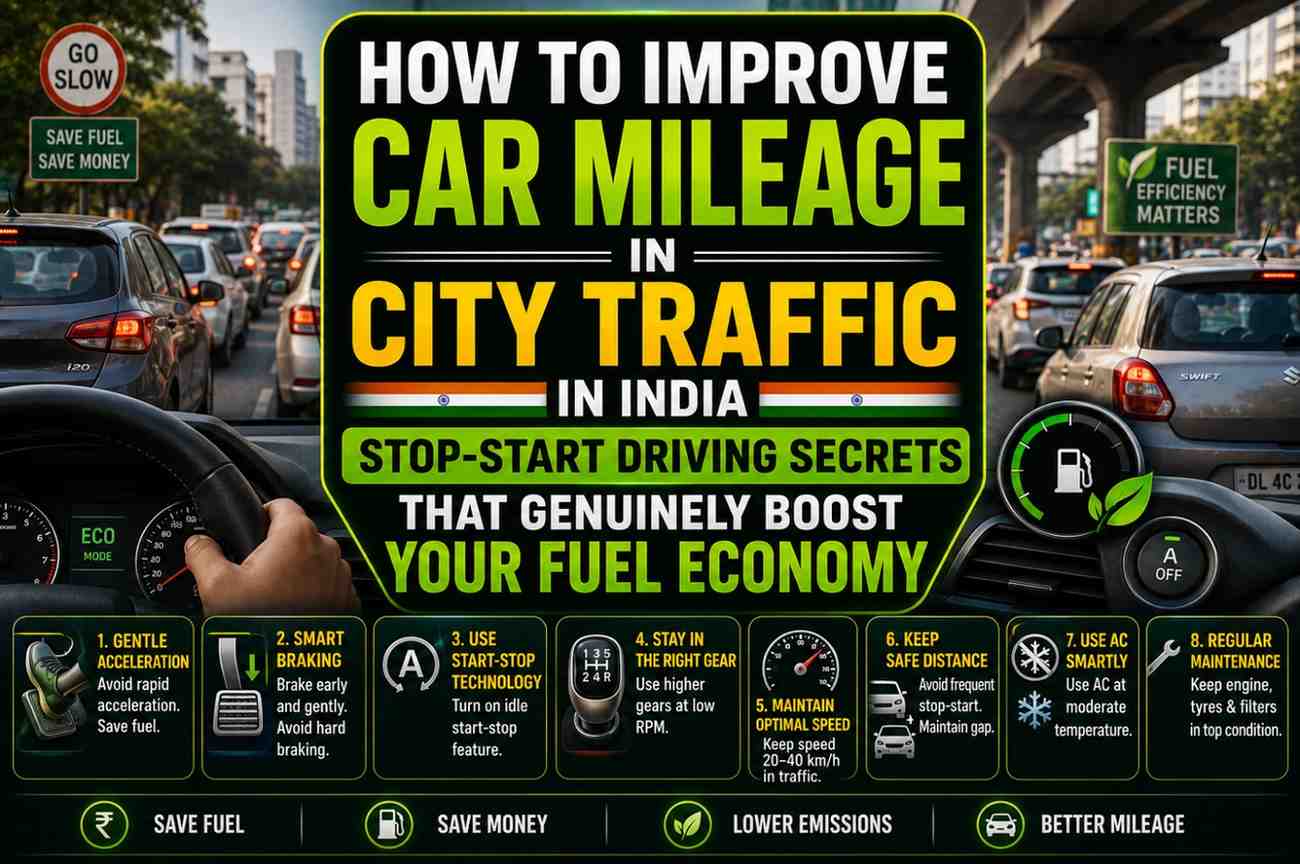
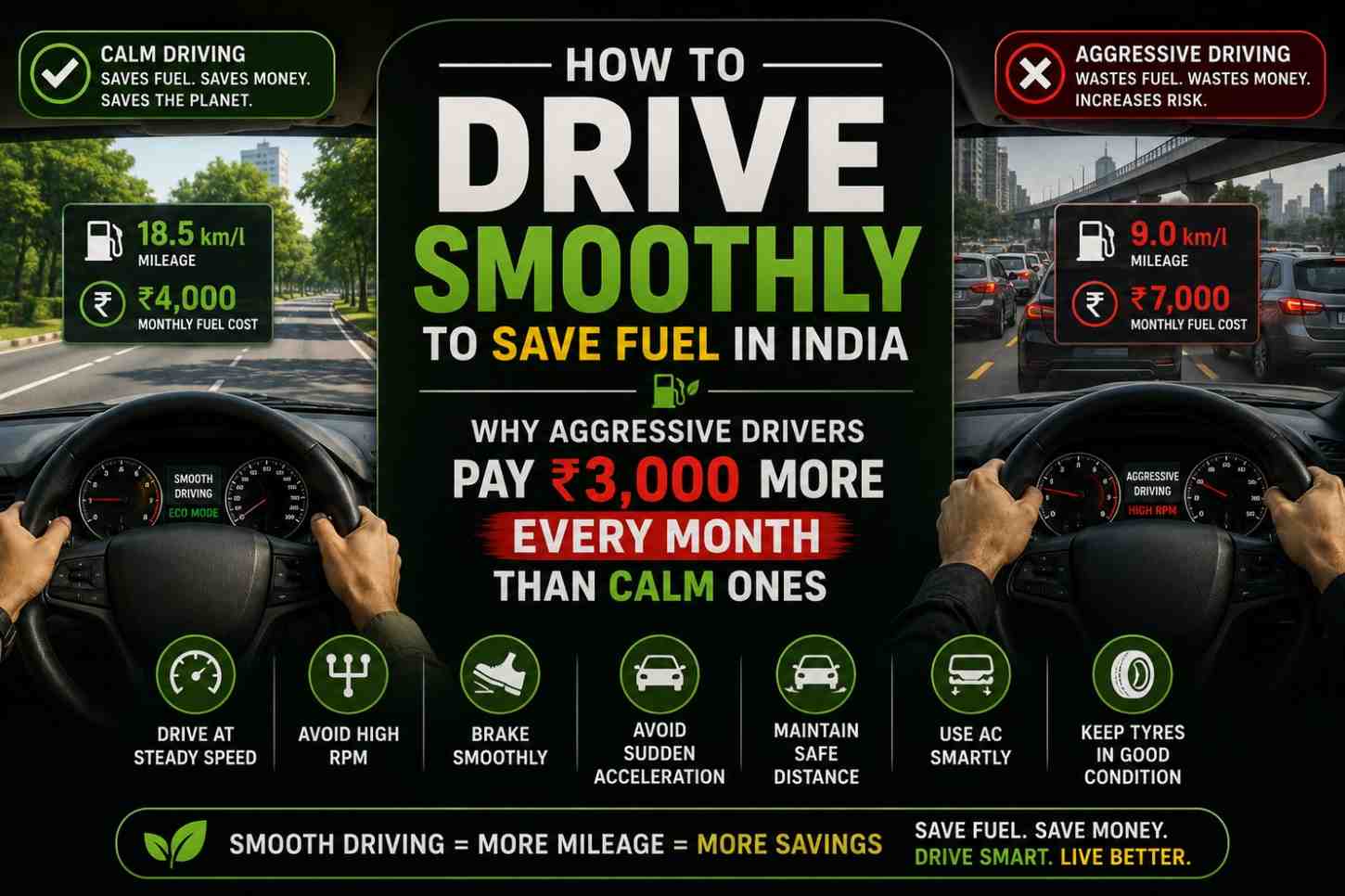
Indian city traffic is among the most fuel-inefficient driving environments in the world. Between Bengaluru’s gridlocked IT corridors, Delhi’s chaotic arterial roads, and Mumbai’s perpetually bottlenecked expressway feeders, knowing how to improve car mileage in city traffic in India is a skill that directly translates into thousands of rupees saved every month. The challenge is real — but so are the solutions.
The standard advice to “drive smoothly” is correct but vague. This guide breaks down exactly how to improve car mileage in city traffic in India with specific, technique-level advice that goes beyond platitudes: what gear to use when, how to read traffic signal timing, how to manage your braking distance, and how to use engine braking to recover energy that would otherwise be lost to brake heat.
According to ARAI (Automotive Research Association of India), the real-world mileage of most Indian passenger cars is 25–40% lower than the manufacturer’s ARAI-certified figure specifically because of city traffic conditions and driving style. The gap between your car’s potential and its actual performance is almost entirely a driving behavior and maintenance problem—and how to improve car mileage in city traffic India addresses exactly that gap.
Why City Traffic Destroys Fuel Economy
Stop-start driving is fuel economy’s worst enemy for one simple reason: acceleration from a complete stop is the single most energy-intensive driving action your engine performs. Every time you stop completely at a signal and then accelerate back to 40–50 km/h, your engine burns fuel at a rate approaching full-throttle enrichment—regardless of how “gently” you press the accelerator.
Understanding this physics is the foundation of how to improve car mileage in city traffic in India: the goal is not to drive slowly, but to stop as rarely as possible and accelerate as smoothly as science allows.
The 10 Secrets of How to Improve Car Mileage in City Traffic India
Secret 1 — Read Traffic Signals Before You Reach Them
Experienced fuel-efficient drivers look at traffic signals 200–300 meters ahead, not just the car in front. When you see a red signal, release the accelerator immediately and coast toward it, arriving at the signal zone with residual momentum rather than stopping completely, waiting, and re-accelerating from zero. This single habit is the cornerstone of how to improve car mileage in city traffic in India and can reduce fuel use at intersections by 30–40%.
Secret 2 — Never Drop Below 10 km/h If You Can Avoid It
The difference in fuel cost between stopping completely and maintaining 10 km/h rolling speed is significant. In slow city traffic, learn to maintain crawling forward movement rather than stopping and starting. This is the technique behind how to improve car mileage in city traffic in India that separates experienced urban drivers from fuel-wasting ones.
Secret 3 — Use Engine Braking Aggressively
When slowing down in a higher gear without pressing the brake, the closed throttle in a fuel-injected engine cuts fuel delivery almost to zero — the engine is being driven by the car’s momentum, not by burning petrol. This engine braking is central to how to improve car mileage in city traffic in India on downslopes and during the approach to every stop.
Secret 4 — Accelerate Slowly and Fully Up to Speed, Then Hold
“Gentle but complete” acceleration — taking 6–8 seconds to reach your cruising speed rather than 2–3 — uses approximately 20% less fuel while achieving the same outcome. Once at target speed, hold it steadily rather than throttle-hunting. This precise throttle discipline defines how to improve car mileage in city traffic in India at the technical level.
Secret 5 — Shift Up Early in City Gears
For manual transmission drivers, shifting up at 2,000–2,200 RPM rather than 2,500–3,000 RPM puts the engine in a lower-load, lower-consumption operating state. Indian cars are typically over-revved in 2nd and 3rd gear in traffic. Shifting earlier is one of the simplest and most impactful aspects of how to improve car mileage in city traffic in India.
Secret 6 — Switch Off at Long Stops, Not Short Ones
The fuel cost of restarting a modern petrol engine is approximately 0.05–0.1 ml—less than 5 seconds of idle consumption. For stops exceeding 60 seconds (railway crossings, long signals, parking lane waits), switching off saves more fuel than it costs. For stops under 30 seconds, idling is marginally more efficient. This calibration is key to how to improve car mileage in city traffic India stop management.
Secret 7 — Avoid Peak Traffic Hours When Possible
The same 10 km journey consumes 40–60% more fuel in peak traffic versus off-peak conditions. If your work schedule allows flexible start times, shifting departure by 45–60 minutes can be the single biggest improvement in how to improve car mileage in city traffic in India without any change in driving technique.
Secret 8 — Keep a Safe Following Distance (For Efficiency, Not Just Safety)
Tailgating forces you to brake hard and accelerate repeatedly to match the erratic movements of the car ahead. A safe following distance of 4–6 car lengths in city traffic gives you time and space to manage your momentum smoothly—reducing unnecessary speed cycles that are the enemy of how to improve car mileage in city traffic in India.
Secret 9 — Avoid Unnecessary Lane Changes
Each lane change in city traffic typically involves a brief acceleration burst to merge and a subsequent adjustment—repeated dozens of times in a single commute. Studies show that lane-change-heavy driving adds 5–8% to fuel consumption on city routes. Patience is a genuine component of how to improve car mileage in city traffic in India.
Secret 10 — Keep AC Use Strategic in City Conditions
In slow city traffic, the AC compressor adds 8–15% load to the engine. Managing AC use—turning it off when cruising at low speed with windows down, using fan-only mode during brief slow stretches—is a meaningfully effective element of how to improve car mileage in city traffic in India for the summer months.
Real-World Mileage Improvement: What to Expect
| Car Type | Typical City Mileage | After Applying Techniques | Improvement |
|---|---|---|---|
| Maruti Swift 1.2 | 10–11 km/l | 13–14 km/l | 25–30% |
| Hyundai i20 1.2 | 11–12 km/l | 14–15 km/l | 22–28% |
| Honda City 1.5 | 10–11 km/l | 13–14.5 km/l | 25–32% |
| Tata Nexon 1.2T | 9–10 km/l | 11.5–13 km/l | 20–28% |
These figures reflect real-world experience from Indian hypermiling communities who have systematically documented how to improve car mileage in city traffic in India across vehicle types and cities.
Frequently Asked Questions
Q1. Can automatic transmission cars also benefit from these techniques? Absolutely. While manual gear control is not available, techniques like smooth acceleration, anticipatory braking, engine braking in “D” mode (or using “B” mode on hybrids), and switching off at long stops all apply directly. How to improve car mileage in city traffic in India works for both manual and automatic transmission vehicles.
Q2. Does driving in lower gears at low speeds save fuel? No — it wastes it. Lower gears at the same speed mean higher RPM and higher fuel consumption. How to improve car mileage in city traffic in India in manual cars always means using the highest gear the traffic conditions safely allow.
Q3. How much difference does AC really make in city traffic? In Indian summer conditions (35–42°C), AC use in stop-start city traffic reduces mileage by 8–15%. On a car doing 11 km/l, that is 0.9–1.6 km/l less. Knowing this allows you to make informed decisions about AC use as part of how to improve car mileage in city traffic in India.
Q4. Does carrying fewer passengers improve city mileage? Every 75 kg of passenger and cargo weight adds approximately 0.5–1 km/l of fuel consumption in city conditions. Weight reduction is always part of how to improve car mileage in city traffic in India, though obviously passengers are not “unnecessary weight” in the normal sense.
Q5. Which Indian city is the hardest on fuel economy? Bengaluru and Delhi consistently rank as the worst cities for fuel economy due to their combination of high congestion index, poor signal synchronization, and extreme stop-start frequency. How to improve car mileage in city traffic: Indian techniques deliver the highest savings for drivers in these cities precisely because the baseline waste is greatest.
Conclusion
Knowing how to improve car mileage in city traffic in India is one of the most financially valuable skills an Indian driver can develop. The techniques in this guide — from reading signals early and coasting to momentum management and strategic AC use — are all free, require no car modifications, and begin delivering measurable fuel savings from the very first journey.
Indian city traffic will always be chaotic. But within that chaos, the driver who understands how to improve car mileage in city traffic in India is consistently spending thousands of rupees less every month than the driver beside them at the same red light. Start with anticipatory braking and early gear shifts—and watch your mileage climb.