 admin@prodriver.in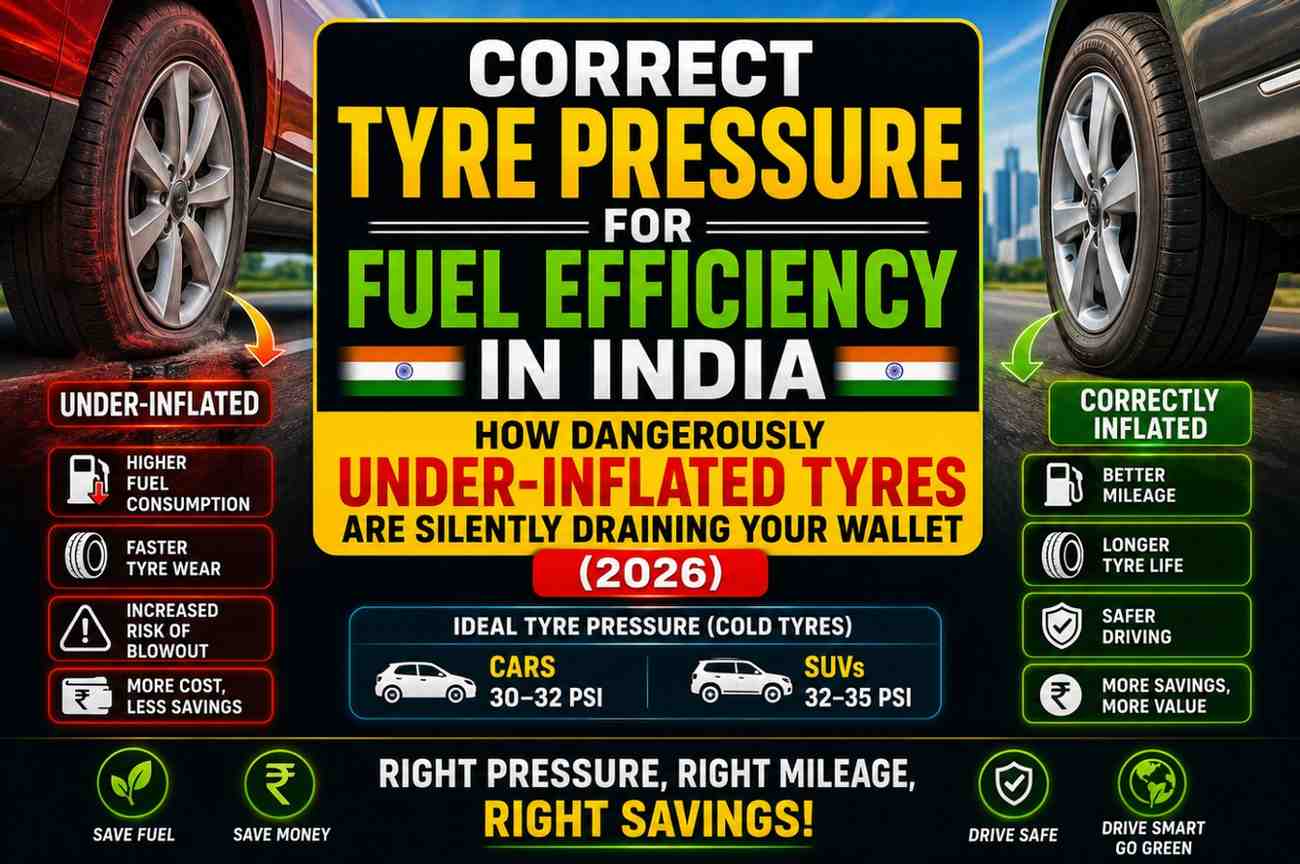
Of all the factors that determine your car’s real-world fuel economy, correct tyre pressure for fuel efficiency in India is simultaneously the most impactful, the most neglected, and the easiest to fix. Studies consistently show that 60–70% of Indian cars on the road are running on under-inflated tires at any given time—each one burning more fuel than it should every single kilometer.
The mathematics of correct tyre pressure for fuel efficiency India is unambiguous: every 1 PSI drop in tire pressure increases rolling resistance and reduces fuel economy by approximately 0.2–0.3%. An Indian car running 8 PSI below the recommended pressure—which is entirely common given natural monthly pressure loss—is wasting 2–5% more fuel continuously, adding up to ₹500–₹1,200 per month in avoidable petrol cost.
According to SIAM (Society of Indian Automobile Manufacturers), tire-pressure-related fuel waste costs Indian motorists an estimated ₹8,000–₹12,000 crore annually in unnecessary petrol and diesel consumption. Maintaining correct tire pressure for fuel efficiency in India across the country’s vehicle fleet would be equivalent to saving hundreds of millions of liters of fuel every year.
What Is the Correct Tire Pressure for Fuel Efficiency in India?
The recommended pressure varies by vehicle, tire size, and load—but the correct tire pressure for fuel efficiency in India standard recommendations for common passenger cars are:
| Vehicle Category | Recommended Pressure (Front) | Recommended Pressure (Rear) | Source |
|---|---|---|---|
| Maruti Suzuki Swift / Dzire | 32 PSI (2.2 bar) | 32 PSI (2.2 bar) | Owner’s manual |
| Hyundai i20 / Creta | 33 PSI (2.3 bar) | 33 PSI (2.3 bar) | Owner’s manual |
| Honda City / Amaze | 32 PSI (2.2 bar) | 29 PSI (2.0 bar) | Owner’s manual |
| Tata Nexon / Harrier | 35 PSI (2.4 bar) | 35 PSI (2.4 bar) | Owner’s manual |
| Toyota Innova Crysta | 36 PSI (2.5 bar) | 36 PSI (2.5 bar) | Owner’s manual |
The single most important rule for correct tyre pressure for fuel efficiency India: Always check the sticker inside your driver’s door jamb or your car’s owner’s manual—never rely on the tire sidewall pressure, which shows the maximum safe pressure, not the optimal operating pressure.
Why Correct Tyre Pressure for Fuel Efficiency India Matters More Than You Think
Rolling Resistance Explained
When a tire runs below its recommended pressure, the tire sidewall flexes more with every wheel rotation. This flexing generates heat—wasted energy that comes directly from your petrol tank. A tire at correct pressure rolls efficiently; an under-inflated tire essentially drags. The gap in correct tire pressure for fuel efficiency in India terms between a properly inflated and under-inflated tire is identical to driving with the handbrake very slightly applied.
The Temperature Factor in India
India’s extreme seasonal temperature variations have a direct impact on tire pressure. For every 10°C change in ambient temperature, tire pressure changes by approximately 1 PSI. This means:
- In Indian winters (temperatures dropping 15–25°C overnight in North India), tires may lose 2–3 PSI overnight from temperature alone—making correct tire pressure for fuel efficiency in Indian winter checks especially critical.
- In Indian summers, tires may gain 2–3 PSI from road heat—always check pressure when the tire is cold, before the first journey of the day, for accurate, correct tire pressure for fuel efficiency in India readings.
The Safety Bonus
Maintaining correct tire pressure for fuel efficiency in India is not just about fuel. Under-inflated tires generate excessive heat that degrades rubber, increases the risk of blowouts (particularly at highway speeds during Indian summer conditions), and significantly impairs wet-road braking performance. Correct pressure is simultaneously the cheapest safety upgrade and the cheapest fuel economy upgrade available.
How to Check and Maintain Correct Tyre Pressure for Fuel Efficiency India
Step 1 — Check cold, in the morning Always check before the first drive of the day or after the car has been parked for at least 3 hours. Heat from driving temporarily inflates pressure by 3–5 PSI, giving a falsely high reading. Morning cold-check readings are the only valid measure of correct tire pressure for fuel efficiency in India.
Step 2—Use a quality digital gauge. Petrol station pressure gauges in India are notoriously inaccurate. A ₹400–₹800 digital tire pressure gauge from Amazon or a car accessories store gives readings within ±0.5 PSI—sufficient accuracy for consistent correct tire pressure for fuel efficiency and India maintenance.
Step 3—Check all four tyres plus the spare. It is extremely common for one or two tires to be significantly below target while others are near-correct. Correct tyre pressure for fuel efficiency India requires checking every tire individually—not assuming uniformity.
Step 4 — Set a calendar reminder Tires naturally lose approximately 1–2 PSI per month under normal conditions, more in hot weather. Set a fortnightly phone reminder for a pressure check. This schedule keeps your correct tire pressure for fuel efficiency in India maintained without reliance on memory.
Step 5 — Consider nitrogen inflation Nitrogen molecules are larger than oxygen molecules and permeate the tire rubber more slowly. Tires inflated with nitrogen (available at most Indian tire shops for ₹20–₹50 per tire) retain pressure up to 3× longer than air-filled tires—making correct tire pressure for fuel efficiency India maintenance less frequent but equally important.
The Financial Case for Correct Tyre Pressure for Fuel Efficiency India
| Scenario | Fuel Economy | Monthly Cost (1,200 km) | Annual Extra Cost |
|---|---|---|---|
| Correctly inflated (32 PSI) | 14 km/l | ₹8,571 | Baseline |
| Under-inflated by 4 PSI | 13.4 km/l | ₹8,955 | ₹4,608 extra |
| Under-inflated by 8 PSI | 12.6 km/l | ₹9,524 | ₹11,436 extra |
Based on ₹100/liter petrol, 0.3% mileage loss per PSI, and 1,200 km/month.
The case for correct tyre pressure for fuel efficiency India is simply this: a ₹500 digital gauge pays for itself in the first month and continues delivering savings every month thereafter.
Frequently Asked Questions
Q1. Should I inflate tires to the maximum pressure shown on the sidewall? Never. The sidewall pressure is the maximum safe limit — not the optimal operating pressure. The correct tire pressure for fuel efficiency in India for your specific car is always the manufacturer’s recommendation on the door jamb sticker or owner’s manual.
Q2. Does correct tire pressure affect tire life? Yes, significantly. Tyres at correct tyre pressure for fuel efficiency India recommendations wear evenly and last 20–30% longer than under- or over-inflated tires. Correct pressure is both a fuel-saving and tire-replacement-cost-saving practice.
Q3. Is overinflation better than underinflation for fuel economy? No. Overinflated tires actually reduce the tire’s contact patch with the road surface, reducing traction and wearing the center of the tread prematurely. Correct tire pressure for fuel efficiency in India means exactly the recommended pressure—not higher or lower.
Q4. Do TPMS (Tire Pressure Monitoring Systems) replace manual checks? TPMS alerts you only when pressure drops 25% or more below recommended—by which point significant fuel waste and tire wear have already occurred. Manual checks are still necessary for truly correct tire pressure for fuel efficiency and India maintenance.
Q5. How much can I save monthly by maintaining correct tire pressure? For an average Indian driver covering 1,200 km/month on a car running 4–8 PSI below recommended pressure, maintaining correct tyre pressure for fuel efficiency India saves ₹400–₹1,000 monthly — a return of several thousand percent on the cost of a pressure gauge.
Conclusion
Correct tyre pressure for fuel efficiency India is the lowest-effort, highest-return fuel-saving action available to every Indian car owner. It requires ₹0 in ongoing cost after purchasing a quality gauge, takes under 5 minutes every two weeks, and delivers immediate, measurable fuel savings from the very first journey after correction.
Stop leaking money through your tires. Check your pressure this weekend. Correct it to your manufacturer’s specification. Set a fortnightly reminder. Maintaining correct tyre pressure for fuel efficiency India is genuinely one of the smartest financial habits an Indian driver can develop — and the science supporting it is absolutely unambiguous.